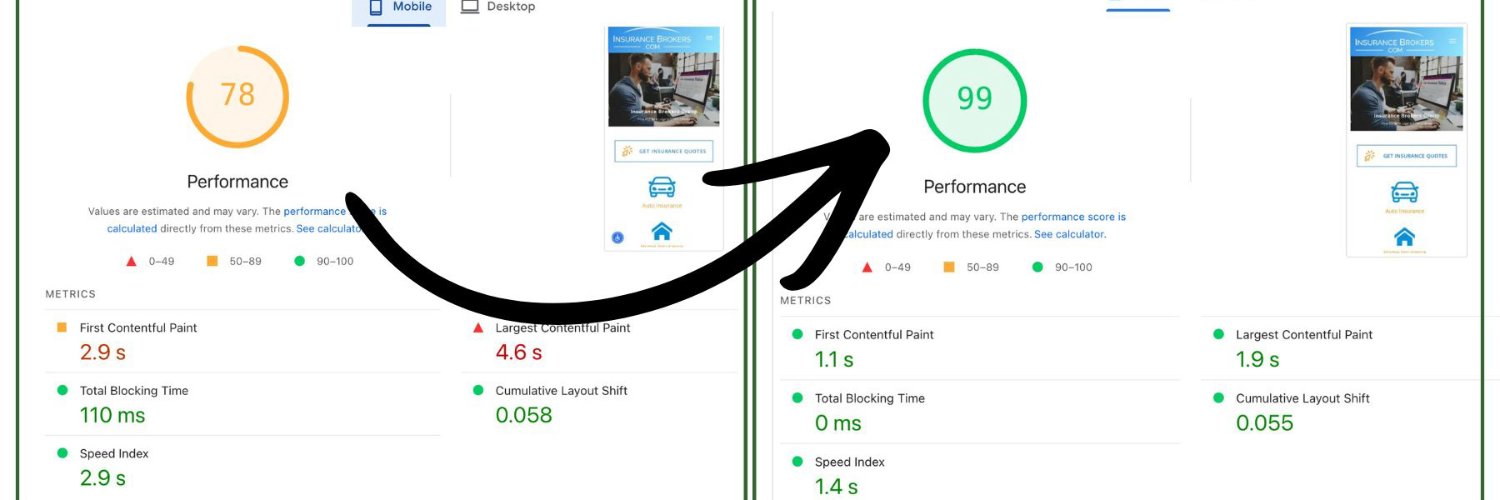
Follow these general principles and it'll help your page perform faster, not only for #PageSpeed, but for real life users as well:
1. Keep a slim, trim page with a small size
2. Avoid too much JavaScript
3. Avoid too much 3rd party content
https://t.co/J2rnWnyeEs
I re-built @sirenaffiliates features page today to be a lot more interactive, and explain some of Siren's differentiators. It took a few days to really get it dialed in, but I'm really happy with the result!
https://t.co/YpGzsykfPB
I feel like @GoDaddyPro could maybe put some guardrails around the first 3 layers so that the customer is warned or even prevented if they try to activate both Cloudflare and Sucuri caching, especially since they cannot all be purged in one-click.
Some Godaddy #WordPress customers have up to 4 layers of caching! 😱
1. Godaddy server cache
2. CDN (Cloudflare) cache (provided by GoDaddy)
3. Sucuri cache (provided by GoDaddy)
4. Possibly an additional cache/optimization plugin
Insanity!
Auto-install a plugin on 1M WordPress sites without anyone's consent, and a few days later you'll have a 1.1 star rating, one of the worst on the repo.
Even if you can opt out, the point is it wasn't opt-in.
Years building a reputation, only to do this.
https://t.co/ASGPIga2A5
From this weekend, if you are using the AIOSEO plugin (like 3M+ sites are), be aware that they pushed an update that's ON by default. They are publishing an llms.txt file for your site and markdown files for every post. If you want an llms.txt file (not for SEO but for agents), then just be aware it's there. And if you don't want to publish many markdown files, then make sure you are aware of that too. It's easy to disable but my guess is most site owners have no idea.
And... no plugin should be publishing files to your site without explicit approval from the site owner. If you had 10K posts, you now have 10K markdown files published too. Again, if you want that, fine, but the plugin should not have done that without your approval.
Generative AI doesn’t run on magic. It runs on massive data pipelines built on privacy violations by design.
Our new @Amnesty report exposes how big tech’s AI systems are powered by surveillance, data extraction, and abuse of people’s rights, at scale.
We researched the models powering some of the most popular publicly available standalone generative AI tools, including GPT 3 by Open AI, Google’s Gemini, Meta’s Llama, DeepSeek and tools by Midjourney and Stable Diffusion.
This is not innovation at any cost. It comes at a high price: our human rights.
Read the report: https://t.co/MGRonqai7o
Companies allow their beloved AI tools to get away with BS that would get humans fired. I don't understand how they expect to build and run businesses on such fuzzy, unreliable and unpredictable technology.
Let me trace the timeline here because nobody's connecting it.
Step 1: Scrape the entire internet. Every book, every article, every conversation, every piece of art, every forum post. Do it without asking. Do it without paying.
Step 2: Train a model on all of it. Call it "artificial intelligence."
Step 3: Go to BlackRock's Infrastructure Summit and announce: "We see a future where intelligence is a utility, like electricity or water, and people buy it from us on a meter."
Step 3 is where you sell people's own knowledge back to them. On a meter.
They took the collective output of human thought, compressed it into a model, and now they want to charge you by the token to access a version of what you and everyone you know already created.
One Reddit user put it perfectly: "They stole all this data from us, the people, our life's work, creativity, art, by devouring the internet and blowing through all copyright laws. Now they want to sell it back to us in the form of a utility."
Imagine if someone photocopied every book in the public library, burned the library down, and then opened a subscription service for the copies.
That's the metered intelligence business model.
And they're pitching it to infrastructure investors as though they invented water.
@gtmetrix@RealWebPageTest@DebugBear 6. Is browser caching applied?
7. Is compression applied?
8. Are there any loading errors on files?
9. The impact of 3rd party content
10. Are there any unnecessary redirects?
What else would you add to the list?
Full article: https://t.co/Sra3I5gzyp
Sometimes you need to go beyond #PageSpeed. Using a tool that provides a waterfall chart, like @gtmetrix, @RealWebPageTest or @DebugBear, can give you a different angle on #webperformance.
Here’s 10 useful things you can learn when running a speed test using a waterfall chart🧵
@gtmetrix@RealWebPageTest@DebugBear 1. What’s the Time To First Byte (TTFB)?
2. Is the visit cached?
3. How many files are loading?
4. Are critical files loaded early?
5. Are files served from your CDN?
🧵
@KatieKeithBarn2 That role will exist but there’s no guarantee it will be fulfilled by the person who set up the automation. Most ceos will think that once the automation exists, someone cheaper can manage it.