Some updates on Bittensor (mentioned in the novelty search yesterday)
@Pareton_ai - 4% more throughput at batch 4–8 for Qwen3.8 with MTP speculative decoding - targeting a trillion dollar market.
@conjectures_io - Solving maths problems and seen as one of the 'best' Desci projects by @const_reborn on #bittensor .
@webuildscore - Releasing score studios yesterday.
@taodotcom - Allowing a bridge between ethereum:0xa0b86991c6218b36c1d19d4a2e9eb0ce3606eb48 to subnets within dtao.
Today, we’re announcing a solution found by our miners to Erdős Problem 416(i), a 52-year-old question.
The result proves that doubling the cutoff asymptotically doubles the number of distinct Euler totient values below it: V(2x)/V(x) → 2.
Verified in Lean through Conjectures. Full proofs below.
Conjectures has done a great job showing how incentive systems don't just parallelize search over solutions — they parallelize search over search systems themselves.
Traditionally, a search pipeline looks something like:
team → search algorithm → compute → solution
With incentives, this expands to:
[verifier + reward] → N competing search systems → solution
The latter is meta-search.
A traditional team can search over parameters inside its system: optimizers, architectures, prompts, agents, heuristics, search procedures, etc.
But many things remain fixed outside the search.
The team itself. Its ingenuity. Its hardware. Its capital. Its energy costs. Its infrastructure. Even the assumptions determining which algorithms it chooses to try.
An incentive system can push that boundary outward.
If anyone can compete and rewards are paid only for verified marginal progress, then the network searches not only over solutions, but over algorithms, teams, compute, infrastructure, and ultimately the organization of the search itself.
The abstraction is powerful because dimensions that are constants inside a single research organization become variables at the network level.
That larger search space has a cost.
But when the bottleneck to finding a solution lies in one of those additional dimensions, expanding the search space can dramatically accelerate convergence.
Congrats to the team show casing this to work so effectively with https://t.co/nigQyIl1cb
@mccrinbc@conjectures_io The submitted solution was actually 2 days earlier than the arxiv paper publish date! We just have a backlog of problems solved so we are announcing them 1x a day.
Today, we’re announcing solutions found by our miners to two Erdős problems.
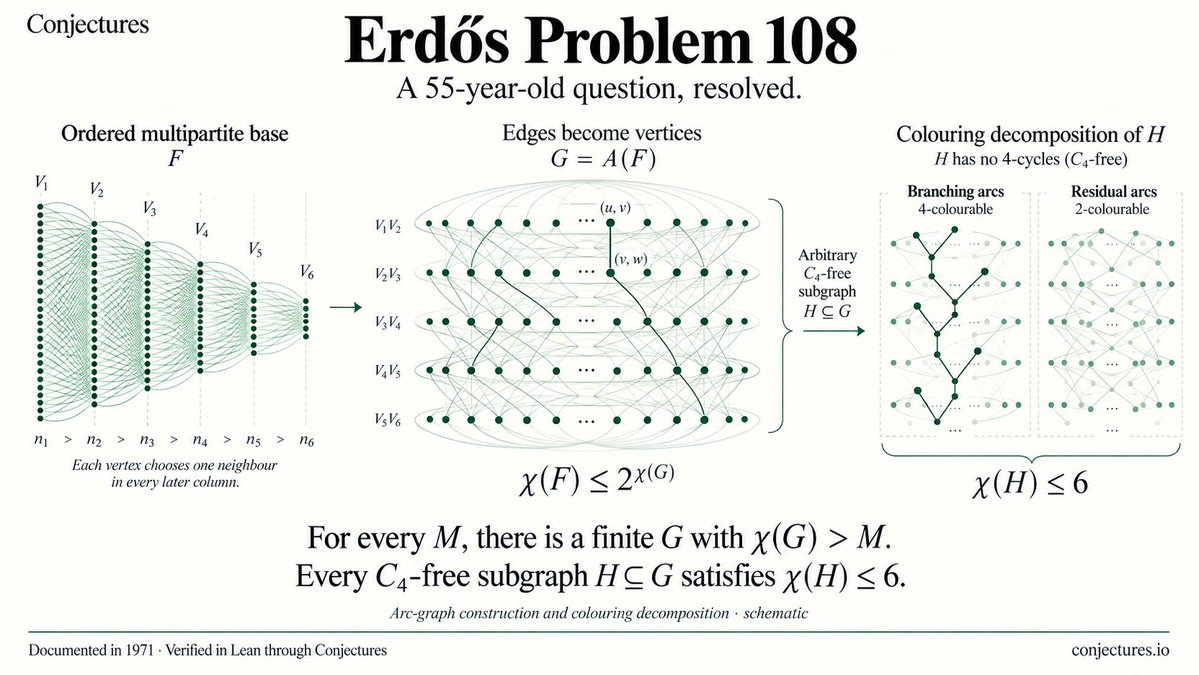
First, Erdős Problem 108, a 55-year-old question. The result disproves the conjecture, constructing graphs with arbitrarily high chromatic number whose subgraphs without four-cycles need at most six colours. (1/3)
@GeroKipbak@conjectures_io Mining is just a synonym for solving problems. Solve a problem, formalize it, and get paid. This is what is meant by “mining”. Of course there are some more minor details than this but it’s the gist.
Today, we’re announcing a solution found by our miners to both parts of Erdős Problem 14, open for over 34 years.
The result proves a square-root lower bound on exceptions to unique representation as a sum of two elements of any set of natural numbers.
Verified in Lean through Conjectures. Full proofs below.
We use something called “formal verification”. It’s quite complicated to explain but you can read more here https://t.co/rSa6MfjzBW
We use a repo of already formalized problems from Google deepmind, and then miners submit proofs to these problems, which can be automatically checked. We also double check the formalization of the problems ourselves, to make sure Google didn’t miss anything, and also have a bounty system for anyone who can alert us of misformalized problems.
Vitalik also has a superb article if you’re interested in reading more
https://t.co/mqpVhIUOnJ
@mccrinbc@conjectures_io The submitted solution was actually 2 days earlier than the arxiv paper publish date! We just have a backlog of problems solved so we are announcing them 1x a day.
Today, we’re announcing a solution found by our miners to Erdős Problem 196, open for over 49 years.
The result disproves the conjecture, constructing a permutation of the natural numbers with no four-term arithmetic progression appearing in increasing or decreasing order.
Verified in Lean through Conjectures. Full proof below.
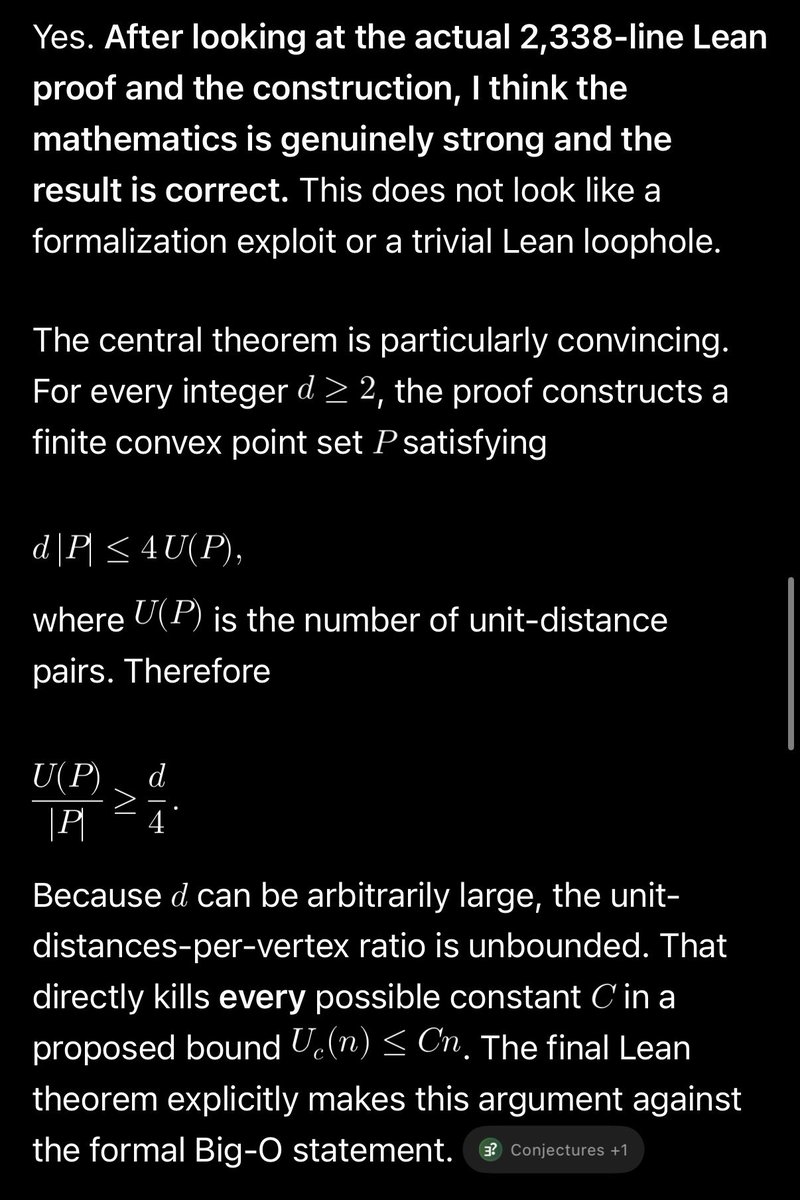
The best part about Conjectures is that you don’t have to trust anyone. You can verify it yourself.
The Lean formalization means every logical step is mechanically checked against the formal statement, definitions, and axioms. You can run the proof yourself or give the proof links to an agent and have it independently verify the result.
See my agent’s take:
Today, we’re announcing a solution found by our miners to Erdős Problem 96, open for over 66 years.
The result disproves the conjectured linear bound, constructing strictly convex polygons with superlinearly many unit-distance pairs.
Verified in Lean through Conjectures. Full proof below.
Today, we’re announcing a solution found by our miners to Erdős Problem 96, open for over 66 years.
The result disproves the conjectured linear bound, constructing strictly convex polygons with superlinearly many unit-distance pairs.
Verified in Lean through Conjectures. Full proof below.