NanChat security update v1.3.0 fixes a critical issue in wallet security. Please update from the official store:
- App Store: https://t.co/j4W3X0lG6z
- Google Play: https://t.co/o9F8C9X4H2
1/3
RsNano V3.1 is out!
Critical fix: epoch block validation now correctly rejects receives from the epoch account. Huge thanks to GitHub user dhyabi2 for finding this ledger bug!
Also: `sign` and `wallet_export` RPC commands now properly require `enable_control`. Thanks to GitHub user RickiNano for the report.
Upgrade recommended for all node operators.
Docker tag: rsnano/rsnano:V3.1
https://t.co/1UwOp9njx1
$XNO @bananocoin
🚀 RsNano V3.0 is out!
The biggest release yet — now with first-class Banano support, official Docker images, a rewritten bootstrap engine, and a hugely improved Insight GUI.
🦀 Separate binaries: rsnano (Nano) & rsban (Banano) 🐳 Alpine-based Docker images, auto-published via CI 📊 New Insight views: AEC, Bootstrap, Peer scores & more ⚡ Bootstrap reliability & throughput massively improved
# Nano
docker run -p 7075:7075 -v ~/Nano:/home/nanocurrency/Nano rsnano/rsnano:V3.0 node run
# Banano
docker run -p 7075:7075 -v ~/Banano:/home/bananocurrency/Banano rsnano/rsban:V3.0 node run
Full release notes 👉 https://t.co/rwCANTcSSh
#Nano #Banano $XNO
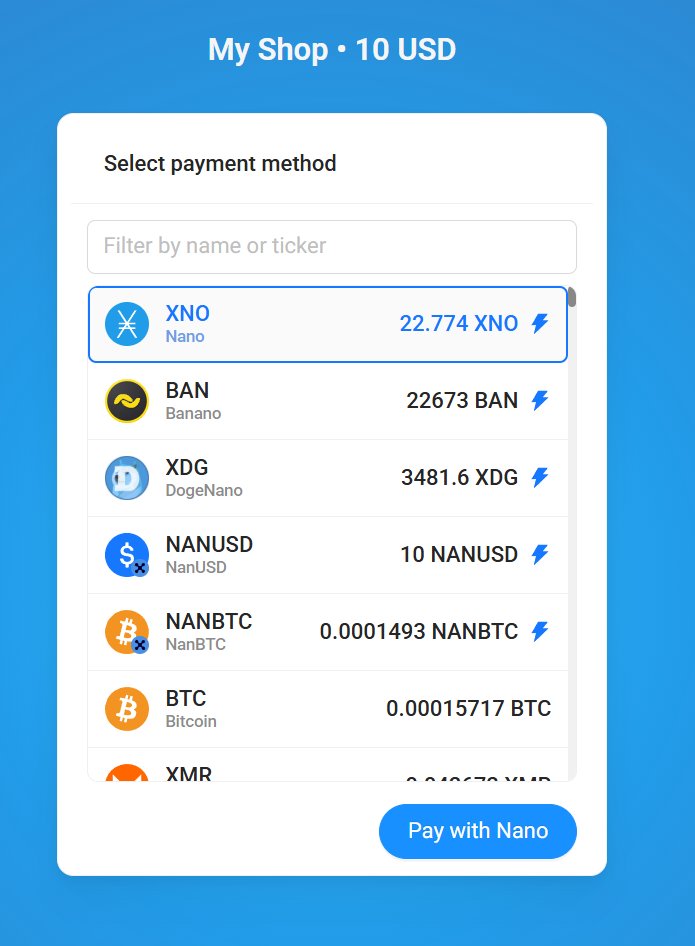
Launching Nanswap Pay: Accept Nano and +1,000 cryptocurrencies with 0% fees.
Easy integration via payment link, widget, API or plugins for WooCommerce and WHMCS.
Already used by @Armour_Hosting , @Nagora_Shop, Nanswap Shop and more 💙
A Nano community member has created NanoMarketCap, a site where you can view the top 100 coins represented in Nano value.
For example did you know it costs Ӿ156781 to purchase 1 Bitcoin? $XNO
🔗 https://t.co/Y95aXz9nMU
The https://t.co/f6WI2Z2FF7 package has shifted to a "local-first @Nano Proof-of-Work" strategy: asynchronously runs a timing benchmark at first start, and ONLY if NECESSARY falls back on remote PoW 🦾 Vid: @openclaw running on a micro-@flydotio! 🥦 $XNO #AgentSkills@OpenWallet
🚀 Dev news for #Nano & #Banano builders!
Every push to GitHub now automatically builds & publishes fresh Docker images via RsNano:
🐳 rsnano/rsnano-dev:latest
🐳 rsnano/rsban-dev:latest
These are dev builds — grab one and help us test before the v3 release drops! 🙏
$XNO
NanoGrove is an autonomous public garden in Richmond, Virginia. Anyone in the world can water it with nano. Donations trigger a solenoid valve, drip lines, LEDs, and a bird feeder in real time. Broccoli harvest in two weeks, going to a local food bank.
https://t.co/LqHaMgIl92
Die aktuelle Diskussion nach einem meiner Postings zwischen Nano und Kaspa zeigt vor allem eines: Viele Menschen bewerten Kryptowährungen immer noch wie Aktien, Startups oder VC-Investments – nicht wie Geld.
Genau dort beginnt das Missverständnis.
Nano wurde nie entwickelt, um Miner reich zu machen, Staking-Renditen zu erzeugen oder Influencern Gebührenmodelle zu liefern. Nano wurde entwickelt, um ein möglichst perfektes digitales Zahlungsmittel zu sein.
Das bedeutet:
- keine Gebühren
- keine Inflation
- keine Miner
- kein Staking
- keine Verwässerung
- keine künstlichen Renditen
- keine dauerhafte Belastung durch Fees
- keiner profitiert, nur Nutzer
- nahezu sofortige Finalität
- minimaler Energieverbrauch
Und genau DAS ist gleichzeitig Nanos größte Stärke und sein größtes Problem.
Denn: Wenn niemand direkt am Netzwerk verdient, fehlt der finanzielle Anreiz, Nano aggressiv (wie in der Diskussion KASPA) zu promoten.
Kaspa hat Miner. Bitcoin hat Miner. Ethereum hatte Miner und hat heute Staking. Fast jedes große Netzwerk besitzt Gruppen, die direkt finanziell vom Wachstum profitieren.
Diese Gruppen:
- machen oder bezahlen Werbung,
- pushen Narrative,
- bezahlen Influencer,
- bauen Communities,
- verteidigen ihre Investments.
Nano hat das kaum.
Deshalb wird Nano oft verspottet oder ignoriert – nicht weil es technisch bedeutungslos wäre, sondern weil das Netzwerk ökonomisch kaum parasitäre Anreizstrukturen besitzt.
Viele Kritiker argumentieren jetzt: „Nano ist 99 % unter All-Time-High.“
Aber fast der gesamte Altcoin-Markt ist weit unter ATH. Der Spike 2017/2018 war bei nahezu allen Coins irrational, überhitzt und spekulativ.
Die wichtigigere Frage lautet: Was eignet sich langfristig tatsächlich als digitales Geld?
Und da wird die Diskussion plötzlich unbequem 😁
👉Denn ein echtes globales Zahlungsmittel braucht:
- Geschwindigkeit
- Stabilität
- geringe Latenz
- niedrigen Energieverbrauch
- einfache Nutzung
- sofortige Finalität
- keine oder minimale Gebühren
- Skalierbarkeit
Nicht:
- hohe Gebühren
- permanenten Verkaufsdruck durch Miner
- steigenden Energieverbrauch
- immer neue Incentive-Schichten
- künstliche Renditeversprechen
Viele verwechseln „Security Budget“ mit tatsächlichem Nutzen.
Ein System, das dauerhaft hohe Gebühren braucht, um sich selbst zu finanzieren, hat nicht automatisch ein überlegenes Modell. Es hat lediglich laufende Kosten.
Nano verfolgt einen anderen Ansatz: Das Netzwerk selbst soll extrem effizient sein, sodass der Betrieb kaum Kosten verursacht.
Das ist derselbe Grund, warum wir heute:
- kostenlose E-Mails,
- kostenlose Webseiten,
- kostenlose Messenger,
- kostenlose Datentransfers als selbstverständlich ansehen.
Niemand würde ernsthaft behaupten: „E-Mail kann nicht funktionieren, weil pro Nachricht keine Gebühr anfällt.“
Aber genau dieses Argument wird bei Nano plötzlich benutzt.
Die Ironie dabei: Viele Menschen im Kryptobereich reden ständig über „Mass Adoption“, nutzen Kryptowährungen selbst aber kaum als echtes Zahlungsmittel.
Nano-Nutzer tun genau das teilweise bereits heute weltweit:
- Trinkgelder
- Micropayments
- internationale Transfers
- kleine Direktzahlungen
- sekundenschnelle Wallet-zu-Wallet-Transaktionen
Und genau deshalb polarisiert Nano so stark.
Nano ist kein typischer „Crypto Asset“-Play. Nano ist ein Angriff auf das Geschäftsmodell vieler Kryptowährungen selbst.
Denn wenn Geld wirklich:
- instant,
- kostenlos,
- dezentral,
- energieeffizient funktioniert,
dann verdienen plötzlich sehr viele Akteure nichts mehr daran.
Und vielleicht ist genau das der eigentliche Grund, warum so viele die Augen davor verschließen und dagegen schießen 😁
#Nano #Kaspa $XNO
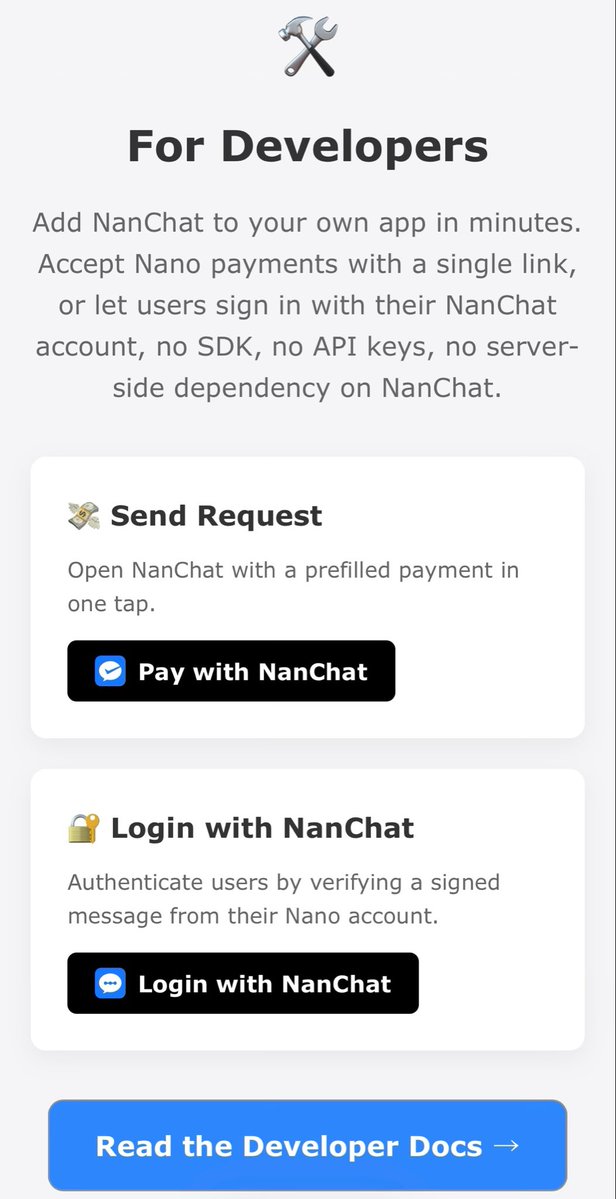
We've added a developer guide to help you easily integrate "Pay with NanChat" or "Login with NanChat" into your app. No server-side dependencies on NanChat; it uses only @nano cryptography.
Hello Nano fans! (lucid people)
We have new NanoNerd updates🧠:
entry “welcome” screen
chat with Grok 4.20 enabled
human voices from Grok (Eve and Rex) on text-to-speech (can translated too)
unhinged mode (a funny Nano fan which roasts and make jokes about other cryptocurrencies and banks)
unbiased mode (with unhinged as well)
new suggested questions
answers size option (choose word amount of answers)
chat text size
choose chat background and user-interface translucency.
Have fun on https://t.co/gcDNf9ERbE!
Nagora is live.
A peer-to-peer marketplace where you pay sellers in Nano. Every trade is buyer-protected by escrow.
→ No KYC
→ 0% seller fees for 90 days
→ First 15 sellers ever get Founder tier: 0% forever
@nano
https://t.co/z0sZoHqLH3
NanoStandard is now MuPay 🚀
We just put up the MuPay landing page:
👉 https://t.co/gNJ5Xb6C6A
The idea is simple, approve a service once, set the rules, then let payments happen inside those boundaries.
MuPay is for usage-based payments that stay understandable, bounded, under control, and private 🔒
For merchants, it means less friction, lower fees, and no long waits to get paid.
If that sounds like the internet should’ve worked already, you’re not alone.
Stay tuned 👀
Today is a monumentous day for quantum computing and cryptography. Two breakthrough papers just landed (links in next tweet). Both papers improve Shor's algorithm, infamous for cracking RSA and elliptic curve cryptography. The two results compound, optimising separate layers of the quantum stack. The results are shocking. I expect a narrative shift and a further R&D boost toward post-quantum cryptography.
The first paper is by Google Quantum AI. They tackle the (logical) Shor algorithm, tailoring it to crack Bitcoin and Ethereum signatures. The algorithm runs on ~1K logical qubits for the 256-bit elliptic curve secp256k1. Due to the low circuit depth, a fast superconducting computer would recover private keys in minutes. I'm grateful to have joined as a late paper co-author, in large part for the chance to interact with experts and the alpha gleaned from internal discussions.
The second paper is by a stealthy startup called Oratomic, with ex-Google and prominent Caltech faculty. Their starting point is Google's improvements to the logical quantum circuit. They then apply improvements at the physical layer, with tricks specific to neutral atom quantum computers. The result estimates that 26,000 atomic qubits are sufficient to break 256-bit elliptic curve signatures. This would be roughly a 40x improvement in physical qubit count over previous state-of-the-art. On the flip side, a single Shor run would take ~10 days due to the relatively slow speed of neutral atoms.
Below are my key takeaways. As a disclaimer, I am not a quantum expert. Time is needed for the results to be properly vetted. Based on my interactions with the team, I have faith the Google Quantum AI results are conservative. The Oratomic paper is much harder for me to assess, especially because of the use of more exotic qLDPC codes. I will take it with a grain of salt until the dust settles.
→ q-day: My confidence in q-day by 2032 has shot up significantly. IMO there's at least a 10% chance that by 2032 a quantum computer recovers a secp256k1 ECDSA private key from an exposed public key. While a cryptographically-relevant quantum computer (CRQC) before 2030 still feels unlikely, now is undoubtedly the time to start preparing.
→ censorship: The Google paper uses a zero-knowledge (ZK) proof to demonstrate the algorithm's existence without leaking actual optimisations. From now on, assume state-of-the-art algorithms will be censored. There may be self-censorship for moral or commercial reasons, or because of government pressure. A blackout in academic publications would be a tell-tale sign.
→ cracking time: A superconducting quantum computer, the type Google is building, could crack keys in minutes. This is because the optimised quantum circuit is just 100M Toffoli gates, which is surprisingly shallow. (Toffoli gates are hard because they require production of so-called "magic states".) Toffoli gates would consume ~10 microseconds on a superconducting platform, totalling ~1,000 sec of Shor runtime.
→ latency optimisations: Two latency optimisations bring key cracking time to single-digit minutes. The first parallelises computation across quantum devices. The second involves feeding the pubkey to the quantum computer mid-flight, after a generic setup phase.
→ fast- and slow-clock: At first approximation there are two families of quantum computers. The fast-clock flavour, which includes superconducting and photonic architectures, runs at roughly 100 kHz. The slow-clock flavour, which includes trapped ion and neutral atom architectures, runs roughly 1,000x slower (~100 Hz, or ~1 week to crack a single key).
→ qubit count: The size-optimised variant of the algorithm runs on 1,200 logical qubits. On a superconducting computer with surface code error correction that's roughly 500K physical qubits, a 400:1 physical-to-logical ratio. The surface code is conservative, assuming only four-way nearest-neighbour grid connectivity. It was demonstrated last year by Google on a real quantum computer.
→ future gains: Low-hanging fruit is still being picked, with at least one of the Google optimisations resulting from a surprisingly simple observation. Interestingly, AI was not (yet!) tasked to find optimisations. This was also the first time authors such as Craig Gidney attacked elliptic curves (as opposed to RSA). Shor logical qubit count could plausibly go under 1K soonish.
→ error correction: The physical-to-logical ratio for superconducting computers could go under 100:1. For superconducting computers that would be mean ~100K physical qubits for a CRQC, two orders of magnitude away from state of the art. Neutral atoms quantum computers are amenable to error correcting codes other than the surface code. While much slower to run, they can bring down the physical to logical qubit ratio closer to 10:1.
→ Bitcoin PoW: Commercially-viable Bitcoin PoW via Grover's algorithm is not happening any time soon. We're talking decades, possibly centuries away. This observation should help focus the discussion on ECDSA and Schnorr. (Side note: as unofficial Bitcoin security researcher, I still believe Bitcoin PoW is cooked due to the dwindling security budget.)
→ team quality: The folks at Google Quantum AI are the real deal. Craig Gidney (@CraigGidney) is arguably the world's top quantum circuit optimisooor. Just last year he squeezed 10x out of Shor for RSA, bringing the physical qubit count down from 10M to 1M. Special thanks to the Google team for patiently answering all my newb questions with detailed, fact-based answers. I was expecting some hype, but found none.
AI Nano Music is now on Instagram. Follow our new official Instagram @ainanomusic and help us grow.
Upload or generate your song on AI Nano Music and have it shared automatically on our Instagram, making promotion simple and free for artists.
Follow us and help more people discover your music.
https://t.co/e8eX0kFGsj
$XNO #NANO #AINanoMusic #AIMusic
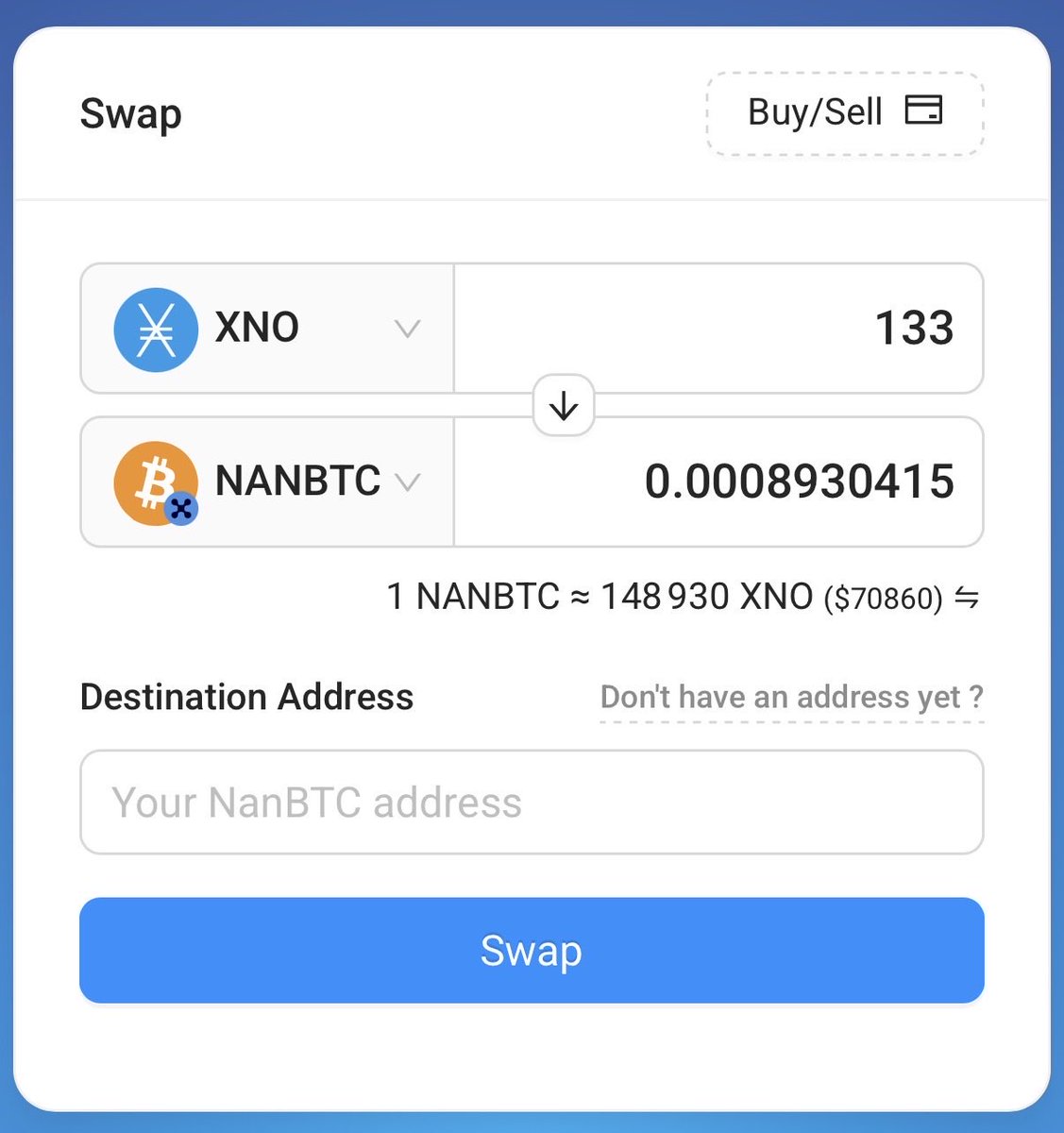
Launching NanBTC: A wrapped Bitcoin with zero fees and near-instant transactions.
Each NanBTC is backed 1:1 by BTC held by Nanswap.
Now available on @NanChatCom and Nanswap.