Honoring Burton H. Singer, a pioneering statistician whose work bridged statistics, public health, and global health. His interdisciplinary career helped shape research and institutions worldwide. Read the PNAS Retrospective: https://t.co/T5jx9wnj1f
Glad to see this published. I hope its message reaches both the communities of practitioners that want to simply use and be able to trust software for the analysis of DIA data, as well as the developers of said software. This is important for the field!
Assessing error control is fundamental in mass spectrometry-based proteomics. Authors introduce a theoretical foundation for entrapment experiments along with a method for more accurate evaluation of FDR control.
https://t.co/mbNj0djXsS
Awesome work by Bo Wen, @thabangh @mjmaccoss @juditvr and colleagues on DIA-optimised in silico spectral libraries (Carafe) https://t.co/DQ1x4kj7JU. You can get more out of DIA-NN with a better lib :) On the screenshot is the use of different libraries vs DIA-NN's built in.
@tangming2005 This is a great tool to try if you want to learn how a typical workflow looks like from raw data to quantification: https://t.co/MJLg0r4tBn.
@mjmaccoss From the mzML converted from the raw file (https://t.co/0aa5a72zwD, https://t.co/COxVzzChlZ), it looks like the raw file was generated in 2015. It's DDA.
#proteomics Does anyone know why some spectra generated by QE don't have precursor charge state when converted to MGF or mzML using msconvert or ThermoRawFileParser?
@Smith_Chem_Wisc I don't have a tool in my Mac to directly open a raw file to look at this. But the raw file generated by QE can be downloaded from https://t.co/COxVzzChlZ
Hari et al.'s analysis represents a landscape of novel peptides of different types that may be expressed in breast #cancer tissues, while their presence in full length functional proteins needs further investigations — @NarayanaHealth@MAHE_Manipal
https://t.co/0fFs04r6ap
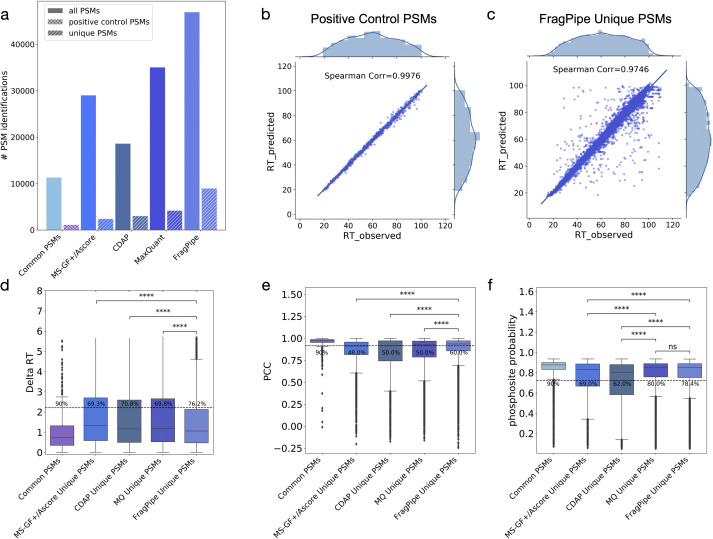
Deep learning-based features can be used as evaluation metrics. This MCP paper uses phosphosite probability (MusiteDeep), Delta RT and spectral similarity to benchmark different computational pipelines on phosphopeptide data, including FragPipe vs MaxQuant https://t.co/J4aBb9sxiU
The benchmark metrics demonstrated in this study will enable users to select computational pipelines and parameters for routine analysis of phosphoproteomics data and will offer guidance for developers to improve computational methods ― @bcmhouston@UMich
https://t.co/xhCNwR4sZM