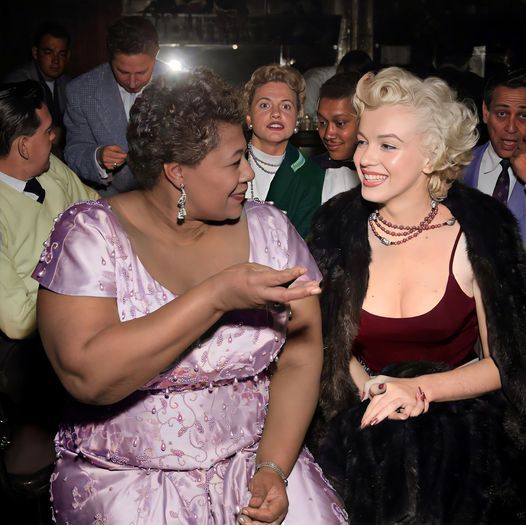
In the 1950s, Ella Fitzgerald was not allowed to play Hollywood's most popular nightclub, Mocambo, because of her race.
Marilyn Monroe, who was a big fan, called the owner & told him that if he booked Ella, Marilyn would be there every night - which guaranteed huge press coverage.
He booked Ella and Marilyn was there, front table, every night. Ella said, "After that, I never had to play a small jazz club again. She was an unusual woman - a little ahead of her times. And she didn't know it."
Extraordinary Attorney Woo ada remake Jepangnya lohh ✨😍
Judulnya Extraordinary Attorney Minami. Pas lihat trailernya, aku malah salfok sama cast cowoknya yang sekilas mirip banget sama yang di Korea 😭
L'inizio della Civiltà
Una volta chiesero alla celebre antropologa Margaret Mead quando, secondo lei, fosse iniziata la civiltà.
Il suo interlocutore si aspettava risposte come: “la ruota”, “gli utensili”, “i vasi di terracotta”. Ma lei sorrise e disse qualcosa di inaspettato:
“Quando, in una caverna, fu trovato un femore guarito.”
Silenzio. Perché?
"Nel mondo animale,” spiegò, “una gamba rotta è una condanna a morte. Un animale ferito non può cacciare, né fuggire. È spacciato.
Ma un osso guarito significa che qualcuno si è fermato. Qualcuno si è preso cura di lui, lo ha nutrito, protetto e aspettato. Qualcuno ha avuto compassione.”
E poi concluse:
" L’inizio della civiltà non è una scoperta, ma un gesto. Non una pietra, ma un atto d’amore.”
È questo che ci rende davvero umani:
non ciò che costruiamo, ma come ci siamo accanto
quando qualcuno cade.
(Dal web)
#antropologia
“Practice any art… no matter how well or badly, not to get money and fame, but to experience becoming, to find out what's inside you, to make your soul grow.”
- McKellen reciting Vonnegut
88세 배우 김영옥이 깨달은 인생 별거 없는 이유 6가지
1 고민해봤자 답 없어, 밥 먹고, 잠이나 자
2 남한테 너무 매달리지 마, 걔들도 바빠
3 돈만 쫓지 마, 힘 있을 때 맛난 거 먹어
4 지나간 일 징��대지 마, 이미 지난 버스야
5 오늘 숨 쉬고 있는 게 장땡, 내 몸이 최고의 재산
6 내일 걱정하느라 오늘 망치지 마, 지금을 즐겨
This is what the internet was invented for.
In 1996, a King Penguin called Lala became a local celebrity in Shibushi, Japan. After being rescued from a fishing net by the Nishimoto family, he refused to return to the wild.
He lived in an air-conditioned room in their home and was famous for walking alone to the fish market wearing a tiny backpack.
The fishmonger would feed him a fresh fish and place another in his bag for the trip home.
Zhang Yimou on the good & bad parts in 'Red Sorghum' (1988) & the sense of balance a filmmaker must possess:
"I actually feel that 'Red Sorghum' is good at some points and bad at others. Some places were brilliant, other places I didn't know how to handle, and the whole effect was very rough. Red Sorghum's strength is its kind of primeval power, but as I've continued to make films, my filmmaking has become more strictly controlled. I've probably matured.
Generally speaking, the more films you make the better your sense of balance. Film is something you or anyone else can make. It all lies in an accurate sense of balance. The master or apprentice is determined by this. It all depends upon how you make it. I think Hou Hsiao-Hsien's sense of balance is very good. But it's difficult to say how it's captured because there are many ways of achieving it."
[Zhang Yimou's Black Comedy: The Story of Qiu Ju, Law Wai-Ming, 1992]
P.S: On this day, 38 years ago, "Red Sorghum" (1988) was released in Hong Kong.
Michelle Yeoh jumping a motorbike onto a moving train in Police Story 3: Super Cop (1992) isn’t a trick shot, it’s really her doing it. A stunt that feels completely unhinged even by today’s standards.
Your cat is leaving a chemical on your face. Its name is F4. The translation is “you’re family,” and cats only leave it on people and animals they trust. F4 was identified in 1998 by a French researcher named Patrick Pageat.
Pageat found five different chemicals coming out of glands on a cat’s cheeks, chin, and forehead, and labeled them F1 through F5. F2 has to do with mating. F3 is for territory, and cats use it to mark furniture and door frames. (You can buy a synthetic version of F3 at any pet store, sold under the brand name Feliway.) F4 is the social one. The face-rub itself has its own name too. Scientists call it bunting when face hits face, and allorubbing when the whole body gets involved.
F4 builds what researchers call a colony scent. In a wild cat colony, the cats rub against each other constantly until they all smell the same. The shared smell works like a family ID. Cats with the colony scent don’t fight each other. Cats without it get treated like intruders. A study of feral cats at Church Farm, run by biologist David Macdonald, found this rubbing made up 15.7% of all social interactions in the colony.
Cats are picky about who gets F4. They reserve bunting for individuals they bond with. A stranger walking in won’t get bunted, even if they try to pet the cat. A new cat being introduced to the home won’t get bunted either. Furniture and walls get F3, the territory chemical, not the social one. Bunting comes out only for the social bond. When your cat plows its face into yours, you’ve been chemically classified as family.
The behavior comes from kittenhood. Kittens rub their faces on their mom as a greeting and as a way to beg for food. Adult cats keep the move and redirect it at the people and animals they bond with. When a cat rubs its face on yours, it’s doing the same thing it used to do to its mother.
In feral colonies, this rubbing flows in one direction, and the direction reveals status. Cats on the edges of the group rub toward cats at the center. Lower-status cats rub toward higher-status ones. Kittens rub toward the adults that raised them. The pattern is consistent enough that researchers use it to read social status in the colony. So when your cat plows its face into yours, the gesture also says “you’re the one with the food and the warm bed.”
I.M. Pei, the architect who designed the Louvre's glass pyramid, used to put it this way. In Western buildings, a window is a hole that lets in light and air. In Chinese buildings, a window is a picture frame. And the garden is always painted on the other side.
These are called 漏窗 (lou chuang), or "leaky windows." Wind. Moonlight. Glimpses of the garden, framed by every cutout in the wall. It all leaks through.
A garden designer named Ji Cheng published a whole manual on this in 1635. The Craft of Gardens. The final chapter is titled "Borrowed Scenery." Ji called it the most important part of designing a garden.
He named four kinds of borrowing. Distant: mountains, rivers, far horizons. Adjacent: the neighbor's roof, a wall, a tree next door. Upward: clouds, branches against the sky, even the stars at night. Downward: a pond, the rocks below. Every shape and height in these images is doing one of those four jobs.
In Suzhou, a canal city near Shanghai, the oldest surviving garden was built in the 1040s. It has 108 of these windows along a single corridor. No two are the same. Each frames a different slice of the same pond and the same hills.
By the early 1900s, Suzhou had more than 170 private gardens. Nine of them are now UNESCO World Heritage Sites. Researchers in 2021 photographed almost 3,000 windows across 15 of these gardens, just to train an AI that could tell the patterns apart.
The shapes meant something too. Pine for long life. Plum blossoms for purity. A bat anywhere in the pattern brought good luck to the household. Phoenix for wealth.
There's a pattern called "ice crack." Lines splinter across the wall like cracks on a frozen pond. Scholars adopted it as their own signature. For them, it stood for the moment ice breaks and spring begins, when life starts moving again.
The point of the design was simple. You should never see the whole garden at once. You walk a path, a wall blocks the view, then a window opens it again, framed differently each time. The Chinese proverb for it: "by detours, access to secrets."
A 2024 paper from Xi'an Jiaotong-Liverpool University showed the ice-crack pattern is actually stronger than a regular grid when the weight on top is uneven. Four hundred years later, the math still works.