Their message is even more urgent today.
At the start of 2024, 35 Nobel laureates and more than 1,000 European scientists called on Members of the European Parliament to back New Genomic Techniques and help Europe unlock more sustainable agriculture.
Now, with climate change accelerating, global instability rising, and energy shocks exposing the fragility of our food systems, that message has only become more urgent.
In just two weeks, MEPs will vote again. They must decide whether Europe will embrace innovation, strengthen food security, and lead on sustainable agriculture — or hold back science while other regions move ahead.
Europe cannot afford to fall behind.
https://t.co/1tKWBGeXvc
In this episode of Saving the World from Bad Ideas, Mark Lynas speaks with science writer Rowan Hooper about one of the deepest misconceptions in biology: that nature is all about competition. Drawing on Hooper’s new book Togetherness, they explore how symbiosis and cooperation run through life at every scale, from lichens and corals to ants, orchids, the human microbiome, and even the origin of complex cells.
The conversation also revisits Darwin, Malthus, ecology, overconsumption, and the ways modern society has been shaped by an overly narrow reading of evolution. It is a wide-ranging discussion about why life’s greatest successes often come not from ruthless struggle alone, but from collaboration, interdependence, and living together.
Togetherness: Symbiosis and the Hidden Story of Life’s Greatest Collaborations will be published on June 4 in the UK, and on August 14 in the US and Canada.
Full episode linked below.
A combination of market factors, policies & innovation are supporting the uptake of EVs globally
Recent declines in battery prices have helped make electric cars more affordable, while higher-voltage batteries are paving the way for faster charging
More: https://t.co/NkYY60UsFL
"Kernekraft. Skal det også medtænkes?"
"Jeg er en 58 årig familiefar. Det er ikke okay at vi er den generation som skabte problemet. Vi er den generation som lavede teknologier til at løse det. Men vi var ikke villige til at bruge dem. Vi skal vende tilbage til at blive førende"
After years of debate, Europe is finally close to approving New Genomic Techniques (NGTs). A vote in the European Parliament is now just weeks away.
Yet the biggest threat to their adoption may no longer be an outright ban, but a growing web of bureaucracy.
As policymakers enter the final vote, they must ensure that Europe does not approve these technologies on paper while regulating them out of existence in practice.
Europe is facing an increasingly difficult agricultural challenge: producing enough food while reducing environmental pressures, adapting to climate change, and strengthening the resilience of its food system in a world that becomes more hostile by the day.
Innovations like NGTs are a critical part of the solution.
In February 2024, together with scientists across Europe, we urged MEPs to vote yes to supporting NGTs.
Now we need your help to finish the job.
Act now: https://t.co/arFh3kw4gH
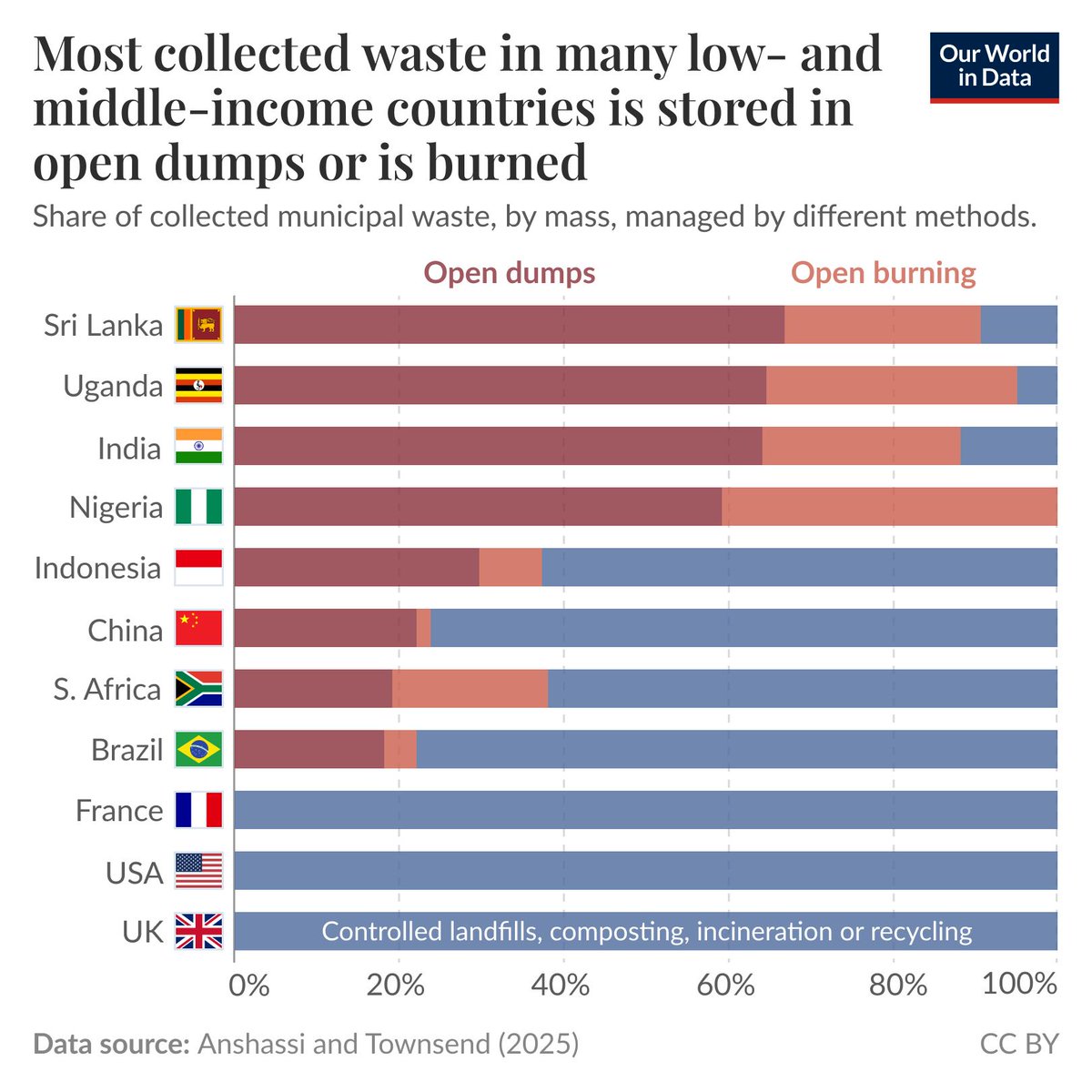
Most collected waste in many low- and middle-income countries is stored in open dumps or is burned.
Effective waste management systems are something that many of us living in high-income countries take for granted. Our waste is collected from bins in our street and taken to controlled or sanitary landfills, incinerators, or recycling centers.
But in many low- and middle-income countries, this is not the case.
In some of them, less than half of the waste (from households, shops, and other sources) is collected by management services at all.
In many countries, even when waste is collected, most of it — sometimes over 80% — is taken to open dumps or is openly burned. You can see this in the chart.
Both methods cause pollution, either through waste leaking from open dumps or toxic air pollution generated when plastics and other materials are burned.
While these numbers show that huge amounts of the world’s waste are mismanaged, they also tell a story of opportunity. Countries that invest in waste management can do so effectively, so that very little waste pollutes the environment, and the air is far cleaner.
(This Data Insight was written by @_HannahRitchie and Veronika Samborska.)
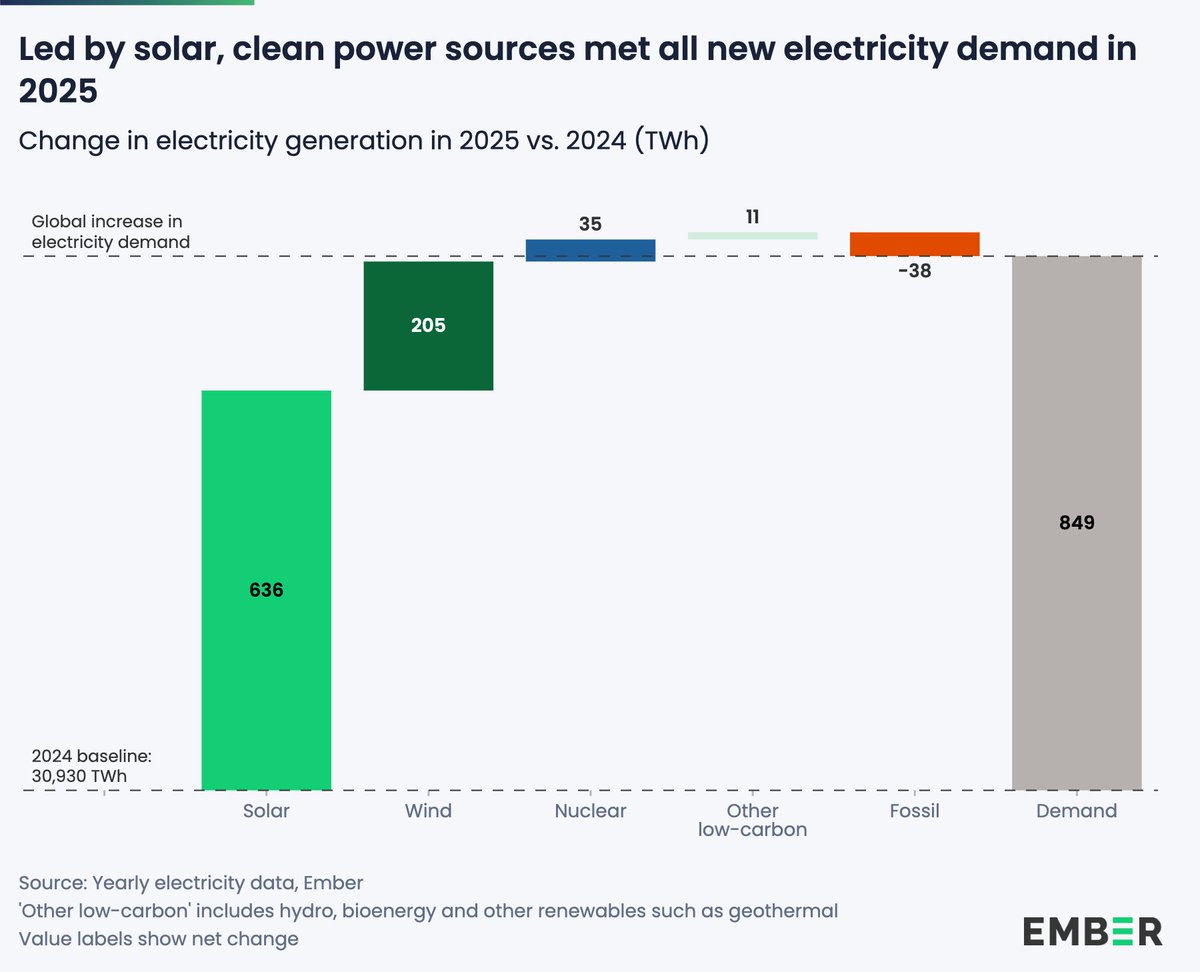
Clean power met all new global electricity demand in 2025.
Electricity demand rose by 849 TWh, while solar alone added 636 TWh ☀️
https://t.co/oJZTWTdmTq
Cobalt has become a symbol of everything wrong with the clean energy transition: child labour, unsafe mines, corruption, colonial legacies, and global supply chains built to keep consumers comfortably distant from the damage.
But the answer isn’t as simple as “move away from cobalt.”
Yes, many newer battery technologies have reduced or removed cobalt, meaning some of the worst cobalt controversies now belong partly to an earlier generation of lithium-ion batteries. That shift matters.
But cobalt remains a powerful material for battery performance. And abandoning it entirely risks dodging the real issue: broken supply chains, weak governance, and moral outsourcing.
In the latest episode of Saving the World from Bad Ideas, Mark Lynas speaks with journalist Nicholas Niarchos about cobalt mining in the Democratic Republic of Congo, and why the clean energy transition must be both fast and fair.
The problem is not the mineral.
The problem is a world that demands clean technology while tolerating dirty supply chains.
We don’t need less ambition.
We need better accountability.
Listen now.
The alfalfa is fed to cattle. The problem is cattle. If you’re upset about water shortages, water pollution, deforestation, or climate change, you should be upset about cattle.
Weplanet Africa's @PatNanteza at Kyambogo University, speaking with students about nuclear energy and Africa’s clean energy future.
Informed conversations today shape better energy choices tomorrow.
#Nuclear4Africa
🚨 NEW DATA | China's cleantech exports in April 2026 remained near record levels despite changes in its tax rebate policies which were expected to slow down solar and battery exports.
The modest drop in solar and batteries were offset by a surge in EV exports 🚗⚡
Two things can be true:
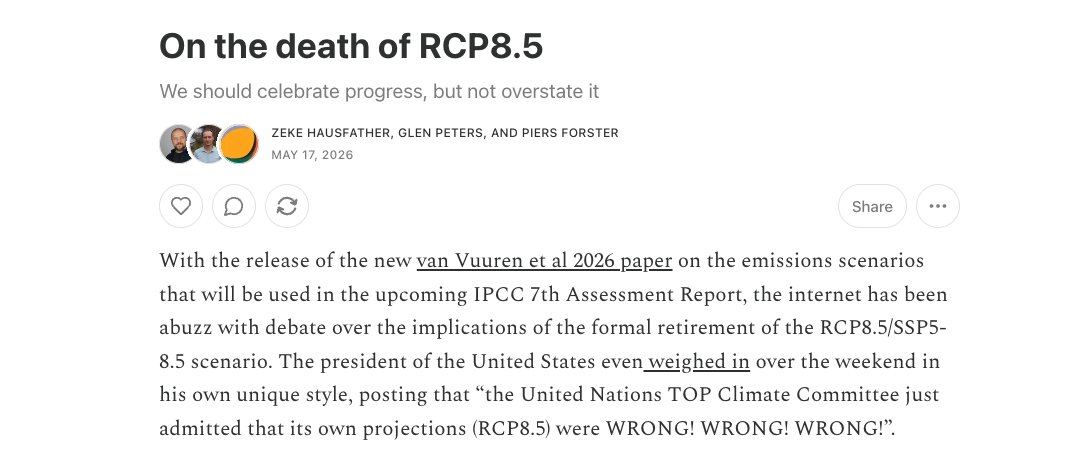
• RCP8.5 was never a realistic "business as usual" scenario
• The world has made real progress bending the emissions curve downward
@Peters_Glen, Piers Forster, and I explain in a new article (link below).
1/11
A majority of Aussies support nuclear energy!
Polling commissioned by WePlanet Australia last month shows that a majority of Australians support developing nuclear energy in Australia.
Nuclear energy provides 24/7 clean, reliable, & affordable energy independent of the weather.
Ein Drittel aller THG-Emissionen kommt aus unserem Ernährungssystem.
Was wäre, wenn die Lösung auf deinem Teller liegt? 🍽️
Morgen um 9 Uhr diskutieren wir den Protein-Shift! #ProteinShift#Ernährungswende mit Marti Reich (@oekoprog & @weplanetint)
Latest photo of the construction site for the future Polish NPP in Choczewo. (source: Daniel Skórkowski)
Managed forest is removed in all of the designated area, with a thin 300m stripe of trees that keep heath spruce forest continuous and separate construction from the beach.
The beach will remain open to public after the construction is finished. The forest's continuity is important for wildlife migrations. Further to the east you can see white dunes of Slovinski National Park.
Manufacturing facilities for key energy technologies can be found around the globe, but overall capacity is highly regionally concentrated.
This is underscoring the importance of strengthening industrial competitiveness and diversification → https://t.co/ztF4A9MlJ0
Nu kommer modularitet også til store reaktorer. Innovation i byggemetoden belært af gasværker og tilpasset regulering. Så er byggetiden på få år. https://t.co/T7QlFniat7