Claude Fable 5 는 확실히 혁명인듯.
기존의 원샷 방식과 다르게 그냥 평소에 앓고 있던 병을 치료하는 느낌으로 코드를 맡길 수 있었음.
6월 22일까지 구독제에서 쓸 수 있으니 꼭 써봐야함.
그냥 기능 추가하는데에 쓰면 솔직히 체감을 못하고 아래의 내용으로 시키는 것을 추천함.
CURSO COMPLETO DE CLAUDE DE 4 HORAS
Esta es la guía más detallada de Claude que he visto hasta el momento.
Guarda esta página antes de que se te olvide.
Construye herramientas.
Automatiza el trabajo.
Aprende cómo las personas construyen bots y sistemas.
구글판 Codex, Antigravity 2.0이 사용 7분 안에 이해하기 (영상 요약 한국어 번역)
Antigravity 2.0은 쉽게 말하면
구글이 만든 AI 코딩 에이전트 도구임
내가 직접 코드 한 줄 한 줄 쓰는 게 아니라
“로그인 기능 만들어줘”
“버튼 눌렀을 때 오류 고쳐줘”
“이 화면 모바일에서도 안 깨지게 해줘”
“실행해보고 문제 있으면 수정해줘”
이렇게 말하면
AI가 프로젝트를 보고
코드를 고치고
실행해보고
테스트까지 확인하는 방식임
Cursor가 옆에서 도와주는 AI라면
Antigravity는 작업을 맡기는 AI 개발자에 가까운 느낌
이번 영상은
Antigravity가 뭔지
어떻게 시작하는지
실제로 어떤 식으로 작업을 맡기는지
14분짜리 내용을 7~8분으로 줄이고
한국어 자막까지 붙여서 정리해봤습니다
구글은 여기에
데스크톱 앱
터미널에서 쓰는 CLI
개발자가 붙여 쓸 수 있는 SDK
Gemini 3.5 Flash
이런 것들을 넣으면서
AI 코딩툴 경쟁에 본격적으로 들어온 것 같음
아직 Codex나 Claude Code보다 좋다고 말하긴 이르지만
초보자 입장에선
“AI한테 앱 제작을 맡기는 방식이 이렇게 가는구나”
이걸 이해하기 좋은 영상일 것 같습니다
Anthropic acaba de mostrar un taller de 26 minutos sobre cómo hacer prompts para Claude de verdad.
Impartido por las personas que lo construyeron.
Gratis. Sin registro. Sin muro de pago.
He visto cursos de pago que no cubren lo que enseñan en los primeros 8 minutos.
Míralo y guárdalo antes de que sea tarde
el ingeniero que construyó Claude Code acaba de publicar un video de 28 minutos sobre cómo escribir prompts que realmente funcionan
he visto cursos de 300$ que no cubren lo que él muestra en los primeros 10 minutos
archivos CLAUDE.md, atajos de memoria, sesiones paralelas, patrones de prompting
todo en un video y completamente gratis
funciona seas desarrollador, principiante o alguien que lleva meses usando Claude
a partir de esto preparé 18 cosas que puedes copiar y usar en Claude hoy mismo
guía completa en el artículo de abajo
AI 에이전트 관심 있으면
이건 저장해놓고 들어보는 거 강추
Anthropic이 Claude 에이전트 구축 강의를 공개했는데
Claude Code 엔지니어가 직접 설명함
터미널 권한
파일 시스템 메모리
훅으로 환각 막는 법
대규모 코드베이스에서 안전하게 굴리는 법까지 다룸
다 보면 Claude를 프로처럼 사용하고 수익화 가능하다고 하는데
2시간 짜리 영상 핵심만 요약해서 한국어 자막 30분 영상으로 만들어봄
Upbit has listed SPK in KRW markets.
Spark coordinates capital across on-chain credit markets through a rules-based allocation framework.
SPK is used to participate in governance of the system.
Most crypto projects spend $100K+ trying to crack Korea Market
I built a Korea GTM Intelligence platform that gives you better output — for $0
🔵 Blue Pill : Everything you were paying $100K for — but free
🔴 Red Pill : The true playbook nobody shared
Here's what's inside 👇
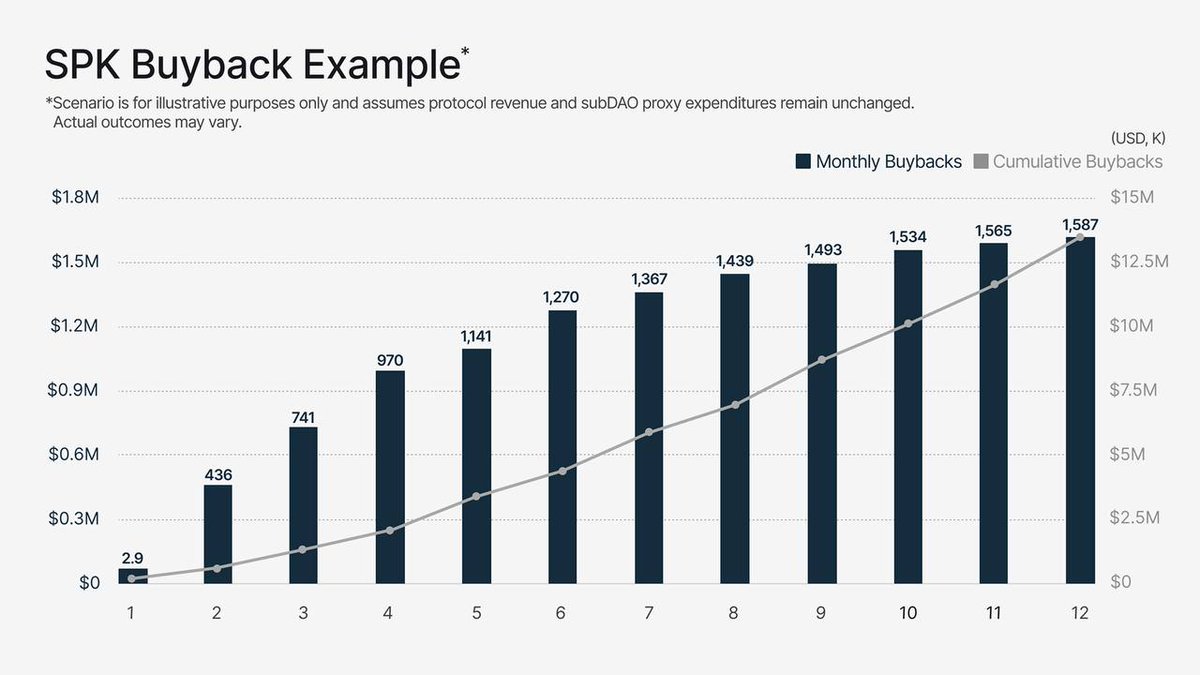
SAEP-09 Proposal: Adjusting SubDAO Proxy Parameters has been put up for vote. The proposal outlines adjustments for Spark governance to consider regarding parameters associated with the previously approved SubDAO Proxy reserve plan.
Key Changes:
- Target Runway: 24m to 12m
- Product Backstop: $5M to $1M USDS
- RRC Lookback: 12m to 3m
- Buyback Rate: 10% to 25%
The proposal incorporates the following chart to illustrate how the proposed parameter adjustments would work, assuming protocol activity and subDAO proxy expenditures remain unchanged.
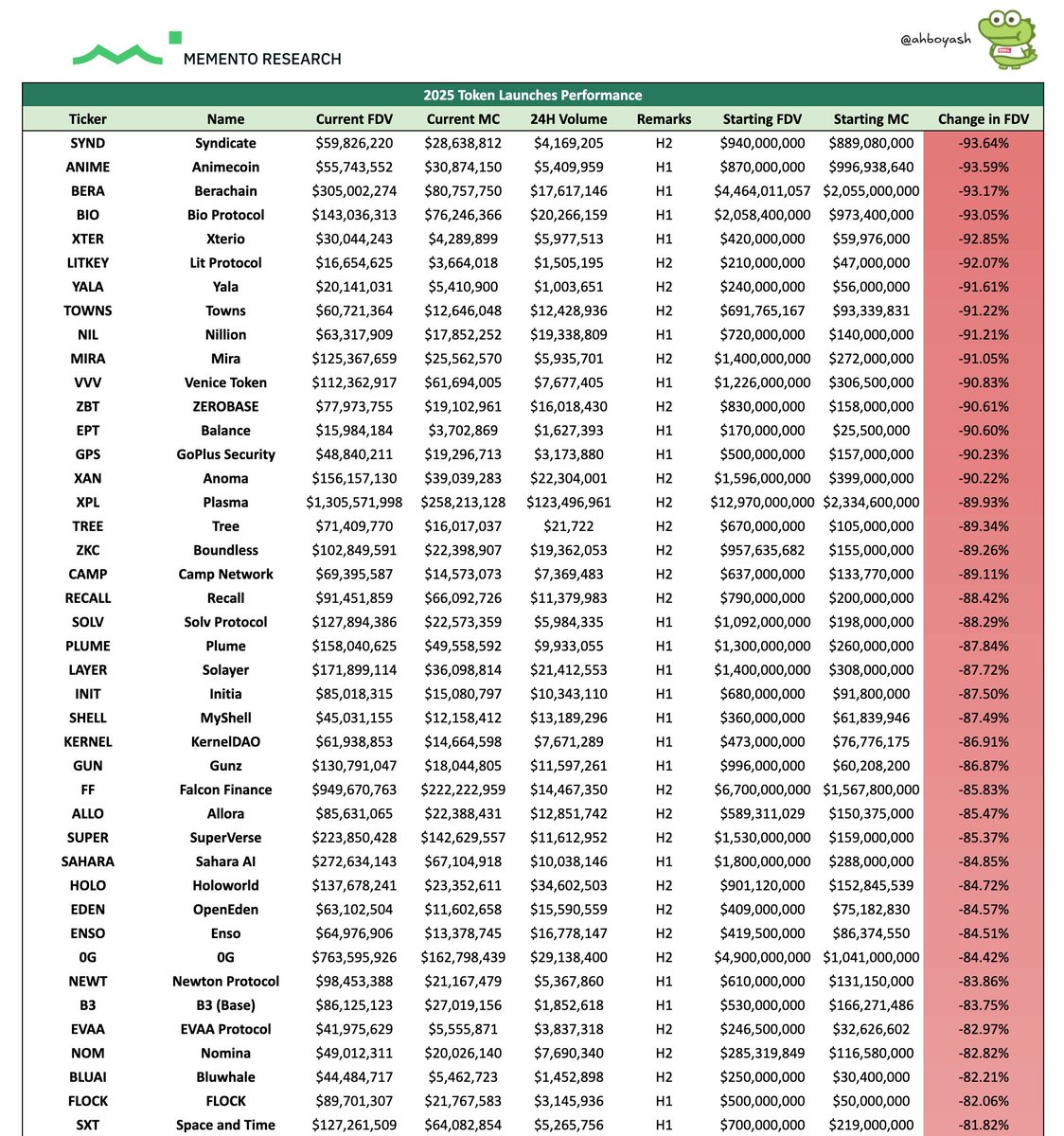
Great overview of 2025 TGEs by @mementoresearch and @ahboyash.
The takeaway is brutal: most tokens launched this year are down bad from TGE.
And not slightly down. We’re talking 60–90% drawdowns across the board. This applies to obscure launches like $SYND, $XTER or $YALA just as much as to some of the most anticipated TGEs like $BERA, $TOWNS or $XAN.
The reasons are not hard to identify:
Overinflated launch valuations, absurd sell pressure from massive exchange listing fees, and "free money" airdrops handed out to people who clicked a few buttons or posted a couple of tweets. Add to that the near-total lack of fundamentals or revenue behind many of these launches, often paired with products no one actually needs.
The combination of these factors sent tokens into free fall, with little to no organic demand underneath.
What’s even more concerning is that the few tokens showing decent performance on paper are often more illusion than reality. Some of the top performers like $ASTER, $ESPORTS or $COAI are well-known BNB Chain insider projects. Prices are propped up artificially while the vast majority of supply is tightly controlled, and wash trading creates the appearance of demand, especially on Pancake Swap and Binance Alpha.
Sure, good for those who caught these at TGE and made some money. But these projects are rarely sustainable, and they do nothing to meaningfully improve overall TGE performance.
If we want token launches to become sustainable again, several things need to change:
1) Expectations in crypto need to normalize.
The community shouldn’t expect billions in free money for low-effort participation. Founders don’t need to raise tens of millions at the seed stage. Investors shouldn’t expect 100x returns at launch. And exchanges shouldn’t think they deserve double-digit percentages of token supply just for listing an ERC-20.
2) We need to think longer-term.
It is not normal to invest in a startup and expect liquidity or meaningful returns within 1–2 years. Many token projects fail because they launch too early. Their fundamentals have no time to grow into their valuations, prices collapse, and a downward spiral begins. Trust is lost, attention moves on, and projects never recover.
3) Valuations must come back to reality.
A major driver here is tIeR oNe vCs that raised far too much capital and now feel pressured to deploy billions into early-stage startups. To fit larger checks, valuations get pushed up, markup rounds are engineered, and paper returns are manufactured. Founders often get blinded by the money and the runway, while missing the second-order effects this inevitably has on their token launch.
4) We need better ways to favor long-term supporters over extractors.
Stop allocating massive token chunks to CEXs, airdrop farmers, short-term investors, and KOLs with no long-term conviction. They will dump and move on, and recovering from that is extremely hard.
5) Stop playing games the market already understands.
Low-float, high-FDV tokenomics, wash trading, and artificial market-making strategies don’t work anymore. The space is too mature to be fooled by this.
6) Either commit fully to your token, or don’t launch one at all.
I’m very black and white on this. Stop pretending tokens have utility while all real value accrues to the equity entity. Tokens need to be treated as equity, either directly or indirectly. The founders who truly understand this tend to avoid most of the mistakes above, because they treat their token as the most precious asset they have, not as funny money printed out of thin air.
There are probably many more points to add, but this post is long enough already. If you have good additions, feel free to share them in the comments.
I hope these thoughts help, whether you’re an investor, a founder, or simply a crypto enthusiast.
If we want positive momentum to return to token launches, a lot needs to change. And the most important takeaway is simple:
It’s on us.
The faster more people realize this and stop playing short-term extraction games, the faster the space can heal. Ironically, long-term compounding would make all of us far richer than these games ever will, but too many people still think in the time horizon of a mayfly.