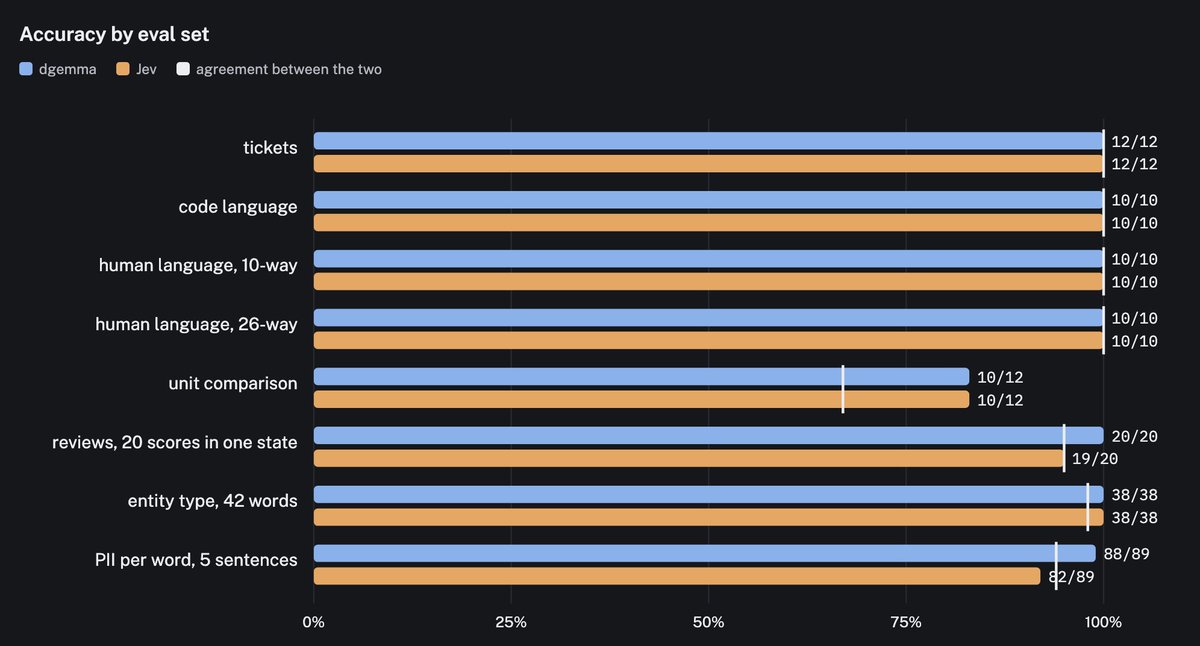
I ran some real, live evals on Jev vs DiffusionGemma-as-Jev (my patch for vLLM!)
DiffusionGemma comes out as the winner, I think.
Headlines:
Is Jev faster than DiffusionGemma? No ❌ (API vs DGX Spark)
Is Jev smarter than DiffusionGemma? No ❌ (they're roughly tied!)
The jev model's inference speed is indeed very fast.
In our tests, we found that when the input was kept at 1600 tokens, inference latency was under 0.3 seconds in 90% of cases.
For comparison, when using DeepSeek V4.1 Flash for inference, even with thinking disabled, it still takes more than 1 second in most cases.
note: We call the Jev model through the OpenRouter API.
#jev
@CompleteSkeptic@rronak_@0xCodila@_MaxBlade@OpenRouter@elvissun
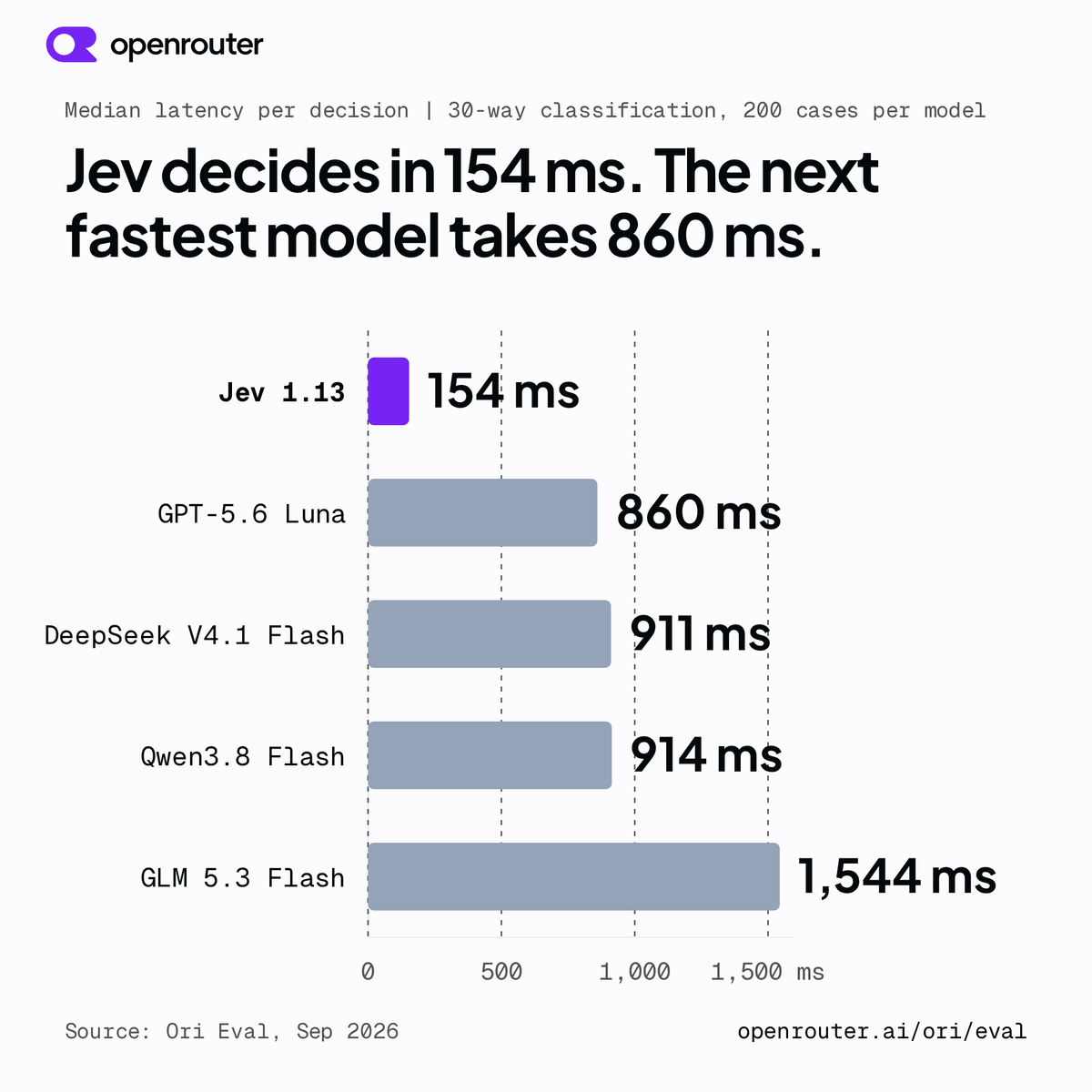
1/ Jev, a decision model by @typesafeai, sparked a burst of projects and discussion. We tested it using Ori Eval against popular LLMs on OpenRouter at judging.
Jev was >5x faster than the next fastest model, and even its slowest requests beat every other model's median.
"DiffusionGemma as Jev" showcases the power of non-autoregressive architectures.
While Jev demonstrates the value of rapid decision models, running DiffusionGemma in this paradigm leverages canvas diffusion to evaluate structured choices in a single parallel pass:
⚡ ️Massive Parallelism: Denoises across an open canvas in a single step instead of sequential autoregressive token generation (~0.2s on a DGX spark).
🧠 Full Bidirectional Attention: Allows every option to attend to the full context concurrently, yielding well-calibrated decision distributions.
👁️ Multimodal Grounding: Inherits Gemma 4's spatial vision capabilities for complex visual and text decisions.
Read more about this approach here:
https://t.co/hCEg276mzA
https://t.co/vRLhy6KECT
https://t.co/EQEumaQLYd
Tokenized stocks just got the regulatory nod of the decade, and Solana is already running the order books.
From an FDIC bank integrating Solana to Africa’s biggest IPO, capital is settling on the fastest rails it can find.
Here’s what happened:
📰 Headline News
- Solana tokenized equities hit a new ATH of 850K unique onchain holders
@Nectar_finance launched Africa's largest IPO ($DPRI) for stablecoin subscription on Solana via @getequity
- @particula_io's Project Harmonia opened applications bridging Solana funds to Allfunds’ €1.9T distribution network
- @column, the FDIC-insured bank behind Brex and Slash, built 24/7 USDC/USDT conversion into its banking core
- @anza_xyz shipped 250ms slot times to mainnet-beta, completing 3 of 4 planned reductions
📰 Launches
- @krakenfx enabled yield on tokenized stocks (SPYx, QQQx, NVDAx) via @veda_labs and @kamino
- @galaxyhq launched two curated USDC and USDT lending vaults on @kamino
- @Lexur rolled out its unified trading layer, aggregating 1,100+ onchain equities
- @supercoinxyz launched ZARsc, an FSCA-licensed Rand stablecoin with @fireblocks custody and @Chainalysis screening
- @PhoenixTrade enabled native SOL collateral for crypto, equity, and commodity perps
- $AMD, $FLY, and $WULF tokenized stocks went live on Solana via @sunrise, issued by @Backpack Securities
- $PEPE went live on Solana via @sunrise
- @peaq launched peaqOS on Solana and partnered with Doosan Robotics to bring Physical AI onchain
- @dawninternet launched the USD infra Vault to tokenize wireless network and compute cash flows
- @scalar_field_, an SEC-registered investment adviser, launched infrastructure for autonomous trading agents
- @ImperialPerps unveiled Armada, a proprietary perps AMM with 1 bp execution fees
- @ripcarsio launched a Hot Wheels gacha featuring 1,500+ vaulted die-cast cars for onchain rips
- @avici debuted Pay with Link, allowing users to claim funds directly via shared URLs
- @Rosentica deployed One Arena to @solanamobile Seeker alongside a $50K tournament
- @trendsdotrun added X integration to instantly tokenize viral posts and trading theses
- @getstonkoptions launched employee compensation rails for tokenized stock rewards
- @MonkeDAO partnered with @Solomon_Labs, starting with a $350K USDC-to-USDv treasury conversion, to fund @MonkeFoundry
- @domaprotocol teased Domain Asset Vehicles, targeting a $360B+ illiquid asset class
📰 Milestones
- @Raydium crossed $5B in cumulative tokenized stock volume
- @xStocksFi’s $VIDAx onchain DEX volume outpaced traditional stock exchange volume by 12.6x over 7 days
- Solana led all blockchains in dApp revenue for the 14th straight week
- @phygitals sold a record 1M packs in a single week
- @PreStocks reached 100K total holders
- @humafinance PST surpassed $300M in market cap
- @solflare perps cleared $65M in volume within three weeks of launch
- Solana daily stablecoin active addresses hit 888K in September
- @Mercuryo_io reported 89% YTD on-ramp growth, with 85% of volume flowing into $SOL
- Solana processed 420M USDC transactions over the last 30 days
If you enjoyed this week’s newsletter, please share it with an RT.
Artwork by @joiceloo_art 🔥
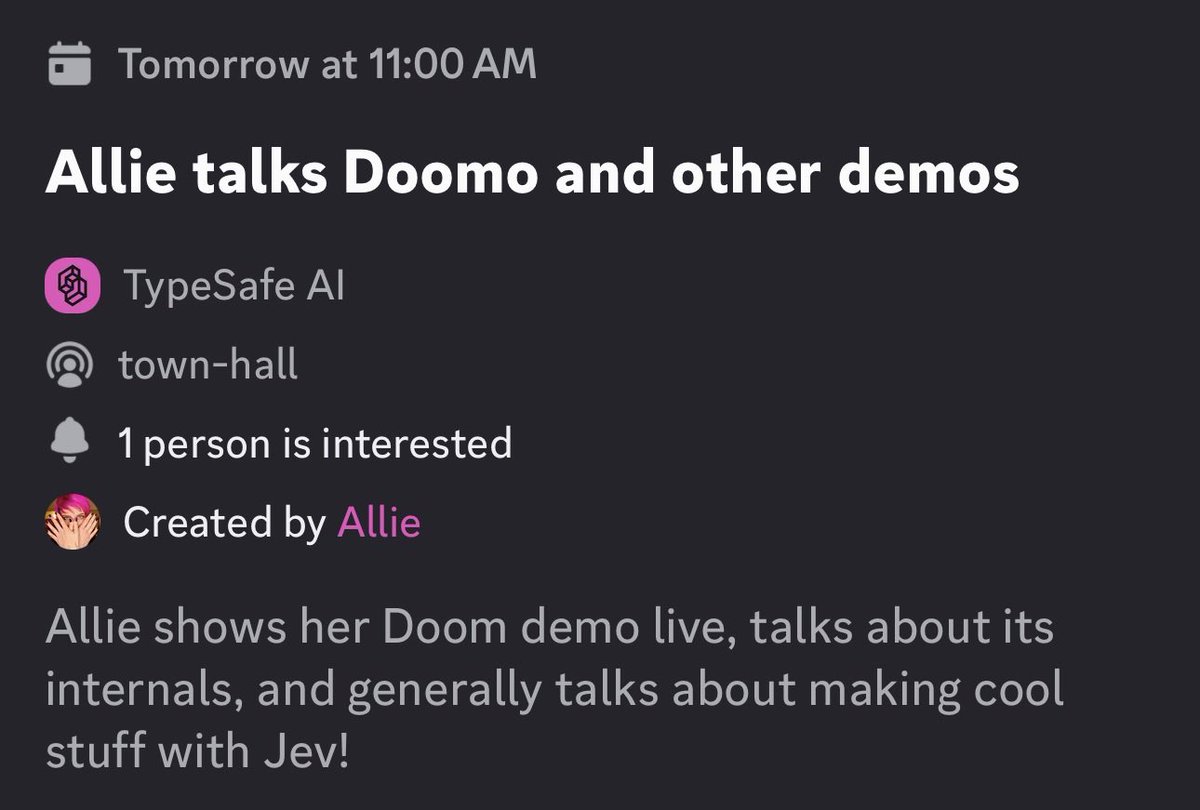
Tomorrow at 11am PDT, I’ll be in our Discord town-hall showing off the Doom demo, talking about how it was made and showing a bunch of stuff that didn’t make the launch vid!
Jev was adopted faster than any other model in AI Gateway history.
In the first day, @typesafeai reached ~13% of teams, 2x the GPT-5.6 family and 6x Fable 5.1.
jev is insane 🤯
Here is Jev playing subway surfers at super human speed, and also playing 50 games at once.
cost less than a cent to do this run.
Jev does not replace llms like astra or fable, but opens up an entirely new world of capabilities.
from my perspective, Meta is still pretty under-discussed in the AI race
> open-source models keep getting more efficient
> distribution becomes a huge edge as models improve
> Meta already has billions of users across its products
> better AI can improve personalization + ad targeting
its open-source AI strategy gives it a different position from other big labs, one of the larger AI companies i’m paying more attention to right now
LLMs vs. Jev, clearly explained!
TL;DR
The key difference is not that Jev generates faster.
Jev does not generate text at all.
A traditional LLM receives context and produces an answer one token at a time. Even when the output is a small JSON object, every token depends on those generated before it.
Jev receives the same context but evaluates predefined decisions directly. When those decisions are independent, it can evaluate all of them in parallel.
Consider an agent handling a failed deployment. It may need to determine:
→ Whether the incident is urgent
→ Which team should handle it
→ Whether the proposed command is risky
→ Whether the task is complete
An LLM generates a response containing these answers sequentially. The application then parses and validates it.
With Jev, you define the questions and expected answer types upfront. It evaluates them together and returns typed answers with probabilities.
Jev supports three decision primitives:
1. **Choice** selects from known options, such as engineering, billing, or sales.
2. **Score** places the input on an ordered scale, such as low, medium, or high risk.
3. **Noul** evaluates a yes-or-no condition and returns the probability that it is true.
The probabilities matter as much as the selected answers.
If engineering receives 91% probability and billing receives 9%, automatic routing may be reasonable. If the probabilities are 52% and 48%, the system can escalate, gather more context, or call a stronger model.
This keeps control inside ordinary software.
Code owns the thresholds and consequences. Jev supplies the semantic judgment that a normal `if` statement cannot derive from unstructured text.
It works best when the possible answers are known, the decision depends on meaning, and a careful person could judge the input quickly.
It is not designed for writing, summarization, code generation, arithmetic, or decisions requiring several dependent reasoning steps. Independent questions can run in parallel, but decisions that depend on earlier results must remain sequential.
Jev also cannot return an option outside the declared schema, but it can still select the wrong valid option. Type safety prevents malformed outputs, not incorrect judgments.
The clean mental model is this:
LLMs generate new language when the answer space is open.
Jev evaluates known paths when the answer space is bounded.
I wrote the full breakdown explaining Jev and where it fits.
The article is quoted below.
Jev is the "Internet" moment for the AI industry
It tells your agents and LLMs what to do next, in milliseconds and at almost zero cost
If you set it up correctly, you will have the AI engineer’s stack for 2028
In this article, I show you how https://t.co/x3qn41ejnr
also we we've been working for months to reproduce deepseek quality of inference. it is difficult
like $100M budget + right connections + getting the right 10 people in the world to help you difficult
if you ever see anyone claiming they can do this, they are lying
Investors just asked @CompleteSkeptic if we would raise prices and boy did they regret that
We're profitable at current prices.
We're gonna make it cheaper.
We're here for the builders.
Jev: on
this game looks absolutely gorgeous
we're truly in the golden age of gaming... remember when Diablo 2 was the only ARPG that existed?
now, no matter what genre of game you like, there are a variety of AAA-indie games to pick from.
10K GOAL HIT ❤️
In just 33 hours, Kintara players and the team raised $10,000 for @stjude through our @donatedotgg campaign.
The community showed up in a huge way, and the team donated 67 SOL to help fulfill the goal.
Thank you all. 🌎❤️
https://t.co/AXRuUwRGga
Enhance intelligence through computation, and boost creativity and experience through applied intelligence.
In our Whale bro project, a smart and reliable AI teammate can significantly elevate the gaming experience.
#whalebro#deepseek