Kalshi and Polymarket both subsidize their market makers.
It's genuinely hard to justify a market maker providing deep, stable liquidity here long-term. The environment is hostile. Makers have to carry positions all the way to settlement, deal with more toxic flow than almost any other market, and do it without the formal risk infrastructure that exists in traditional finance or even spot and perp order books.
Right now everyone is running their own ad hoc system, each with its own quirks and blind spots, and the data needed to improve those systems is thin.
It gets worse the moment you move past simple binaries into new market primitives, where even the limited data that exists stops being relevant.
My take is that the only real path to making this business reliably profitable is building formalized, generalized risk and inventory management systems and iterating on them the way other markets have.
Without that, it's hard to see how prediction markets get stable, reliable liquidity at any real scale.
i agree with most of your points on strategies and adverse selection however the main issue with this is that there's no actual evidence on whether you get better results/accuracy with more liquidity concentrated, if anything i think there's a research that argues past a certain threshold of liquidity information accuracy actually starts to decrease as more uniformed/consumer heavy userbase starts to participate
@Marko_Poly i refuse to take any consumer facing thing that meta does seriously until it gains actual traction and results. i dont whats with the social media hyping up random news.
unbounded loss isn't something that only traders specifically deal with, its a common issue that market makers and liquidity providers of all types have to deal with. its like the number 1 variable that every research tries to control with different kinds of risk and inventory management systems. i dont see how someone creates a profitable strategy without finding out about them along the way
unbounded loss isn't something that only traders specifically deal with, its a common issue that market makers and liquidity providers of all types have to deal with. its like the number 1 variable that every research tries to control with different kinds of risk and inventory management systems. i dont see how someone creates a profitable strategy without finding out about them along the way
unbounded loss isn't something that only traders specifically deal with, its a common issue that market makers and liquidity providers of all types have to deal with. its like the number 1 variable that every research tries to control with different kinds of risk and inventory management systems. i dont see how someone creates a profitable strategy without finding out about them along the way
@Marko_Poly honestly at this rate with the kind of money and outreach kalshi has polymarket wont be able to keep up they simply dont have the resources its not even close.
I kept seeing RFQ parlay quotes where the implied probabilities added up to more than a dollar, and assumed it was a pricing bug.
It wasn't.
When a market maker quotes a combo, they're really choosing between three bad options.
They can restrict the menu, which protects them but kills the entire point of RFQ, flexible combinations that are actually tradable.
They can loosen collateral requirements, which keeps quotes flowing but leaves them exposed to real losses. Or they can quote defensively, wide spreads that keep risk contained but bleed out information.
That third option is where the padding comes from.
Once the price stops representing a real probability and starts representing a risk premium stacked on top, the implied probabilities across the combo stop needing to sum to one. They just need to cover the maker.
In practice, makers keep choosing that third option:
leave the menu open, quote wide, and eat the information loss rather than restrict what users can build.
Knowing the edge exists is the easy part. Figuring out who's holding it is where this got messy.
Sports prediction markets can sound straightforward from the outside:
The house wins, whales are sharp, insiders print. But the data is a lot messier than that.
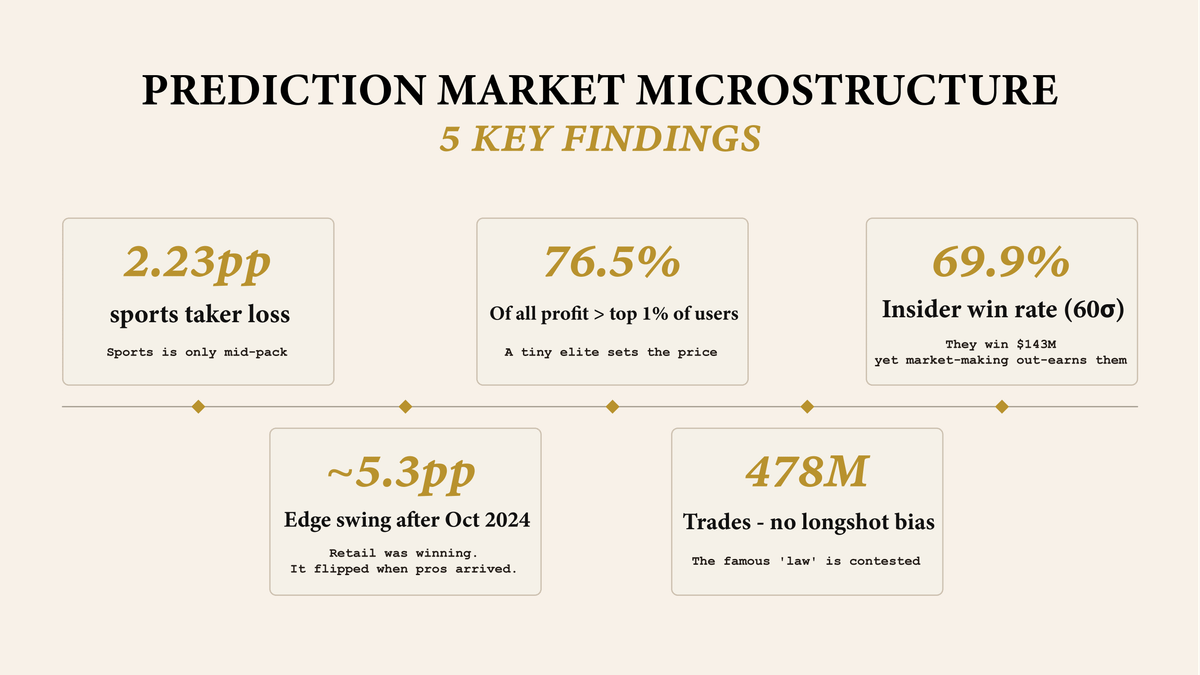
Retail takers were actually winning before late 2024. Then professional market makers showed up in size and the edge flipped. That's not some timeless "house always wins" law, it's a market structure change happening in real time.
Same with whales. The top 1% captures most of the profit, but that doesn't mean the biggest wallets are automatically the sharpest. Size can just be conviction with more zeros attached.
And sure, insiders exist. Sports has a huge information surface: injuries, lineups, refs, team news, all of it.
But the boring edge still seems to be market making, not the movie version of insider trading.
Which is probably the real lesson here. Sports prediction markets aren't clean truth machines. They're where fan flow, maker edge, and market structure collide in public.
Sports prediction markets are messier than people assume.
The case for 'efficient' looks airtight on paper: public odds, injury news, models, arbers, market makers, more data than any other category. So sports should be the sharpest market on the exchange.
It isn't. On Kalshi, finance markets show a taker loss around 0.17pp. Sports runs about 2.23pp. That's a real gap, on a category everyone assumes is already picked clean.
The reason is sports has fans, and fans aren't just worse forecasters, they're playing a different game.
They're not pricing a probability, they're buying a feeling: the comeback, the longshot, the story. That flow doesn't go away just because better data shows up.
Which is exactly why the category works. Enough information for pros to bother showing up.
Enough emotional flow that the market never gets too sharp to quote.
Too efficient and the market goes hostile. Too dumb and no serious money wants in. Sports sits in the middle, liquid enough to matter, messy enough to keep an edge.
That's probably why it keeps ending up as the load-bearing category for the whole industry.
yeah seems overvalued, but then again they have so much money right now that they can keep subisidizng markets for now and narrative and research toward using this markets is gradually shifting toward financial instruments and hedging rather than pure gambling .
will have to see what happens though.
@Polymarket i mean did anyone ever assume those are even remotely safe? i feel like they have certain assumptions about our intelligence when they decide to publish this kind of news as a "shocker"