Using novel light-powered enzymes, CABBI researchers at @UofIllinois created a precise, cost-effective way to make chiral ketones, complex chemicals used in agrochemicals, medicines and other products.
News ➡️ https://t.co/e81w1hiMBB
📰 @NatureCatalysis: https://t.co/oJdnQMkZnB
🚨RADICAL RETHINK: STEREORETENTIVE CROSS COUPLING UNLOCKED🚨 Today in @ChemRxiv (https://t.co/zGZFCsK7aK) the first method for stereoretentive radical cross-coupling is disclosed. No fancy ligands or redox needed—just a Ni-diazene twist. 120 years after Gomberg, a new chapter begins.
Quick summary:
Since Gomberg discovered free radicals over 120 years ago and Kochi pioneered radical cross-coupling in the 1970s, this field has surged with interest for linking C(sp3) fragments. Unlike traditional polar methods (e.g., Suzuki), radical cross-coupling excels with saturated systems, offering mild conditions and chemoselectivity to build complex molecules from common fragments. Until now, enantiospecific radical cross-coupling was deemed impossible due to rapid racemization, but today that changes with readily available sulfonylhydrazides and a simple Ni-catalyst. This stereoretentive approach, enabled by a unique Ni-diazene transition state and driven by loss of N2, skips chiral ligands and redox steps, opening new possibilities for synthesis.
I dream of a world in which every synthetic chemist runs biocatalytic rxns on the regular. Led by talented @NarayanLab postdoc @Apatoneh & in collaboration with @gpggrp, we take a major step toward this goal by making biocatalysis more accessible.
🌿CATNIP for all the #biocats
Automated comparison tool (beta) is now live for all Plasmidsaurus users! 🦖🦕
Learn if the sequences are correct in your results email, or upload your references later to get the results on the website. Thanks for the software team for pushing this out!
"… research requires failure. But constant failure drags you down. A mind whose only intake is failure cannot possibly produce anything resembling happiness. Ultimately, your life is your project—not the other way around." #ScienceWorkingLife https://t.co/Pw87m5PFFz
Our second paper on the excited flavoproteins triggered single-electron transfer biocatalysis is online @angew_chem, please check out
https://t.co/nZiPKbY3OF
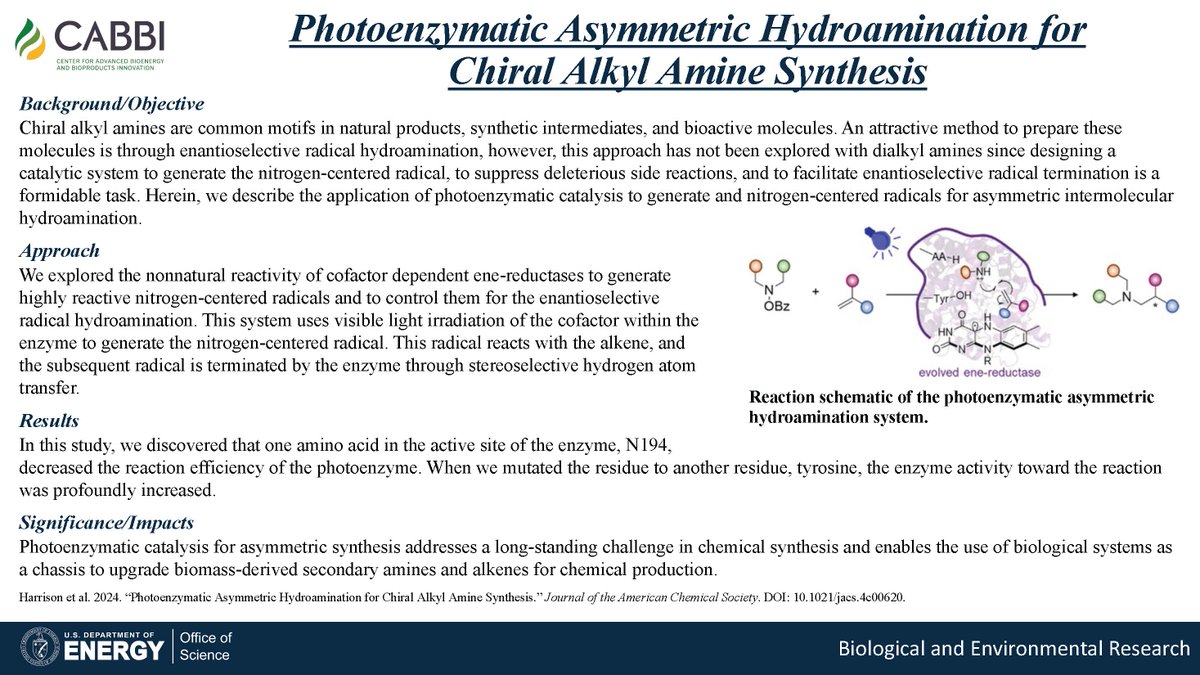
A #CABBI team has made another breakthrough using photoenzymes to catalyze biological systems that can upgrade certain building blocks into valuable chemicals. This study was led by @wharrison52 of @HuiminZhaoLab.
Paper in @J_A_C_S:
📰 https://t.co/q0g2eHxZhD
Check out my latest publication! Here we explore the use of photobiocatalysis for a hydroamination reaction which can shorten the synthesis routes to chiral amine building blocks, molecules which have applications in pharmaceuticals, agrochemicals, and specialty chemicals.
In some new work (the first from the new lab!), we lay out a vision for a biological foundation model that unites DNA, RNA, and protein modalities and operates at molecular, systems, and genome levels of scale.
Blog: https://t.co/zAtUvaP1LS
Preprint: https://t.co/H6oV2qS7ll
We are thrilled to present a new #enzyme to the world, the first shown to break the man-made carbon-silicon bonds in #siloxanes, which are persistent in the environment.
https://t.co/BJOuWk4WGW
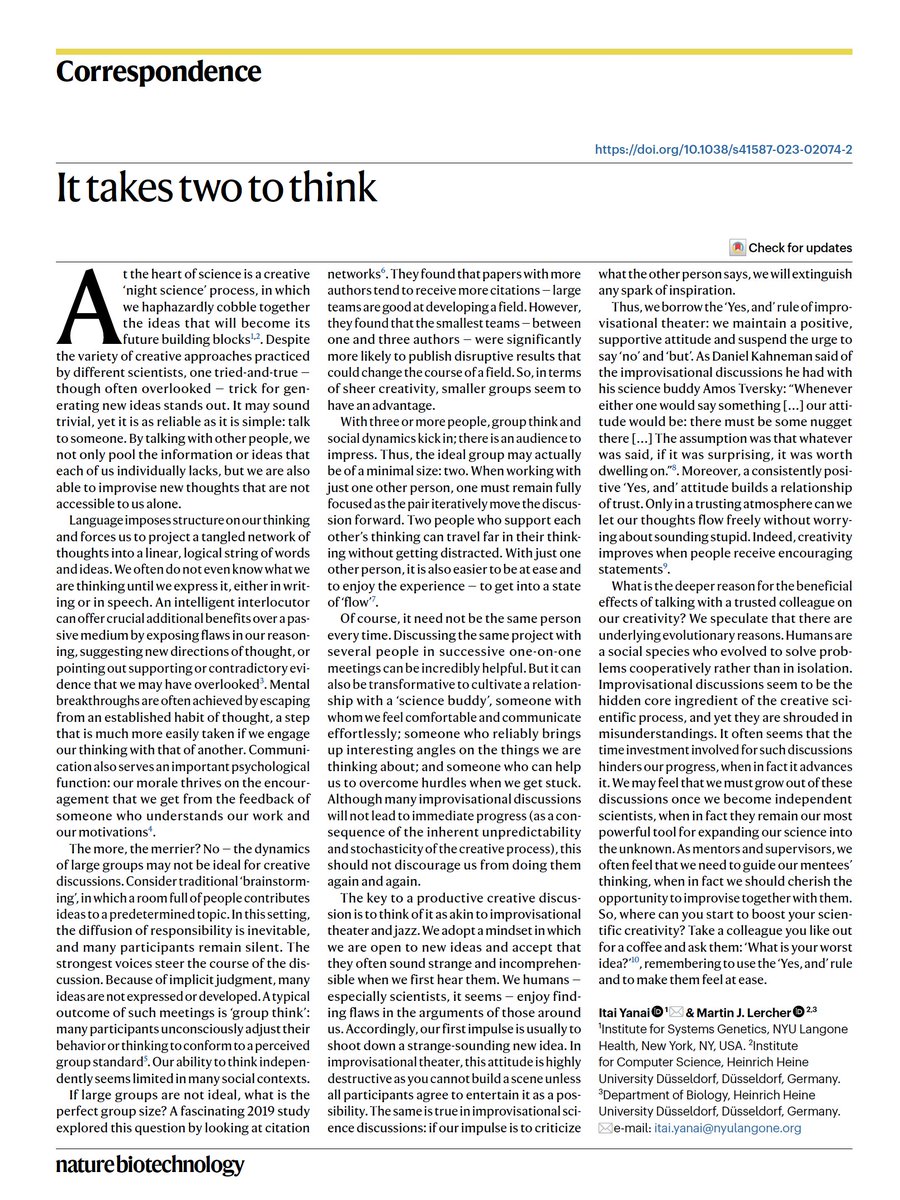
Out today in @NatureBiotech! PhD students & postdocs: there's a trick – overlooked and underused – for having new ideas in the creative process. Talk science 1 on 1 with a science buddy that you trust and think of it as an improvisation. https://t.co/Xw7VpKHot2…
@MartinJLercher