100% #savestargate@AmazonMGMStudio honestly it’s a no brainer. As per wiki “MGM executives described the Stargate TV universe as the television equivalent of their Bond franchise because it was highly profitable.”
Sort it out. I stand (or ascend) with @MichaelShanks
My ENTIRE feed is Stargate fans calling out @amazon@AmazonMGMStudio
I LOVE IT! The fans are amazing. 🥹Amazon was WRONG! They made a MISTAKE by discounting Stargate fans.
Keep telling Amazon how you feel and be sure to tag them! RT your fellow fans.
#stargate#savestargate
Today we go live on mainnet with the Fusion Rollup, the world's first multi-ledger rollup, connecting 74 blockchain networks in one unified environment, built for institutions.
When I started @quantnetwork in 2015, the vision was simple: make blockchain work for institutions at scale across any network, without the complexity and fragmentation that's held the industry back.
For years, institutions had two bad options: bet everything on a single chain, or stitch together insecure bridges across many. Fusion refuses that trade-off. It connects to many networks at once, moving assets, settling transactions, and messaging across chains as built-in capabilities, not workarounds.
The breakthrough is unified assets. A example of a stablecoin like USDC or tokenised fund like BUIDL or any other digital assetspread across 7 chains collapses into one: uUSDC or uBUIDL. One asset, one liquidity pool, instead of 7 copies and 7 fragmented pools. Each stays anchored to its origin chain and is withdrawable anytime. No custody or compliance trade-offs.
This isn't another layer 2 or a blockchain. It's a new category of infrastructure and it's live.
Read more on: https://t.co/MGfs1FgA6T
→ https://t.co/OQBfu2CEZb
→ https://t.co/4o9nnaA7zc
#QuantFusion #EnterpriseBlockchain #MultiLedgerRolleUp #FusionRollup
I’m delighted to announce that @quantnetwork and Murex are partnering to bring tokenised deposits and digital bond settlement into MX.3.
Institutions have been asking the same question. How do we move forward with tokenisation without disrupting the trading, risk and post-trade operations we depend on?
The answer is now inside the platform they already use.
Tokenised RWAs just crossed $100 billion. DTCC has SEC approval to tokenise real-world assets from mid-2026 and major UK banks are already working with Quant through the Great Britain Tokenised Deposit initiative - all of which signals that the market is moving.
Users in banks, asset managers, insurance companies, pension funds, hedge funds, corporations and energy utilities in over 65 countries now have a production-ready path into tokenisation through the systems they already run.
The future of capital markets infrastructure is programmable: https://t.co/RmT2yVJ4SH
#Tokenisation #DigitalAssets #CapitalMarkets #Programmability
This is exactly why we built Dusk.
On-chain payments only work for businesses when salaries, invoices, and transactions stay confidential.
Dusk enables private transactions with selective disclosure.
On-chain finance that works for everyone.
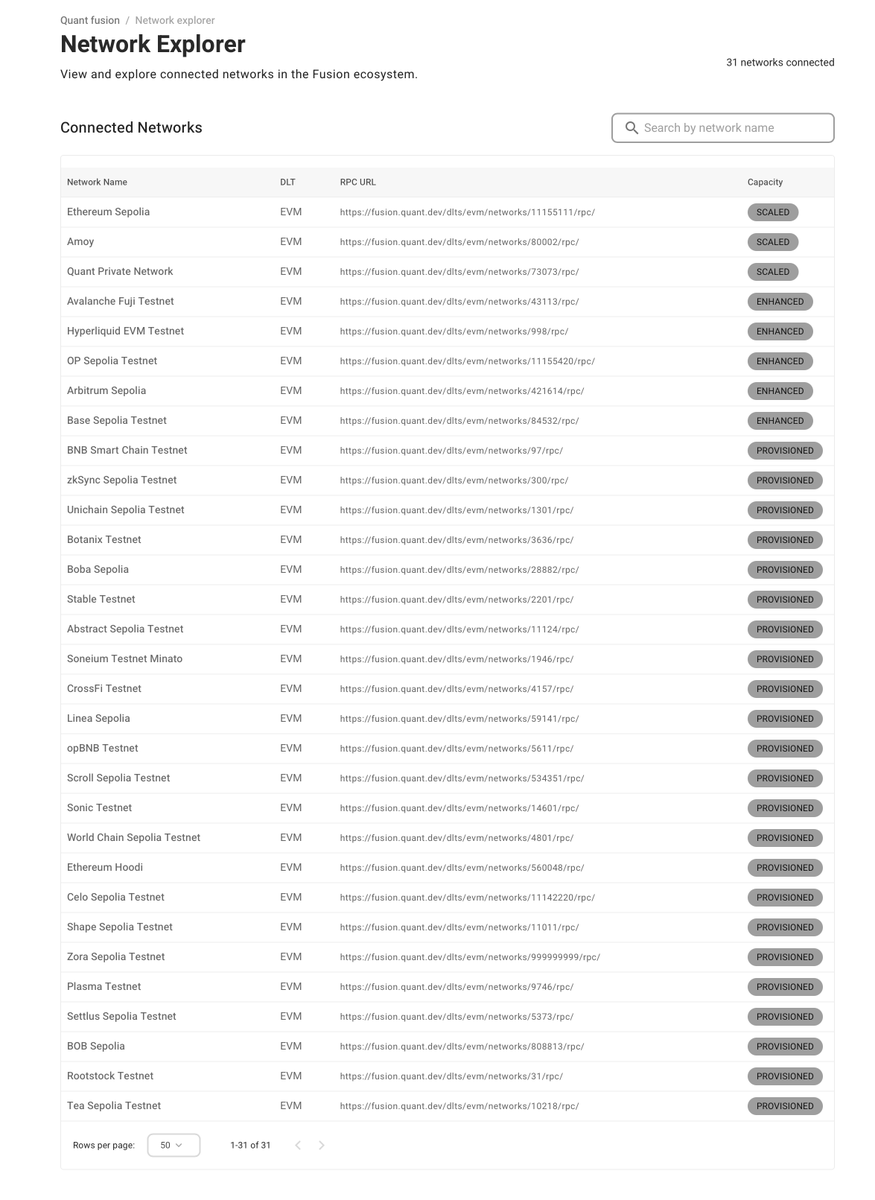
The Layer 2.5 Network of Networks @FusionLayer25 is coming together nicely!
31 Networks connected in the first hour! 🚀
Sign up and interoperate: https://t.co/N3rDK9bOYd
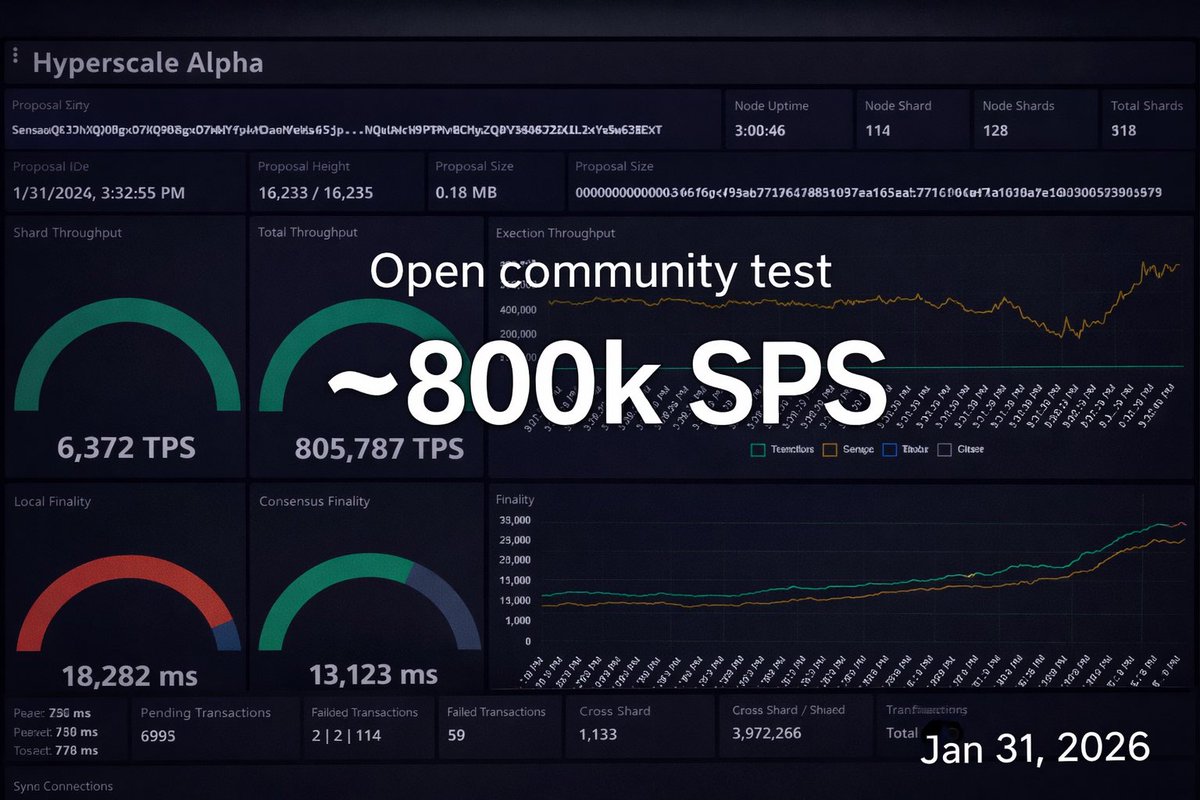
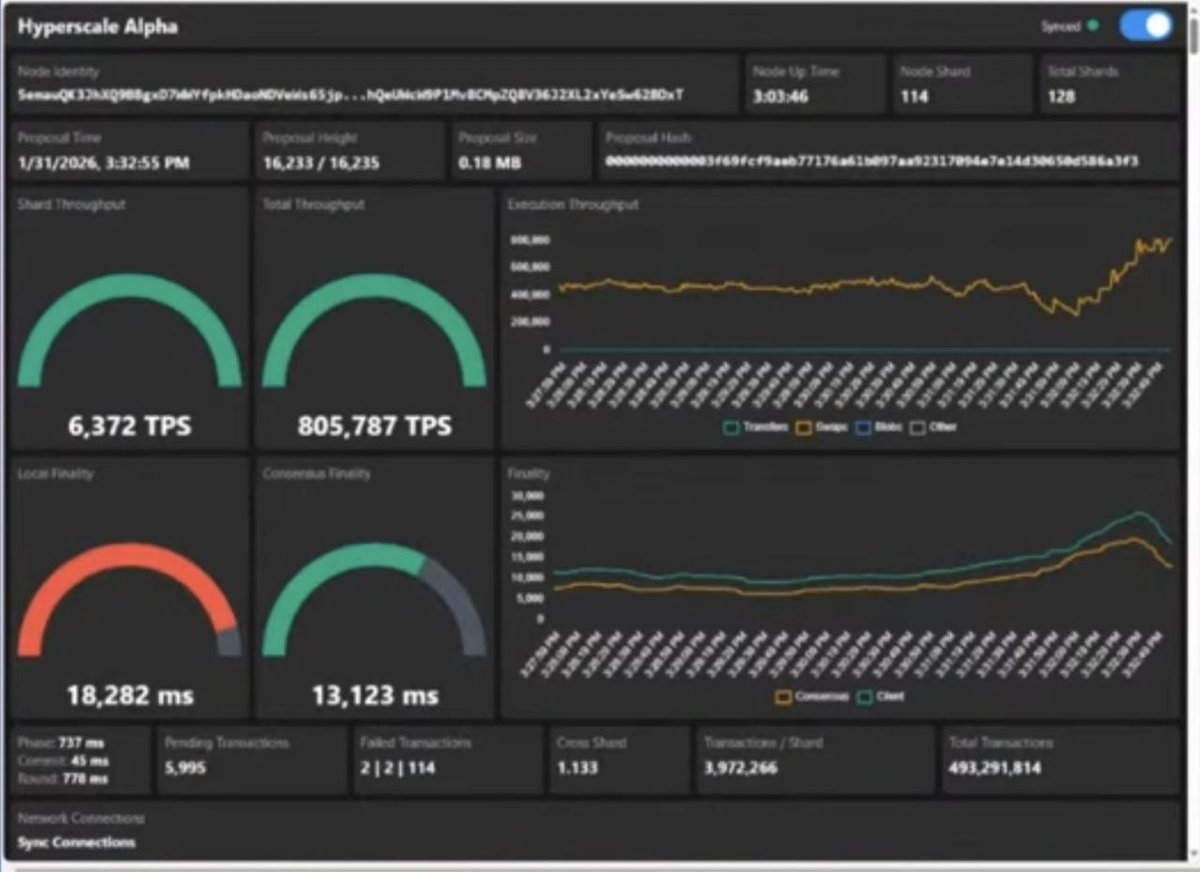
Yesterday’s @radixdlt Hyperscale public test lead by @timanrebel exceeded expectations.
📈 Peak throughput surpassed 800,000 SPS under live, real-world conditions.
Why SPS matters:
•TPS counts transactions submitted
•SPS measures transactions actually executed and finalized
SPS reflects real network capacity, not theoretical input.
Key points:
• fully open, community-run test
• heterogeneous, non-sterile environment
• real cross-shard atomic execution
• horizontally scalable on modest hardware
This result demonstrates practical, decentralized scalability - not benchmark theater.
Hyperscale is not a lab concept.
It is operating infrastructure.
Results like these reinforce the depth of @fuserleer Dan Hughes’ original vision.
The architecture being validated today reflects ideas that were far ahead of their time - and his absence is still felt across the community ❤️
#SPS #BlockchainInfrastructure #DLT #Web3
#doitfordan
Emanuele from Dusk just dropped some real alpha.🔥
During the HTX x Dusk X Spaces, Emanuele shared key insights into what $Dusk is building behind the scenes.
Beyond the upcoming Dusk EVM, Dusk has been working for a long time on a DLT TSS license that would allow it to operate as a CSD, one of the core pieces of global financial infrastructure.
To put that in perspective: CSDs don’t handle billions. They settle trillions in transactions every year.
And Dusk believes it can do this with up to 90% lower costs than today’s post-trade systems.
At that scale, this isn’t a small efficiency gain. It would fundamentally change how settlement works in global finance.
On top of that, they’re building multiple yield-bearing products, including real-economy use cases like invoice and contract financing. These aren’t short-term plays,
they’re traditional businesses with long sales cycles.
And as Emanuele said himself: there’s a lot more coming.
This goes way beyond just the DuskEVM launch.
Dusk is quietly building something much bigger.
DYOR @DuskFoundation@HeinDauven@Autholykos@HTX_Global x Dusk X Spaces⚡️👇🏼
Market cap is noise.
We’ve been building while others were posting charts, and we’re just getting started.
DuskEVM is imminent: EVM compatibility, real scalability, built for serious financial use cases.
Hedger is becoming the privacy hub for RWAs and Web3: programmable, compliant, unavoidable.
DuskTrade brings real market infrastructure on-chain: tokenization, trading, settlement, done properly.
Price reacts. We ship.
More soon.
Exciting progress on #QuantFusion as we kick off 2026!
1. Fusion Firewall Updates
We recently upgraded Fusion's Multi-Ledger Rollup to deploy critical updates to Fusion Firewall #smartcontracts.
Key enhancements based on institutional feedback:
- Self-managed token whitelists for institutions
- Liquidity isolation options for shared tokens
- Privacy-preserving on-chain whitelist synchronisation
2. Bring Your Own Node (BYON) - Now Live
A foundational upgrade for #QuantConnect users. BYON allows users to attach their own nodes to Fusion via our Quant Connect UI. It’s as simple as selecting the network and entering a URL. Starting with pre-selected node providers to ensure reliability and simplify setup, with plans to expand to user-hosted nodes.
The infrastructure is fully generic, any EVM-compatible node can connect, with minimal adjustments needed for non-EVM chains. Currently testing on Sepolia and Amoy testnets.
3. Staking Infrastructure in Development
We're evaluating staking algorithms that balance inclusivity with meaningful participation. The goal: encourage QNT staking at all levels without disadvantaging smaller holders. Staking will be tied to BYON, users stake QNT against their nodes to earn rewards.
Rather than slashing, we're following proven models (like Avalanche) where withholding rewards effectively incentivises node reliability.
#Blockchain #Interoperability
$ETH = Smart contracts for everyone
$SOL = Speed and scalability
$DUSK = Compliant privacy for regulated finance
Here's what most people are missing:
ETH market cap: $400B
SOL market cap: $80B
DUSK market cap: $50M
That's an 8,000x gap to ETH.
A 1,600x gap to SOL.
But here's the kicker:
ETH and SOL are glass houses.
Every transaction is public. Your wallet, your holdings, your entire financial history — visible to anyone.
Corporations won't put supply chains on a public ledger. High-net-worth individuals won't expose their portfolios.
Institutions need privacy AND compliance.
DUSK is the only L1 built specifically for this:
– Zero-knowledge smart contracts
– MiFID II, MiCA, DLT Pilot compliant
– Already partnered with regulated EU exchanges
– RWA infrastructure that institutions can actually use
DAC8 just went live in the EU. Privacy is no longer optional — it's infrastructure.
ETH and SOL can't solve this. They weren't built for it.
DUSK is.
$50M market cap for the only compliant privacy L1 in a world moving toward total financial surveillance.
The asymmetry here is absurd.
You deserve financial privacy.
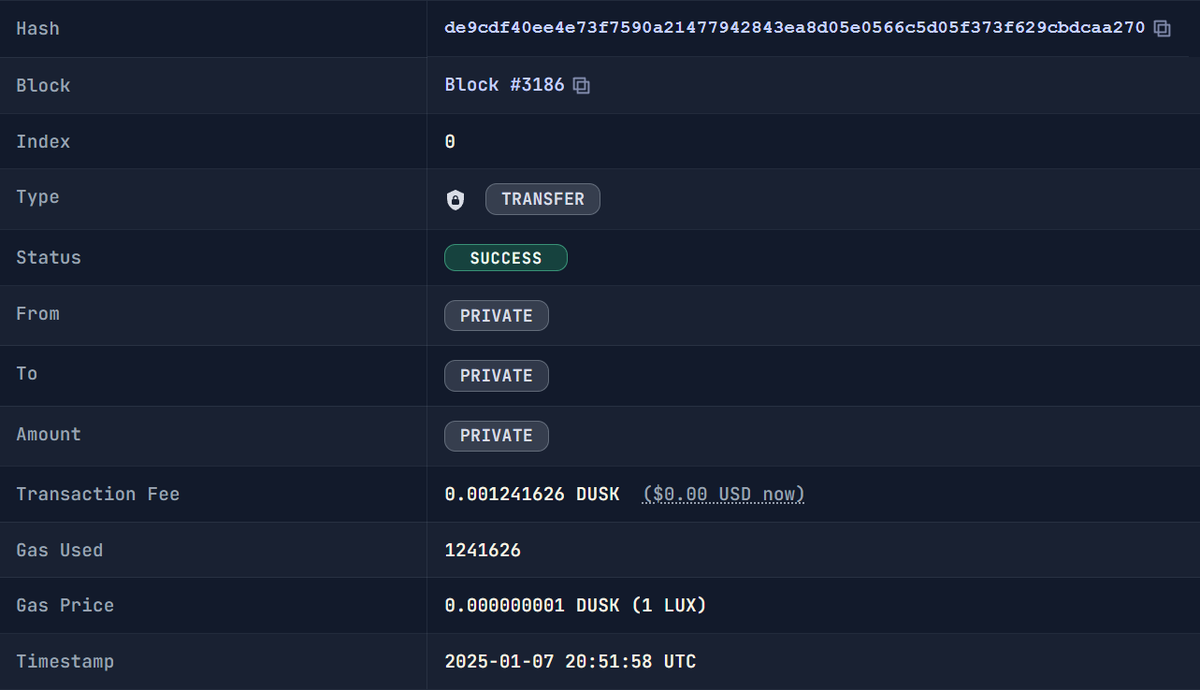
On Dusk, you can make fully private transfers that hide your personal data, yet remain verifiable for compliance when required.
See it in action. 👇
Great News from @DuskFoundation. The team lead by @HeinDauven just did their silent launch of #DuskEVM on the $dusk public testnet. The validation stage starts now and soon after we will see the #mainnet launch! Lets go!
I think $DUSK has legit shot at $3+ ($1.5B MC) by Jan 2026
Wouldn’t shock me to see it way higher tbh
#PrivacyCoins are eating this cycle and $DUSK is the most criminally undervalued gem I’ve found, tech is next-level.
#Crypto
Dusk (@duskfoundation) is adopting the Chainlink interoperability & data standards to enable compliant, cross-chain tokenized securities backed by real-world equities from NPEX, a fully regulated Dutch stock exchange with €200M+ in financing raised & 17.5K+ active investors.
https://t.co/vY8deBSiyO
Chainlink CCIP will serve as the canonical interoperability solution for tokenized NPEX assets, while also enabling the Dusk Network’s native token, DUSK, to be natively transferable across Ethereum and Solana via the Cross-Chain Token (CCT) standard.
Chainlink DataLink will serve as the exclusive data oracle solution for bringing NPEX exchange data onchain and cross-chain. Dusk and NPEX will become official data publishers of regulated market data, and Chainlink Data Streams will deliver low-latency price updates for institutional-grade DeFi applications on Dusk.
Together, this integration brings regulated securities, verified financial data, and cross-chain connectivity into a unified infrastructure, unlocking a new era of institutional capital markets onchain, powered by the Chainlink platform.
Hedger Alpha is now live for public testing.
Dusk brings compliant privacy to EVM, enabling you to send confidential transactions and keep your balance private.
Private to everyone, yet auditable by regulators.
Here's how to get access 👇
Zero-knowledge isn’t just a niche anymore.
It’s projected to become a $5-$10 billion sector by 2030.
If the ZK giants led the first wave…
→ $ZEC vs $DUSK
→ $WLD vs $VFY
→ $STRK vs $SXT
Can the challengers deliver the next 10x? 👇
🟢 Zcash vs Dusk
✦ Zcash: the OG of Private Money
☞ Vision: Permissionless digital cash with full user privacy.
☞ Original Idea: Bitcoin-style blockchain + zk-SNARK–shielded transactions.
☞ Tech Stack: Orchard pool, unified addresses, viewing keys, FROST multisig.
☞ Evolution: Sprout → Sapling → Orchard with huge UX upgrades.
☞ Recent Behavior: Added threshold signatures (FROST), DeFi bridges, shielded staking.
Zcash is the project that proved zero-knowledge works in production.
It brought encrypted transactions to a public blockchain way back in 2016 years before privacy was trendy.
Modern upgrades like unified addresses and FROST make ZEC actually usable across apps and wallets, while keeping everything private by default.
Regulators still hate how strong Zcash privacy is.
But that’s why users love it.
It remains the blueprint for private money.
✦ Dusk: the Challenger
☞ Vision: Regulator-ready privacy infrastructure for financial markets.
☞ Original Idea: Confidential, compliant L1 for securities & RWAs.
☞ Tech Stack: PLONK-based consensus, Moonlight accounts, Phoenix UTXO, Zedger.
☞ Evolution: Built specifically for compliant on-chain finance.
☞ Recent Behavior: Tokenized bond pilots with EU banks, sub-2s finality, $500M+ institutional TVL.
Dusk isn’t trying to be “private money.”
It’s trying to be private finance the rails institutions can actually use legally.
Zedger lets regulated assets run privately but auditable, and finality is fast enough for financial workflows.
By 2025, European banks are piloting tokenized bonds on Dusk a huge signal of trust.
If Zcash is underground money…
Dusk is private Wall Street.
👉 Comparison:
Zcash = battle-tested consumer privacy
Dusk = institutional-grade confidential finance
🔵 World vs zkVerify
✦ World: the OG of ZK Human Identity
☞ Vision: Global “one person, one account” identity.
☞ Original Idea: Biometric uniqueness → ZK proof → private identity.
☞ Tech Stack: World ID, World App, L2 World Chain.
☞ Evolution: From app → global ZK credential network.
☞ Recent Behavior: 15M+ users, Optimism-based L2 rollout, DeFi integrations.
World is the largest ZK identity experiment ever attempted.
The Orb creates a private biometric commitment, and apps only receive a zero-knowledge proof of uniqueness not identity.
Whether people love it or fear it, it’s the only identity protocol operating at true global scale.
And with World Chain (its own L2), issuing credentials is faster and cheaper than ever.
World wants to be the identity layer for the entire internet.
✦ zkVerify: the Challenger
☞ Vision: Make verifying any ZK proof cheap and universal.
☞ Original Idea: Offload proof verification from L1s to reduce costs.
☞ Tech Stack: Multi-curve verifiers, modular circuits, proof marketplace.
☞ Evolution: Neutral proving layer for rollups, bridges, identity systems.
☞ Recent Behavior: 90% cheaper verification, L2 integrations, STARK/SNARK support, $200M network TVL.
zkVerify doesn’t issue identity.
It makes everyone’s ZK proofs cheaper including World’s.
Ethereum is limited by curves and gas costs, so zkVerify built a specialized network that verifies proofs off-chain and posts the result.
This makes ZK bridges, ZK rollups, and ZK identity systems all more scalable.
It’s the kind of infra layer nobody sees but everyone benefits from.
👉 Comparison:
World = ZK identity at scale
zkVerify = ZK verification for the whole ecosystem
⚫ Starknet vs Space and Time
✦ Starknet: the OG of STARK Scaling
☞ Vision: Scalable general-purpose computation secured by Ethereum.
☞ Original Idea: Off-chain execution → STARK proofs → L1 verification.
☞ Tech Stack: Cairo VM, SHARP prover, account abstraction.
☞ Evolution: From permissioned → fully permissionless rollup.
☞ Recent Behavior: STRK staking live, parallel execution, $1B+ TVL, quantum-resistant upgrades.
Starknet brought STARKs into the mainstream transparent, quantum-resistant, mathematically beautiful proofs.
Cairo gives developers expressive compute power, and the network continues to evolve with parallel execution and composability upgrades.
It’s one of the most academically rigorous L2 ecosystems ever built.
If Ethereum is the settlement layer, Starknet is the compute engine built on top.
✦ Space and Time (SXT): the Challenger
☞ Vision: Trustless data for smart contracts.
☞ Original Idea: “Proof of SQL” → ZK-verified off-chain queries.
☞ Tech Stack: GPU provers, decentralized warehouse, tamper-proof tables.
☞ Evolution: From ZK data proofs → full verifiable data pipelines.
☞ Recent Behavior: Sub-second proofs for billion-row datasets, multi-chain verification, AI dataset integrity.
Space and Time solves a problem Starknet doesn’t tackle:
“How do smart contracts trust data?”
Its Proof of SQL lets contracts verify complex analytics, historical data, and even AI datasets without trusting an oracle.
The GPU-accelerated proving system is absurdly fast, opening the door to ZKML and verifiable AI.
👉 Comparison:
Starknet = scales computation
SXT = scales verifiable data
🔚 Final Thoughts
Zero-knowledge isn’t one battlefield it’s three:
Money: Zcash proved private payments; Dusk brings privacy to regulated finance.
Identity: World scaled ZK credentials; zkVerify scales the entire ZK verification layer.
Scaling/Data: Starknet handles execution; Space and Time handles data trust.
The OGs built what ZK is.
The challengers are building what ZK can become from finance to AI to identity.
This is where some of the biggest long-term asymmetric bets still live.