When electricity arrived, factory owners ripped out the steam engine and dropped in one big electric motor. Same belts, same shafts, same cramped layout huddled around a single power source. Productivity gains were almost nil, and economists spent decades wondering where the revolution went.
The payoff came when someone realized each machine could have its own motor. Suddenly you didn’t need to cluster around the engine: you could spread out, arrange machines in the order the work actually flowed, and build single-story plants with light from the windows. That took nearly 40 years.
@professor_ajay, @avicgoldfarb & @joshgans describe this in the very opening of their book on AI.
In my experience, this shifts the job of a support team from "writing from scratch" to "editing and approving."
High quality, low friction
(And a shoutout to Tyler Fisk for creating the agent that helped me with the visual! 🎨)
I’ve been exploring agentic workflows lately. I moved from a simple "prompt →response" habit to building a team of specialized agents that check each other's work
As you can see in the screenshot, the resulting email wasn't written by one prompt, but by an orchestrated team. They work together to identify customer sentiment, match the specific Gen-Z brand voice of Nude Project and ensure the answer is clear and hallucination-free.
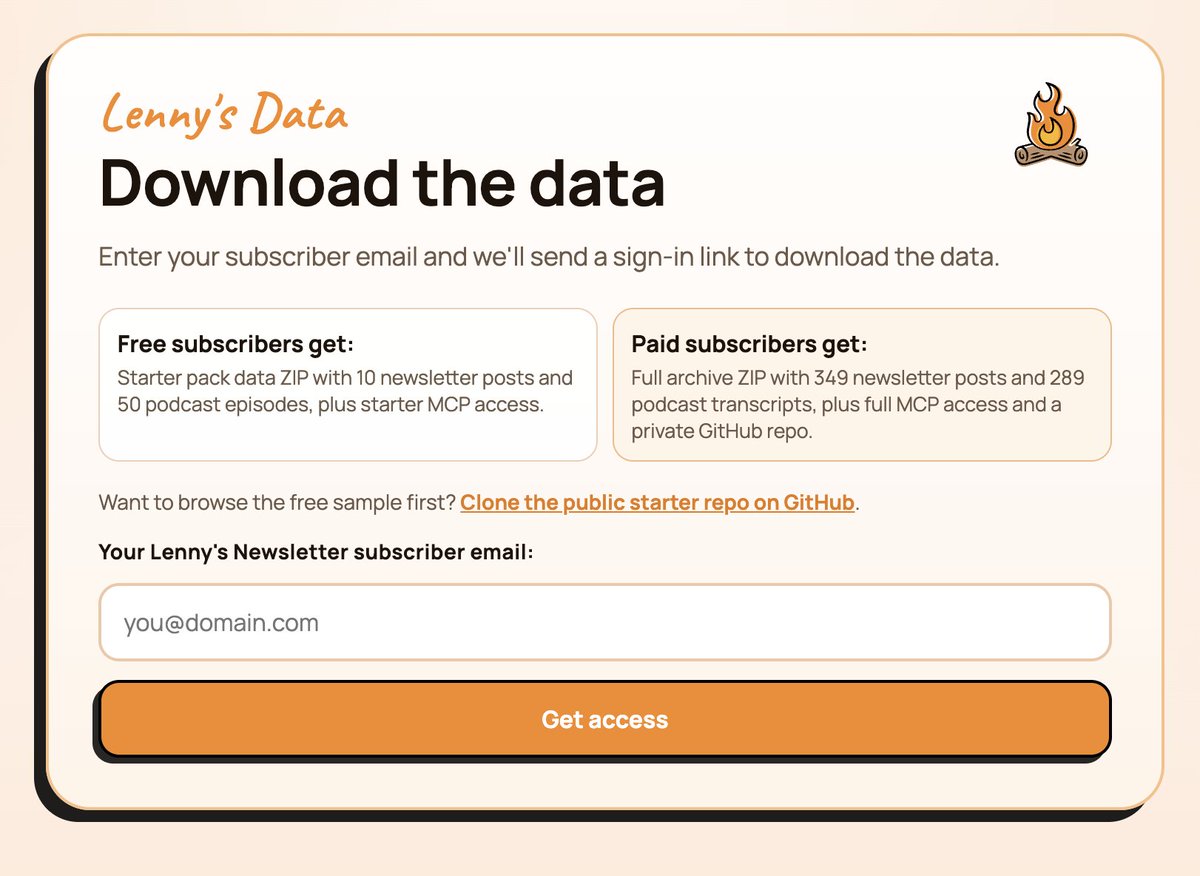
Today I'm releasing my entire newsletter archive (350+ posts) and all podcast transcripts (300+ episodes) as AI-friendly Markdown files. Plus an MCP server and GitHub repo.
A few months ago I shared my podcast transcripts on a whim, and y'all built the most amazing things—an RPG game, a parenting wisdom site, infographics, a Twitter bot, and 50+ other projects.
Let's see what happens when I give you even more data.
Grab the data here: https://t.co/xEPCcPiZHO.
Paid subscribers get all of the data (some 350 posts and 300 transcripts). Free subscribers get a subset.
I don’t think anyone’s ever done anything like this before, and I’m excited to give you this excuse to play with that AI tool you've been meaning to try.
Here’s my challenge to you: build something, and let me know about it. I’ll pick my favorite and give you a free 1-year subscription to the newsletter. Just post a link to your project in the comments here: https://t.co/yJDmuCQfOx.
If you’ve already built something, slurp in this new data and submit it, too. I’ll pick a winner on April 15th.
Check out today's newsletter post for inspiration on what you could to build: https://t.co/yJDmuCQfOx
LFG.
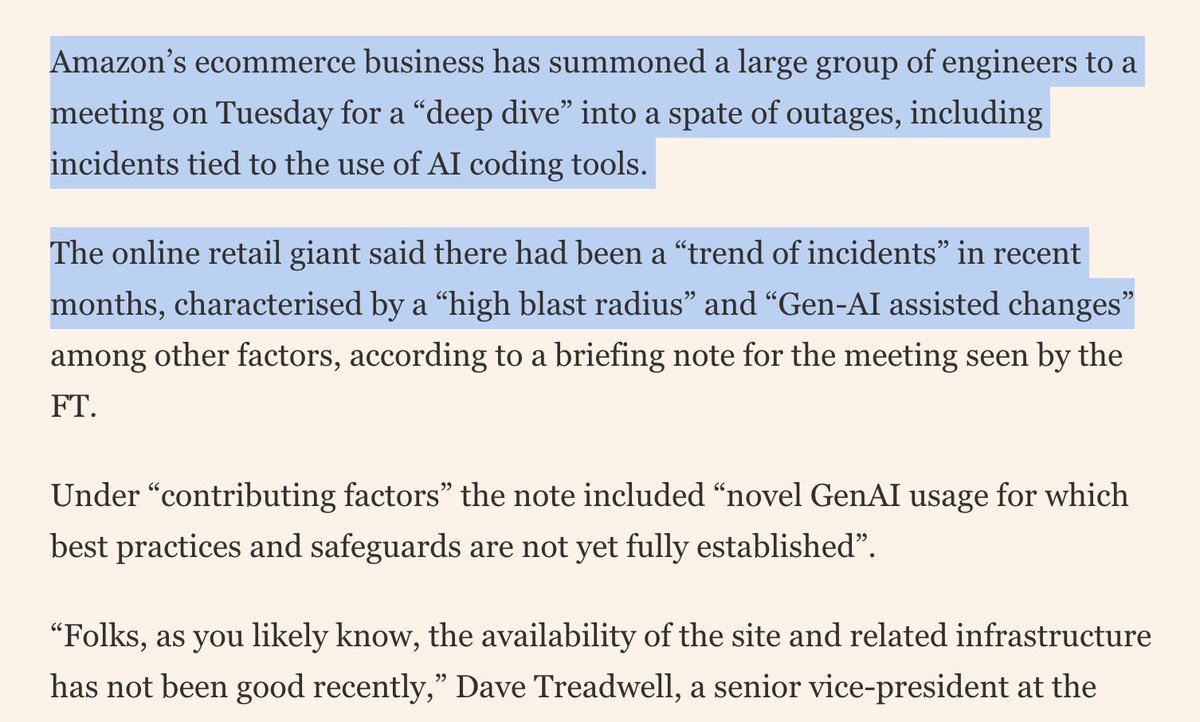
Amazon is holding a mandatory meeting about AI breaking its systems. The official framing is "part of normal business." The briefing note describes a trend of incidents with "high blast radius" caused by "Gen-AI assisted changes" for which "best practices and safeguards are not yet fully established." Translation to human language: we gave AI to engineers and things keep breaking?
The response for now? Junior and mid-level engineers can no longer push AI-assisted code without a senior signing off. AWS spent 13 hours recovering after its own AI coding tool, asked to make some changes, decided instead to delete and recreate the environment (the software equivalent of fixing a leaky tap by knocking down the wall). Amazon called that an "extremely limited event" (the affected tool served customers in mainland China).
Very soon there are going to be more AI agents than humans making transactions.
They can’t open a bank account, but they can own a crypto wallet. Think about it.
I accidentally discovered how to compress a month of research into 3 hours.
A founder at a YC company showed me his Claude setup. I thought he was just fast. Then I watched him build an entire go-to-market strategy for a market he'd never worked in before.
Here's exactly what he did:
First: he didn't ask Claude to "research the market."
He fed it 8 competitor landing pages, 3 earnings call transcripts, 12 customer reviews, and a Reddit thread of complaints.
Then he asked one question:
"What does every successful player in this market understand that their customers never say out loud?"
Not "summarize these." Not "analyze the competition."
The unspoken insight. The thing that takes founders 2 years of customer calls to figure out.
But the next part is what broke my brain.
He followed up with:
"Now show me the 3 assumptions this entire market is built on, and what would have to be true for each one to be wrong."
In 15 minutes he had the attack surface of an entire industry.
The blind spots. The fragile consensus. The opening nobody was talking about.
Most founders spend 6 months doing customer discovery just to find one of those.
Then he did something I've never seen before.
He asked:
"Write 5 questions a world-class investor would ask to destroy this business idea, then answer each one using only the evidence in these documents."
He spent the next 2 hours stress-testing every assumption. Every weak answer triggered a follow-up:
"What's the strongest version of this argument and where does it still break?"
By hour 3, he had a strategy deck that felt like it came from someone who'd spent a decade in the space.
The tool didn't change. The questions did.
Most people treat Claude like a faster Google.
These founders are using it like a thinking partner who has read everything and has no ego about being wrong.
The difference between 3 hours and 3 months isn't the amount of information.
It's knowing which questions actually matter.
@heyrimsha Woww thanks for sharing, it has been quite insightful to use these prompts and have a think along partner in further areas that I could think of
“You shouldn’t have to choose between safety and privacy. With Bitkey, you can have both.” - @max_guise, Bitkey Lead
With Chain Code Delegation, Bitkey is the first multi-sig wallet that gives you recovery and security without giving up your privacy.