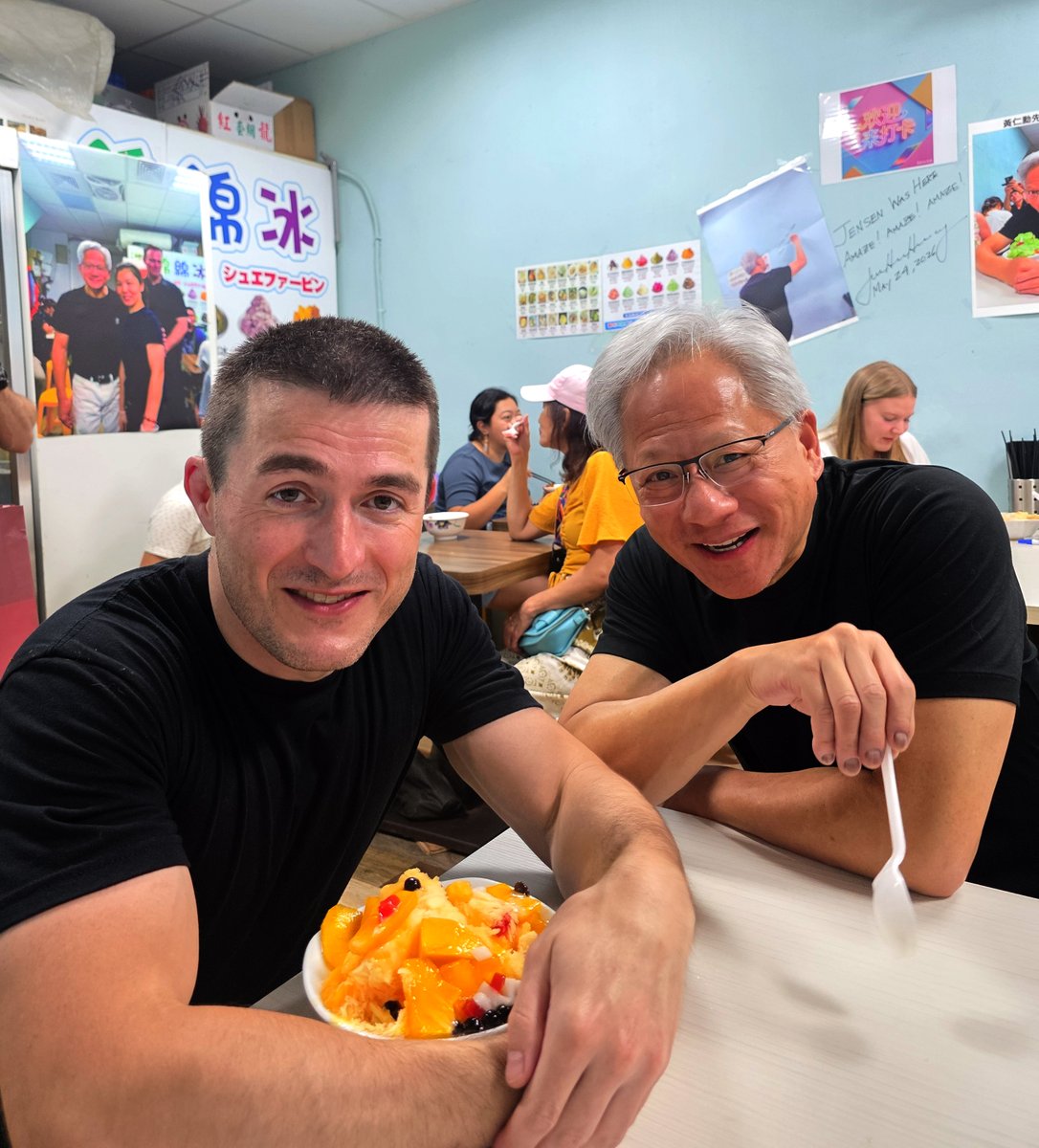
I got to spend all day today with Jensen in Taiwan: talking with thousands of engineers and eating street food at a night market. Jensen is received as a rockstar in Taiwan, like it's Beatles in the 60's. It's mind-blowing and fun to watch. But most importantly, through all the interactions and all my conversations with him, he remained the same humble, kind, thoughtful, funny guy he always was, even as a kid who went to these same night markets many years ago.
Btw, we tried a crazy amount of different street food. It's legit some of the most delicious food I've ever had. I can't wait to share video of it, including a ton of our conversations and hangout. When I can pause for a moment from all the travel to edit the video, I'll post it.
Can't wait to continue talking to Jensen and engineers at Computex this week, and exploring more of Taiwan, and of course roaming the night markets for some more delicious street food.
Days like these, even more than usual, I feel like the luckiest kid in the world.
Love you all! ❤️
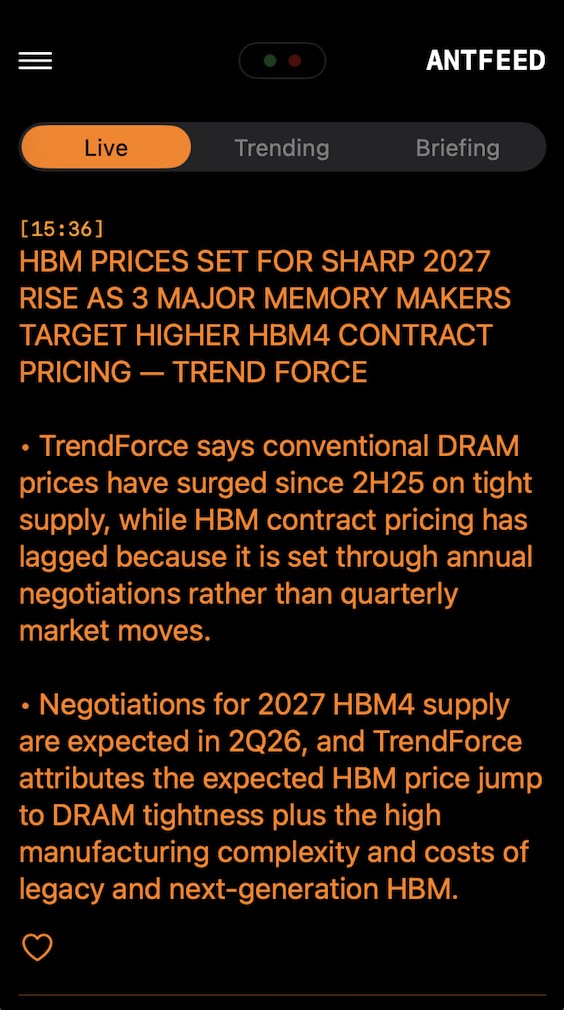
BREAKING: HBM prices set for sharp 2027 rise as three major memory makers target higher HBM4 contract pricing — TrendForce
TrendForce says conventional DRAM prices have already surged on tight supply, while HBM contract prices have lagged because they are negotiated annually.
With 2027 HBM4 talks expected in 2Q26, the next leg of the memory rally may come from HBM pricing catching up to DRAM tightness.
#HBM #HBM4 #DRAM #MemoryChips #AIChips #Samsung #SamsungElectronics #SKHynix #Micron #NVIDIA #TSMC #KoreaSemis #Semiconductors #Kospi #Kosdaq $KORU $DRAM $EWY
The most consequential event of an entire company’s history.
Got released today with a photonics player.
Making them the functional standard laser for CPO, Pluggables, and SiPH.
For companies like $NVDA, $AVGO, $AMD, to $MRVL using the foundry.
Does anyone know the name?
DID YOU LISTEN ANON?
Reuters: New Sivers x GFS strategic collaboration.
$SIVE has now announced its lasers will be integrated into reference designs built on Globalfoundries Silicon Photonics Platform.
For pluggable optical transcivers, CPO, and SiPH.
This is fundamentally the most groundbreaking news for Sivers in history.
As Broadcom, Nvidia, Marvell, AMD, and anyone who goes through GFS silicon photonics has Sivers embedded as a default laser route.
I personally think this news alone should easily 2x or 3x Sivers market cap over the medium term, given how fundamental this is to their revenue.
To have Sivers be the standard laser route for the many hyperscalers that use the world's leading photonics foundry.
One of many great conversations at #GTC Taipei 2026! SK Group Chairman Chey Tae-won and @NVIDIA CEO Jensen Huang connected at the @SKhynix booth, highlighting the collaboration driving the next chapter of AI.
Take a look at the moments from the show floor 📸
#SKhynix#NVIDIA
MediaTek at Goldman Sachs Taiwan Day:
“The next-generation program is adopting only EMIB-T, with tape-out targeted for 4Q26 and mass production by 4Q27.”
This is significantly different from what Taiwanese media had reported — that the next-generation program would use both CoWoS and EMIB-T in parallel.
$INTC
▶ Marvell CEO says copper wall is moving inside the rack, and copackaged optics is the only way through
• Marvell CEO Matt Murphy emphasized at Computex 2026 that the next bottleneck in AI infrastructure is not compute or memory but connectivity.
• The shift from copper to optical interconnect is already underway and is expected to trigger a large scale demand cycle within the semiconductor industry.
• He highlighted Marvell’s sophisticated engineering capability, integrating advanced CMOS DSP, fourth generation SiPh, and SiGe based broadband analog technology through its Coherent optical modules.
• Marvell’s first 102.4T switch dedicated to AI data centers, the Teralynx T100, is built on a 3nm process, draws under 1,000W, and delivers up to 25% lower power than competing solutions.
• The T100 routes signals through copper traces on the PCB to optical modules on the front panel, whereas a CPO switch connects optical fiber directly to the package and removes copper wiring entirely.
• The reach of copper cable is inversely proportional to bandwidth: at 100Gbps per lane it can carry signals about 5m, but at 200Gbps this shortens to roughly 2.5m, and at 400Gbps copper can no longer make connections even within the rack.
• Each time the “copper wall” moves one step, the number of connections that must shift to optical increases at least tenfold, which is expected to drive explosive demand across the optics industry, and the Taiwan supply chain is already expanding to respond.
• The number of connections inside a rack is roughly ten times the number of connections between racks, so conventional pluggable optical modules alone cannot address the power and space limits; CPO solves the connectivity problem by integrating the optical engine directly into the switch and compute package.
• Nvidia’s Vera Rubin platform has already adopted Spectrum-X Ethernet Photonics, the first CPO based switch to enter mass production, a case showing that the CPO transition has moved beyond proof of concept into actual commercialization.
• As optical connectivity extends into the server itself, compute, memory, and network resources can be disaggregated and dynamically configured per workload, enabling a shift from a fixed server architecture toward operating the entire data center as a single integrated system.
• He stressed that the CPO transition is impossible without Taiwan’s manufacturing ecosystem, explaining that Marvell has accumulated high volume PAM4 production experience, field data, and supply chain infrastructure including ASE.
• Over the past decade Marvell has invested a total of $36 billion to acquire companies such as Inphi, Cavium, and Celestial AI, expanding its connectivity portfolio.
• He emphasized that Marvell is the only company able to address the full connectivity stack of an AI data center, from millimeter scale inside the package to kilometer scale between data centers.
$MRVL
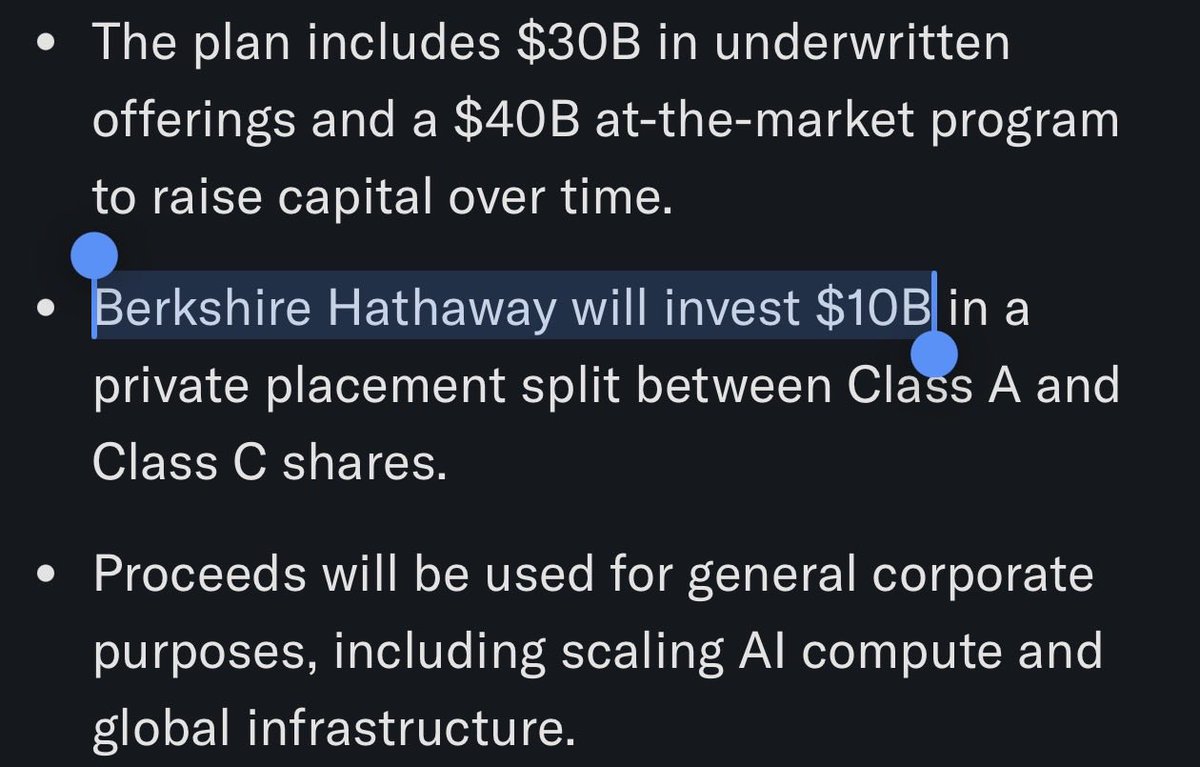
I never thought I’d see the day where $GOOGL needs to raise $80b for AI capex…
Then Warren Buffet’s $BRK.A is funding the hyperscaler AI buildout.
- $40B ATM, $30B offerings, Berkshire $10B
Upstream ecosystem from $LITE to $AVGO to Mediatek to $TSM to $MU should go brrr.
Not sure if the Google holders are though, given this massive capex scale isn’t as funded by FCF.
Let’s be honest
The AI Earnings Super‑Cycle Has Arrived
First Dell and now HPE are telling investors the same thing: the AI earnings super‑cycle is no longer theoretical, it has arrived, and S&P 500 numbers are still too low. HPE is now guiding fiscal 2026 non‑GAAP EPS to roughly 3.35–3.45 dollars and free cash flow to at least 3.5 billion dollars—levels it had previously targeted for 2028—on the back of nearly 30–plus percent revenue growth and more than 70 percent networking growth this year. Dell, meanwhile, has turned into an AI systems pure play, with AI‑optimized server revenue exploding, a multi‑year backlog measured in tens of billions, and management now talking about AI server revenue running toward 50 billion dollars as data‑center capex accelerates rather than fades.
This is what an earnings super‑cycle looks like in practice: the core infrastructure providers are pulling multi‑year profit curves forward because AI demand is compounding from a high base, not rolling over. Scarcity in GPUs, power, networking, and physical capacity means the constraint is supply, not demand, and that in turn is forcing customers into larger, longer‑dated contracts to secure AI infrastructure years out. Ignore the noise about quarterly “AI capex deceleration.” First Dell, now HPE: the message is that the AI build‑out is accelerating, hardening into long‑term commitments, and dragging index‑level earnings power higher and faster than the current S&P 500 forecasts are willing to admit.
$Dell $HPE $NVDA
This is absolutely incredible.
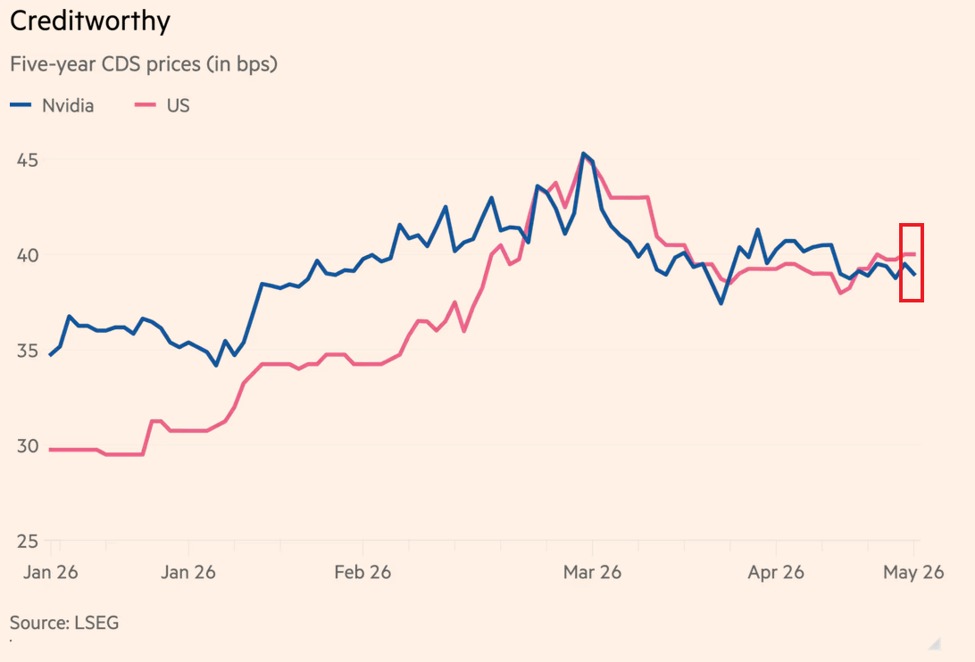
Investors now perceive Nvidia to be as creditworthy as the US government.
Nvidia's $NVDA, 5-year credit default swap (CDS) is trading at ~38 basis points, slightly below the US sovereign CDS, at 40 basis points.
In other words, markets consider the world's largest company to be less likely to default on its obligations than the US federal government.
This comes as in FY2026, Nvidia carried only ~$8.5 billion in total debt against ~$10.6 billion in cash and generated nearly $100 billion in free cash flow, giving it one of the strongest balance sheets of any company in the world.
Even if Nvidia's earnings dropped -90%, it would still rank among the 100 most profitable companies in the world.
Markets are treating Nvidia as one of the safest companies on the planet.