Spending tokens blind drains your whole budget
Tokdash v2.7.0 shipped Oct 24.
8 open-source GitHub repos for tracking token spend and capping agent budgets:
22.8k stars as of Oct 24. MIT and Apache-2.0. Pushed Oct 19–24.
MEASURE THE BURN
01. codeburn ★11.6k
▸ https://t.co/7JqpqGxGTI
→ spend by model, project, task
02. tokscale ★5.7k
▸ https://t.co/jUNpRpda2X
→ token and cost CLI across agents
03. Tokdash ★87
▸ https://t.co/orOp04Ma9l
→ local dashboard with quota resets
PRICE EACH CALL
04. genai-prices ★401
▸ https://t.co/vo7yQUpoAr
→ price table for LLM calls
CAP THE SPEND
05. floe-guard ★347
▸ https://t.co/mJ5dgXB9fV
→ hard stop before budget ceiling
06. cycles-server ★5
▸ https://t.co/tX6YrMkcs7
→ reserve budget before agent acts
07. ai-gateway ★2.3k
▸ https://t.co/GVfqDcSYpN
→ quotas and attribution at gateway
08. openmeter ★2.4k
▸ https://t.co/cd7PQmrRwB
→ usage metering and enforcement
pip install floe-guard
from floe_guard import BudgetGuard
guard = BudgetGuard(limit_usd=5.00)
the stack:
logs → count → price → guard → reserve → quota → meter
Wrong ceiling stops a live agent.
Not the model. The blind spend around it.
Full cost stack in the terminal ↓
WHOEVER LEAKED THIS JEV SIGNAL CASCADE SHOULD BE RUNNING THE FABRIC
I thought routing an agent's packets meant one queue, one worker, and a retry loop that eventually drops the slowest ones.
Apparently not.
This cascade's setup is much more interesting:
→ INGEST pushes every packet into one of 16 typed channels by hashing its state, 1.25k packets per second per lane, no polling anywhere
→ ROUTE selects the target lane deterministically from the hash, every select logged with the packet id, no "pick whichever queue is shortest" guess
→ MERGE syncs packets back on their emit event across lanes, p99 under 0.42ms, no cross-lane bleed on retry
→ RETURN re-hashes the packet state when it comes back from a node, commits to the trace, never trusts a mutable field
→ NODE LOAD surfaces per-node pressure in percent (ingest 65, merge 63, return 33), flags 7 lanes drifting above baseline with 2,260 drops and 0 lost this run
so you get:
Packets typed. Lanes selected. Merges synced. Returns hashed.
the interesting part isn't widening the pipe.
it's giving every packet a lane the router can't guess around.
Instead of one queue chewing packets at best-effort pace, you route across 16 lanes in parallel at 0.35ms per hop, p99 under half a millisecond, 2,260 drops accounted for and nothing lost.
Hash the state. Route the lane. Commit the trace.
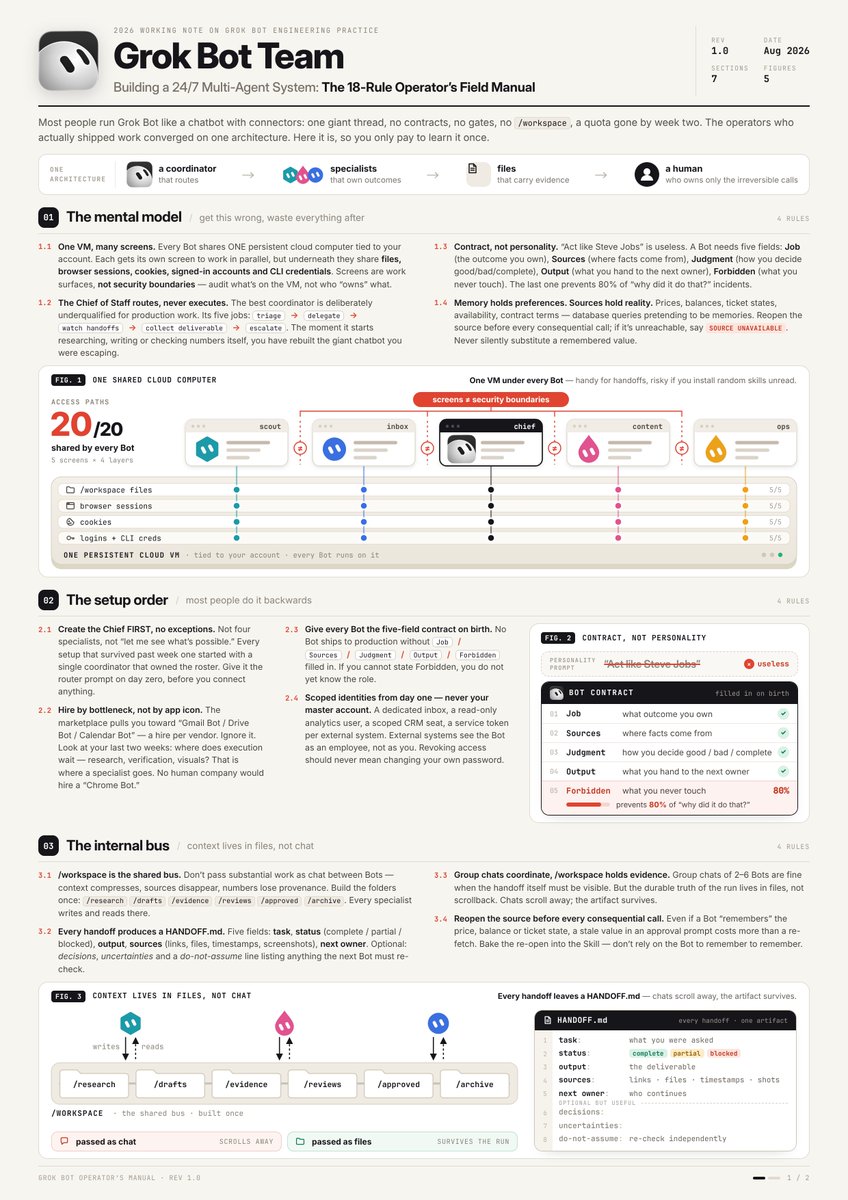
spacexai team just released a 2-page operator manual for turning grok bot into a multi-agent system that handles entire workflows 24/7
the idea - instead of prompting one bot task by task, you set up a chief + specialist teams that fully own entire workflows
here is the 7-step grok bot playbook:
step 1 - mental model → one persistent cloud computer, multiple bot screens, shared files, browser sessions, credentials and /workspace underneath
step 2 - setup order → create the chief first - it does not do the work, it routes → delegates → monitors handoffs → collects outputs → escalates
step 3 - internal bus → stop passing important context through chat - research, drafts, evidence, decisions and handoffs live inside /workspace so any bot can pick up exactly where another left off
step 4 - specialist teams → split content, intelligence, ops, research and coding across separate bots while one chief coordinates the whole thing
step 5 - automation → every serious workflow gets 3 gates: source gate → evidence gate → action gate - bots keep running until something actually requires human approval
step 6 - trust layer → let bots research, draft, summarize, reconcile, verify and queue on their own - humans approve only money, publishing, deletion, signatures and irreversible external actions
step 7 - expensive lessons → constant polling burns quota, syncing everything wastes usage, bad retries duplicate actions, undocumented internals break, and too many bots can actually slow the system down
the result - grok bot stops being a chatbot and becomes a full ai team running 24/7 - every workflow has an owner, every handoff leaves evidence, and humans only step in when judgment or approval is needed
read this before spinning up another grok bot - it covers the 18 rules, multi-agent architecture, handoff system, approval layer and automation model most agent tutorials skip entirely
bookmark it and build your own grok bot team from the full breakdown below 👇