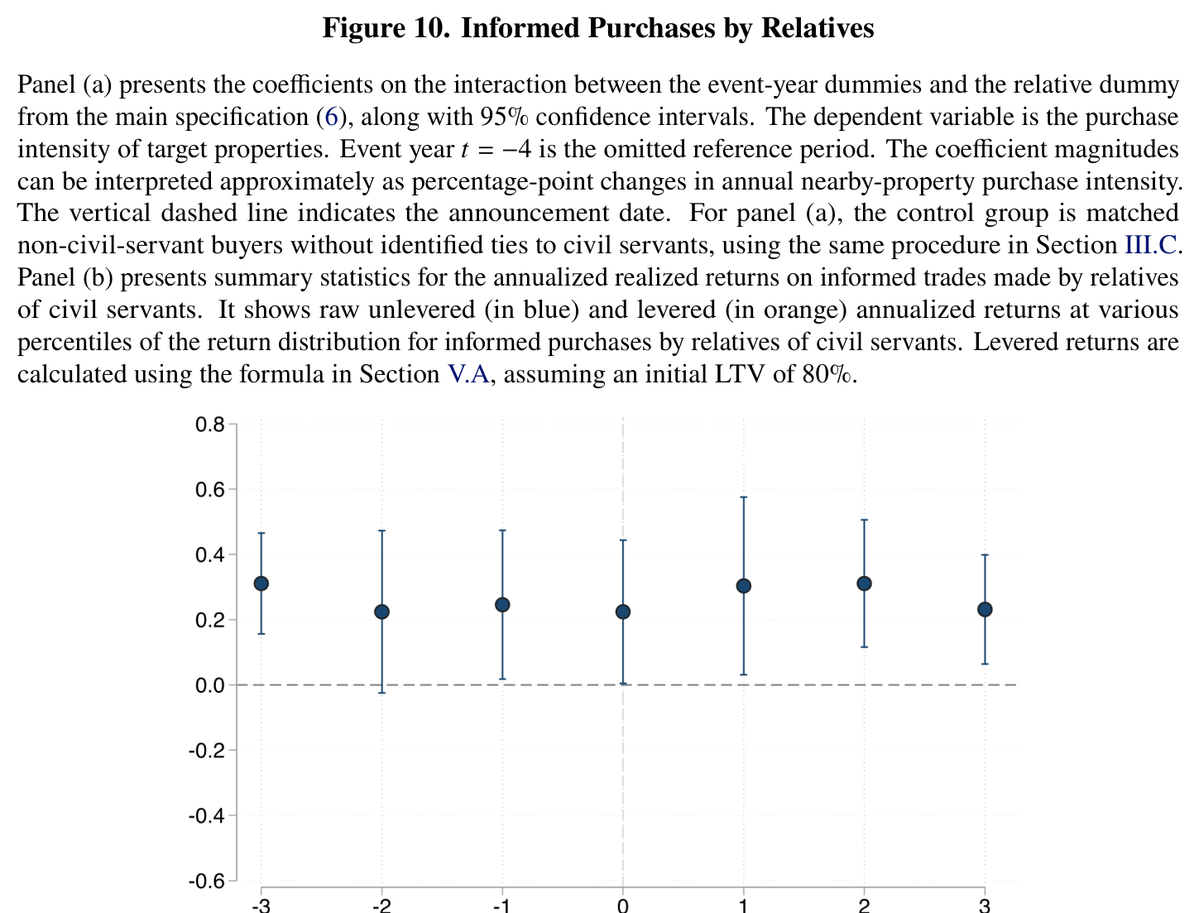
Fui ler o paper do NBER que tá sacudindo Singapura. Pesquisadores de Stanford e Columbia usaram IA pra varrer TODAS as transações imobiliárias do país entre 1995 e 2019 e cruzaram com o cadastro de 141 mil servidores públicos.
Funcionários compravam imóveis perto de futuras estações de metrô 1-2 anos ANTES do anúncio oficial. 60% acima da taxa normal. Não pagavam mais caro na compra, mas revendiam com retorno de 12% ao ano. Os parentes faziam a mesma coisa. S$270 milhões no total.
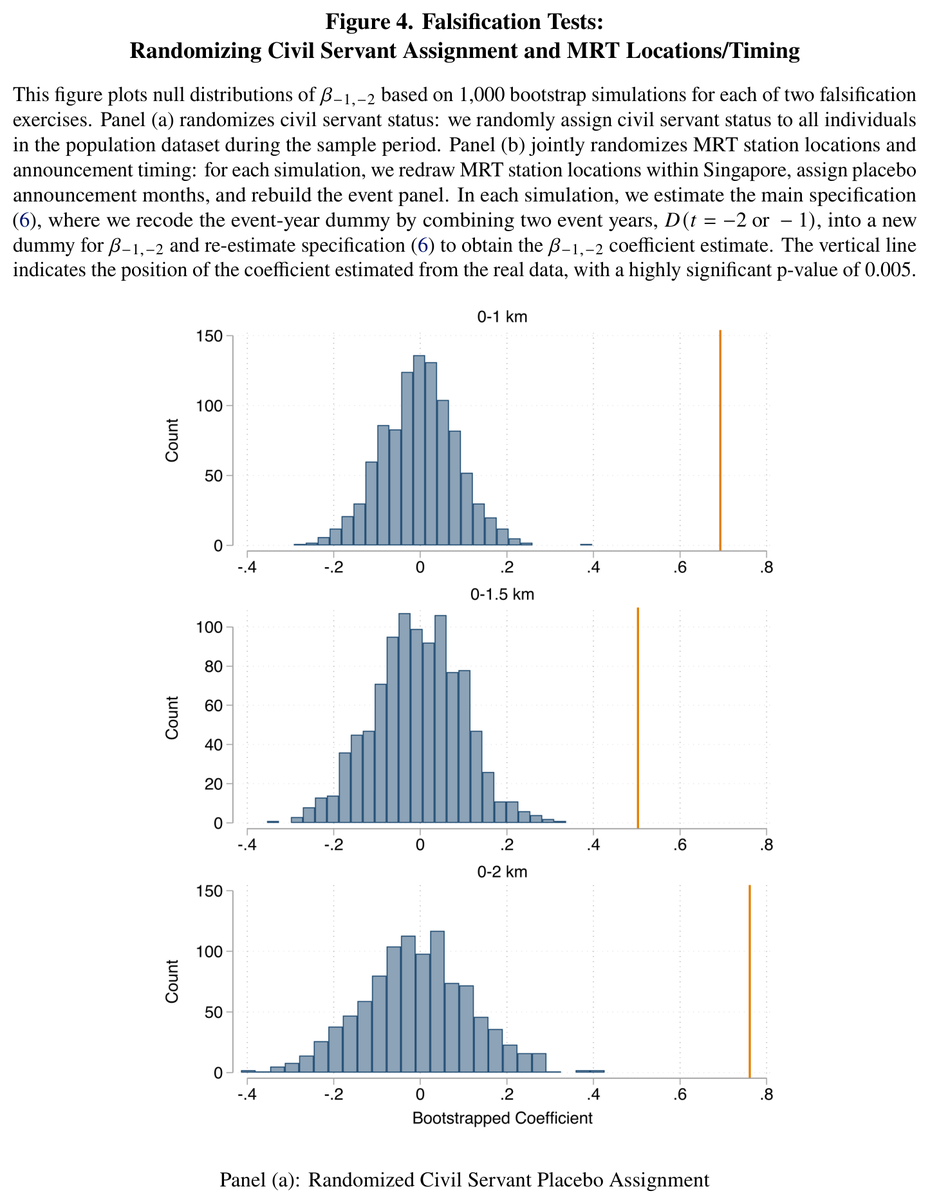
Pra descartar que fossem só mais espertos, compararam com corretores de imóveis e diretores de empresa. Nenhum dos dois mostrou o mesmo padrão. Rodaram 1.000 simulações aleatórias e o efeito real ficou totalmente fora da distribuição.
Quem mais operava? Gerentes médios do planejamento de transporte. Cargo suficiente pra saber, baixo o bastante pra ninguém olhar.
Em 2012, Singapura apertou a fiscalização com novas leis e punição de casos de alto escalão. O padrão sumiu, dos funcionários e dos parentes.
Singapura é top 5 em transparência no mundo. Norma social sozinha não segurou.
fonte: NBER WP 35756
"I changed the perception of market from a battlefield into an ocean. I changed my self-image from a rookie soldier to a fisherman."
- Mike Bellafiore, in The PlayBook
This is one the most quietly powerful things I've read about trading.
Very similar to Mike's writing, for the initial years I approached the market like a fight. A me versus them mentality. Me versus the institutions. Me versus whoever was on the other side of my trade. Every loss was thus a defeat for me. Every win was a conquest. And it was exhausting, because it sucked the joy out of the process often.
When I reflected on this line years ago, it helped me shift my mindset.
I realized, a fisherman doesn't fight the ocean. He studies it. He learns the tides, the currents, where the fish gather at certain times of day and year. He goes out with his equipment, drops his line, and waits. Some days the catch is good. Some days it isn't. He doesn't take it personally. He doesn't rage at the water just because he didn't catch a fish that day.
Similarly, the ocean isn't really trying to hurt him. It's just indifferent to the fisherman. And that indifference, once you realize it and accept it, is actually one of the most freeing things in trading.
The market isn't your enemy. It's just the ocean. Learn its rhythms, show up prepared, and fish.
A reminder from The Subtle Art of Not Giving a F*ck by Mark Manson:
“Happiness comes from solving problems. The keyword here is "solving." If you're avoiding your problems or feel like you don't have any problems, then you're going to make yourself miserable. If you feel like you have problems that you can't solve, you will likewise make yourself miserable. The secret sauce is in the solving of the problems, not in not having problems in the first place. To be happy we need something to solve. Happiness is therefore a form of action; it's an activity.”
@thsottiaux one thing i've learnt going through a few days of cold turkey is using ChatGPT web and working through my config.toml & agents.md to use cheaper models, leaving Sol High for more challenging tasks.
From Sol's release my reasoning effort went from xhigh to high and now medium
Your brain will always adapt to your repeated behaviors; that's why you should never expect a sudden cure for your bad habits. The only way to improve your quality of life in the long term is to repeat difficult and fulfilling activities, even if they're less exciting than your bad habits at first. Over time, your brain will adapt, and the cycle of dependence will be broken. No other way around this. Do the right things and do them often. It's the most efficient boring solution out there.
Now that everyone has access to the whole accumulated knowledge of mankind, and could in theory easily learn everything they need to know in order to become their best and happiest selves, it's going to become obvious as most people don't change that the problem was never access to knowledge, but intellectual curiosity, good taste when it comes to what they choose to learn, and self-respect when it comes to how they spend their free time.
🚨 Stephen Miller just WENT OFF on the vaccine schedule being FORCED on American children
"We have to get off of this RIDICULOUS path of having our children get 70 to 90 shots. That is WANTONLY EXCESSIVE."
"The pressure from the pharmaceutical industry and from aspects of the medical industry to pump your kids full of shots DAYS AFTER BIRTH with NO understanding of the long term consequences has been a medical TRAVESTY."
"Why is it that in Japan you can get a separate measles shot, a separate mumps shot, a separate rubella shot, but in America, it has to all be packaged together?" 🎯
🚨 IT'S OFFICIAL: By the stroke of pen and flanked by RFK Jr., President Trump establishes a new US vaccine schedule that decreases the number of jabs from 72 to 11 — and spreads them out over multiple visits, rather than pumping the child all at once
"That's a big one in my book!"
MAHA is alive and well! 🇺🇸
Earth is still bound to the Late Cenozoic Ice Age, and our planet's average global temperature still hovers around a very livable 15°C.
This is far below the world's long-term planetary average of 18°C to 24°C - seen throughout most of Earth's biological history. It makes the idea of a global warming crisis seem out of sync with reality.
Despite four decades of continuous climate alarmism, roughly 10% of the Earth's total land area remains permanently capped by glacial ice, which covers 15 million square kilometers (5.8 million square miles).
That is nearly a third of its extent during the peak of the Last Glacial Maximum (26,000 to 19,000 years ago), when continental ice sheets reached their historical zenith.
The Antarctic ice sheet remains the largest and thickest body of ice on the planet, extending up to 4.8 kilometers (about 3 miles) deep. It holds roughly 90% of global ice volume and accounts for 85% of total glacial land cover. Spanning 14 million square kilometers (5.4 million square miles), Antarctica alone makes up 8.3% of Earth's total land surface.
A basic geographical reality is often forgotten: land comprises a mere 28% of the planet's surface. All human cities, towns, and infrastructure combined occupy just 1% to 3% of that land (while deserts take up 33% and forests 31%).
We live on an ocean world, and waters cover 72% of the globe to an average depth of 2.3 miles.
Crucially, the oceans hold 86% of the global carbon reservoir and absorb over 90% of retained thermal energy. By contrast, the atmosphere holds a fraction of a percent of each. The oceans—not human industrial activity—serve as the true long-term regulatory engine for atmospheric carbon dioxide and global climate stability.
The current Quaternary Glaciation is part of an ice age cycle that began 34 million years ago with the thermal isolation and glaciation of Antarctica, later intensified by the closure of the Isthmus of Panama and orbital variations (Milankovitch cycles).
Carbon dioxide was not the driver of these immense shifts.
All of human civilisation, agriculture and technological progress has unfolded within a brief, warm respite: the Holocene interglacial period, which began just 11,700 years ago.
Yet for 40 years, the narrative has been dominated by a campaign driven by an unaccountable bureaucratic authority—the United Nations—pushing an agenda of global control.
The promised catastrophe of runaway, unprecedented warming never arrived.
After all the defamation, threats, and insults...
US Cancer Data Just Dropped
Will there be even one single apology?
Will allies acknowledge this?
Will they remember we showed this mid-2021?