Following 2 mouse models with #purkinje cell #degeneration, we found that different patterns of symptomatic progression in #gait#ataxia. This suggests that gait ataxia is not a gradual process, but follows stages dependent on the underlying pathology. https://t.co/z9d8fcCHjQ
Are you interested in the #brain? 🧠Visit the #brainawarenessweek2023! We will be open tomorrow (Saturday) between 2 and 4 pm @ Nieuwemarkt 1A, Rotterdam. Join us for workshops, quizzes and an exposition! Entrance is free. 🙂
https://t.co/X5gKBzOqop
What are whiskers for? How do they work? And what can we learn from them? With the help of some porcupines and @BBCIdeas, here are five things you never knew about whiskers:
#whisking and #respiration are tightly coupled. This is one of the many reasons to better understand #neural#control of respiration.
With @krohn_krohn, @ManueleNovello, Ruben van der Giessen, Chris De Zeeuw, Johan Pel and @lwjbosman today in @eLife:
https://t.co/ET5ERgxJfv
💙🦭WHISKER WEEKEND🦭💙
Ever wondered how a seal uses their whiskers?... 🤔
Learn how our seals are contributing to science through the use of their wonderful whiskers! 🦭
Come and join us for Seal stories, whisker wonders and mask making! 😁🥳
Open 10am 💙
@MatteoCarandini As administrator of this account, I migrated myself to Mastodon (@[email protected]). Still considering whether to move the lab account as well. What did you do? I noticed more European than American people on Mastodon, but that might be my bubble.
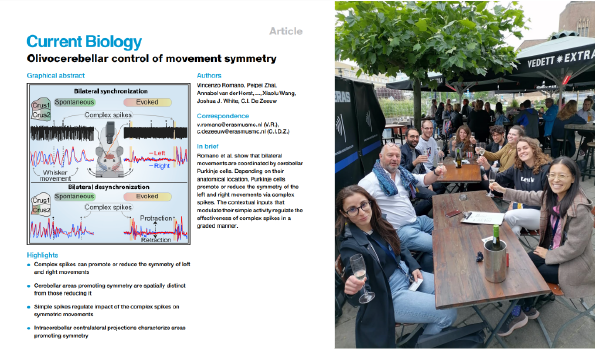
Just out from our friends and neighbors: how the #cerebellum can contribute to left/right coordination of mouse #whisker#movements. If you have spare time: read it! And if not, try to make time to read it.
Purkinje cells in the #cerebellum can change the #sensory modality they are responsive to, when the context requires so. They adapt to subjective #salience and prepare to (re)act.
With Lorenzo Bina, @in_romano, @tmhoog and Chris De Zeeuw. https://t.co/KUOYRlLoJ3
1/3
My lab at the Case Western Reserve University SOM is recruiting a postdoc! Our goals are to extract the principles governing neural population activity in cerebral cortex and cerebellum, and to define how these principles enable skilled movement and break down in disease.