China is opening up internally.
For generations, the hukou system meant the average Chinese national couldn’t freely emigrate within China. Like being geolocked to New York and being unable to relocate to Texas.
China did this in part for social control, and in part to prevent huge floods of people from moving to big Chinese cities for jobs before the infrastructure was available.
But now development in China is so broad-based, and the infrastructure so reliable, that they are gradually opening the borders *within* China by letting everyone move around.
The Soviets also had a system of internal passports. But the new Chinese system is less similar to traditional communism, and more similar to the Schengen region for the EU, or the free migration between the fifty states within the US.
In many ways China is moving in the opposite direction from the West, by opening up visa-free travel to China for 50 countries, introducing the K visa for skilled migrants, and gradually shelving the hukou system.
The overall trend is towards more free (albeit still controlled) flows of capital and talent within China.
@HESaidADeni Deni should be in Tehran the moment Somaliland gets wider recognition.
Iran 🇮🇷 recognizes Puntland.
Declare secession, absolve parliament and return to sultante governance.
This would be the most wildest card for the BeM corridor.
🚨 THE WORLD RUNS THROUGH 8 STRAITS
Trade, Oil, LNG, Military power.
Key chokepoints:
• Malacca ~25% of global traded goods
• Hormuz ~25% of global oil, ~⅓ of LNG
• Singapore ~50% of global seaborne trade
• Gibraltar Atlantic ↔ Mediterranean
• Bosphorus Black Sea outlet
• Magellan Atlantic ↔ Pacific backup
• Bering Arctic gateway
• Bass Australian passage
These are pressure points.
Close Hormuz... Oil spikes.
Disrupt Malacca... Asia freezes.
Block Bosphorus... Black Sea trade halts.
Geopolitics isn’t abstract.
It’s maritime geometry.
#oott #commodity #trade
What if the world is more fragile than you could ever imagine?
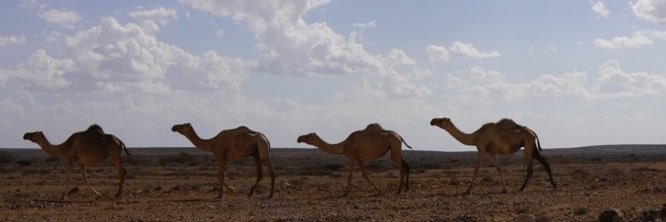
Farm land with camels, regenerative agriculture and many guns mights be a safe option. Especially in a third world country where the people have already been used to fasting and being on a OMAD-Nomad Diet.
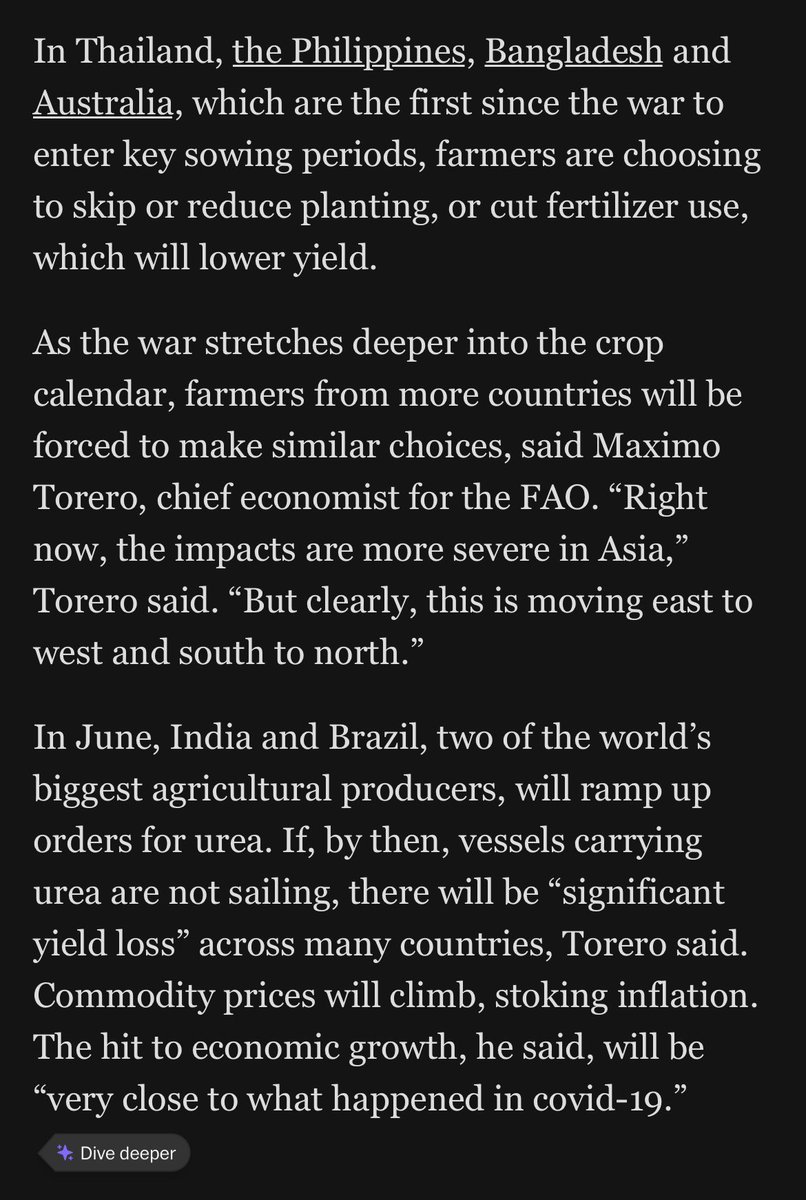
Thailand is one of the first ag countries to enter a planting season since the Iran war. We went to document the impact of supply shocks to fuel/fertilizer — It was worse than I anticipated.
Farmers are leaving huge tracts of land barren bc they can’t afford to plant.
The New Zealand fuel crisis rationing plan is not even a particularly radical one by contemporary standards. That is precisely what makes it worth scrutinising carefully.
It is the latest iteration of a governance model that has been quietly consolidating for decades: the state and large capital as co-administrators of the economy, with small business and the individual citizen positioned as residual claimants on whatever resources remain after the primary beneficiaries have been served.
Call it economic fascism, corporate statism, or crony capitalism — the label matters less than the mechanism. And the mechanism is, once again, hiding in plain sight inside a document described as emergency planning.
Full article below.
If these attacks are from anti-federalist collaborating with factions within Puntland. Then they failed to account for geography. Puntland is still a distinct entity on the Map 🗺️. I keep saying the world wants Puntland autonomous more than Puntlanders themselves.
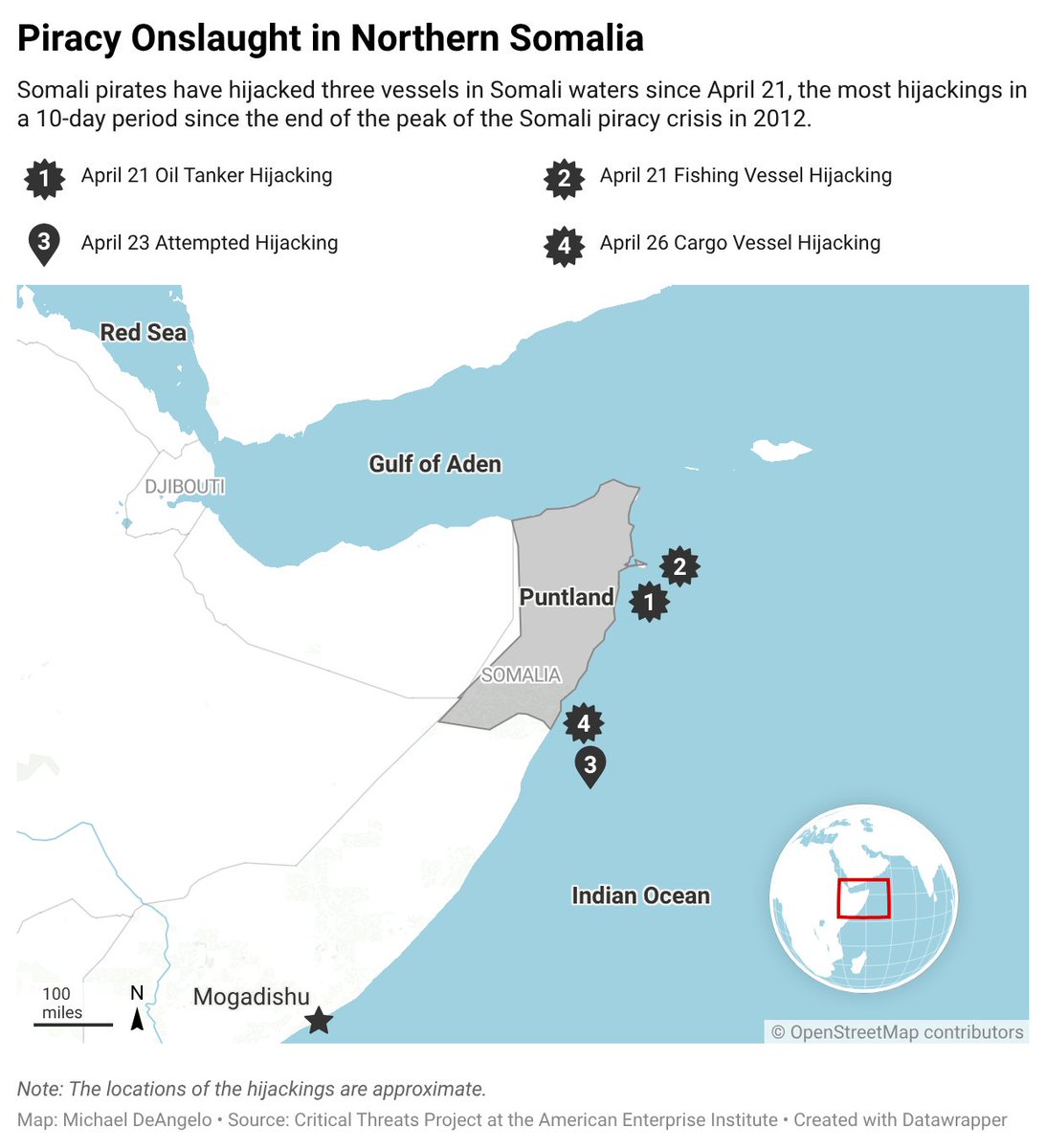
NEW | Somali pirates have conducted the most hijackings in Somali waters in a 10-day period since the end of the peak of the Somali piracy crisis in 2012.
Sustained piracy off the Somali coast would degrade security in another vital global shipping lane amid the fallout from the Iran war and create opportunities for al Shabaab to benefit financially and further its ties with the Houthis. 🧵⬇️
Tomas Masaryk said: “Dictators are rulers who always look good until the last 10 minutes.”
These phone calls made in 2011 by the Tunisian dictator as he fled the country to Saudi Arabia Arabia give that saying its true meaning. While he was minutes away from landing in Saudi Arabia for exile, he kept working the phones looking for evidence that things were good so he could return. Yet, his presidency was water under the bridge then. Even his own pilot disobeyed him in the end, Saudi became his permanent home till his death in 2019!
The thing is, most dictators don't even realise they are dictators. They think people love them genuinely - like they have no choice but to - that they’re, in fact, doing the people some favour no one else can do. In a way, they fee like they’re making a great sacrifice by being the rulers. Since elections are rigged, & independent polls don't exist, they even never realise that they are not popular with the masses. So, when power begins to slip away from their hands - as it always does eventually - they believe something will happen to bring it back to their hands - after all, they are God’s anointed person to lead over the ungrateful masses!
Hence, even as Amin fled the country, he kept giving the impression he was still in charge. Then there was the ridiculous press conference by Robert Mugabe after he was overthrown where he still sounded like the president, and called upon people to vote for the opposition candidate.
ISIS operation in Puntland was to end all sources of funding to the group including piracy. They are strategically supported by factions that want to undermine Puntlands autonomy, however this incident will offer Puntland more global interest and friends not less.
Strategic Piracy Discredits Puntland?
Honour 25 (IMO 1099735) is a Turkish linked oil carrier moving through one of the most politically contested maritime corridors in the Horn of Africa.
If Mogadishu and Turkey can present Puntland waters as unstable and pirate-infested, they gain a stronger argument for centralized outside-backed maritime control.
That weakens Puntland’s claim that it can manage its own coast.
So the piracy story serves a strategic purpose.
Ask yourself who gains from every maritime incident being reduced to the word “piracy”.
As Somali waters become more militarized and commercially valuable, the sea is turning into the new frontline in the struggle between Garowe, Mogadishu, and Ankara.
During covid two philosophically opposed neighbours ended up entering a grocery store with a mask.
If the Hormuz is closed and this war continues, those same two neighbours with philosophically opposed narratives about the war and Covid, will stand inline with jerrycans.
World War Walking 🚶🏽🚶🏽♂️🚶🏻♂️🚶🏼♂️🚶🏻♀️🚶🏼♀️.
Regardless of sloganeering or narrative building, the outcome of this war could mean global economic collapse.
I’m still bullish on Peace, Prosperity and Rule of law thriving in different pockets of the world.
“people who get these SNAP benefits can't use that money to buy chips. It means demand goes down for those foods because the government was subsidizing consumers to buy junk food.”
“What does Pepsi do in response to a decline in demand for its products? It lowers prices.”
“That's how the free market works. The government subsidized consumers to buy junk food by giving them money to pay for it. And so that allowed the companies that sell that type of food to charge higher prices. When the government reduces the subsidy that it provides. Now the companies have to cut their prices.”
“Well, if it works with junk food, it works the same way with everything. Everything the government subsidizes costs more as a direct result of the subsidy. Why is education so expensive, particularly colleges? Because the government subsidizes students to go to college.”
“The government arranges for guaranteed loans or directly finances low interest rate loans to make it easy for people to borrow money to pay for college. That means that colleges could charge more because their customers are getting money from the government to buy their product. What would happen if the government stopped doing that? The government stopped giving out grants and loans. Well, just what Pepsi did. They'd have to cut their prices because demand would go down.”
@PeterSchiff
🚨Why U.S. Refineries Still Rely on Middle Eastern Heavy Sour Crude ; And Why Sour Matters for Diesel:
Despite the shale boom making the United States the world’s largest crude oil producer, America remains a net importer of crude oil. In early 2026, U.S. refineries continue to import around 6.5 million barrels per day of foreign crude while exporting roughly 3.8 million, a structural gap driven not by overall volume, but by chemistry and refinery design.
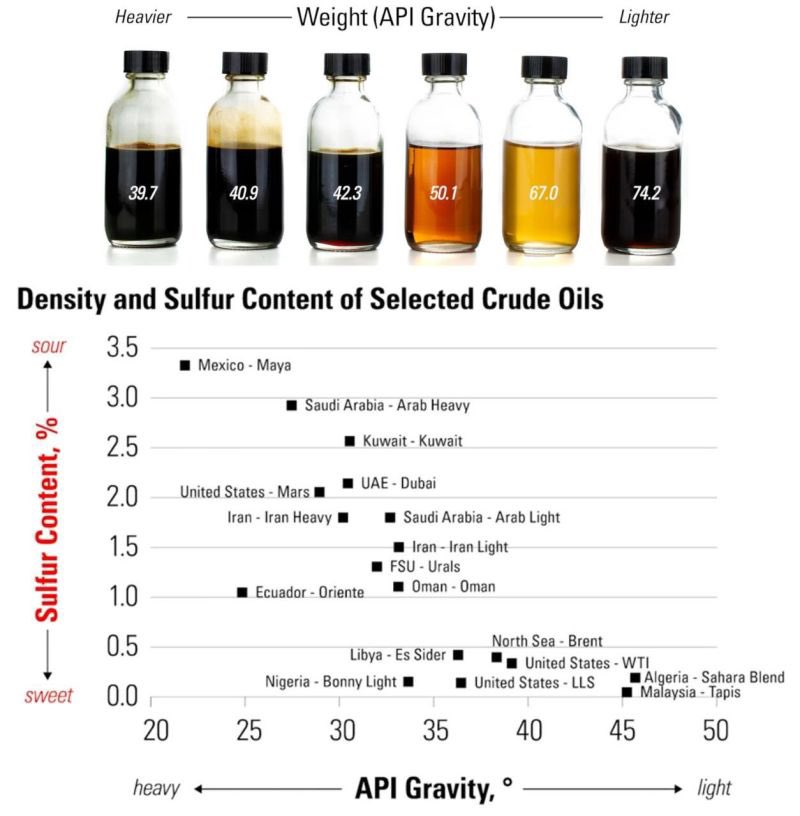
WTI light sweet crude, the benchmark from the Permian and other U.S. basins, is ideal for producing high yields of gasoline and jet fuel with minimal processing. It’s light (flows easily, high API gravity) and sweet (very low sulfur, typically under 0.5%). But most American refineries, particularly the complex Gulf Coast facilities that make up nearly 70% of U.S. capacity, were engineered decades ago to run on a blend that includes heavier, sour crudes from the Middle East, Canada, and Latin America.
⭕️Here’s where heavy sour crude becomes essential, especially for diesel production:
Heavy sour grades have higher density and significantly higher sulfur content (often >0.5%, sometimes much more). They contain more complex, longer hydrocarbon chains that end up in the “bottom of the barrel” during initial distillation. U.S. Gulf Coast refineries are equipped with advanced upgrading units, cokers, hydrocrackers, and hydrotreaters, precisely to break down these heavy residues and convert them into valuable middle distillates like diesel and jet fuel.
Sour crude’s sulfur must be removed through energy-intensive hydrodesulfurization (hydrotreating), a process that turns sulfur compounds into hydrogen sulfide for capture. This step is critical because modern environmental regulations demand ultra-low-sulfur diesel (ULSD) for cleaner combustion in trucks, ships, and heavy equipment. Without the heavy molecules from sour crude, and the sophisticated equipment designed to process them, refiners couldn’t maximize diesel output efficiently. Running pure light sweet WTI would leave expensive upgrading capacity underutilized, reduce overall yields of diesel, and hurt refinery margins.
In practice, about 90% of U.S. crude imports are heavier than domestic shale oil for exactly this reason: the blend optimizes the full product slate (gasoline + diesel + petrochemicals) while keeping costs competitive for American consumers and exporters.
Middle Eastern heavy sour barrels (from Saudi Arabia, Iraq, and others) remain strategically important not just for volume, but for the molecular profile that keeps the world’s largest refining system running at peak efficiency.
Disruptions to these supply chains, whether from geopolitical tensions or Hormuz risks, could force costly adjustments, lower diesel availability, and raise prices at the pump and for freight.
#OilMarkets #WTI #Diesel #EnergySecurity #USRefineries
It's good to see how Mogadishu still has a sizeable army and it's using it to fight A̶l̶-̶S̶h̶a̶b̶a̶b̶ ̶. Not really.
Actually, this force, reportedly including US-trained and Turkish-trained special forces, is marching towards a civil war against local government forces
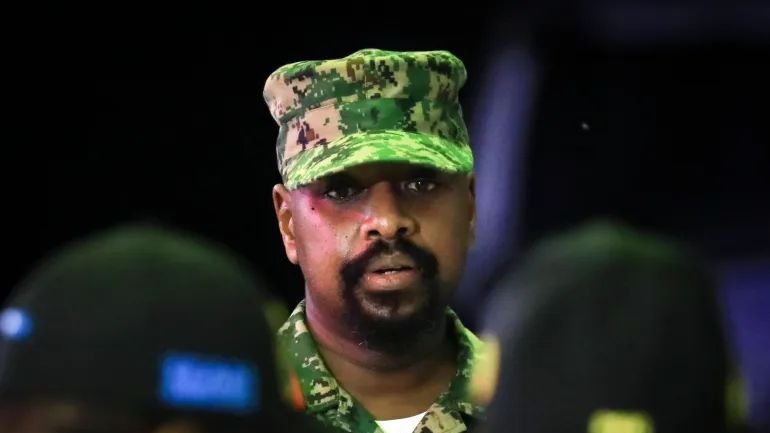
🇺🇬🇮🇱 Uganda's military chief says his country would enter the Iran war to defend Israel
Muhoozi Kainerugaba:
"Any talk of destroying or defeating Israel will bring us into the war.
On the side of Israel."
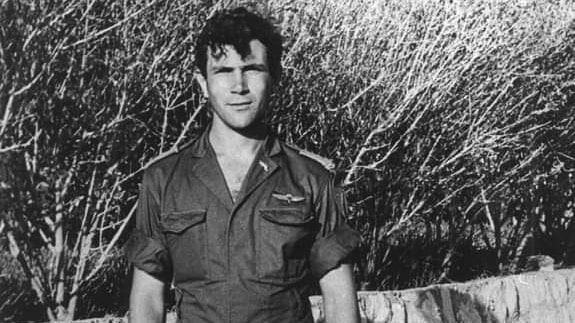
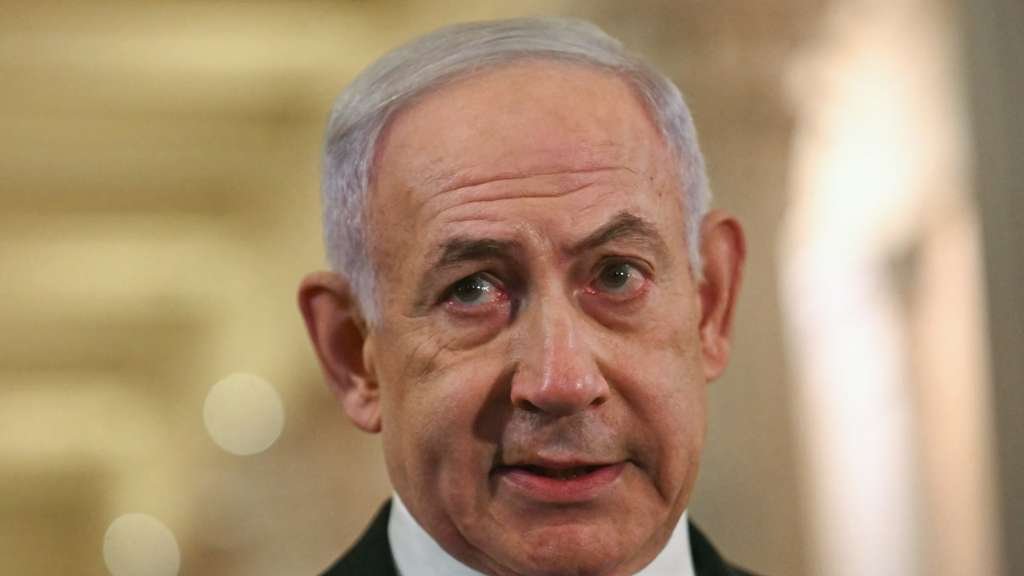
Uganda and Israel have a unique bond dating back to the 1976 Entebbe rescue, where Netanyahu's brother was killed leading the operation.
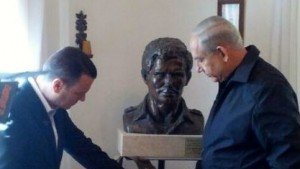
Last month, Uganda announced a statue in his honor.
Now the head of its military is publicly pledging to fight for Israel if the situation deteriorates.
The coalition of countries being pulled into this conflict's orbit keeps growing in the most unexpected directions...
Source: TOI
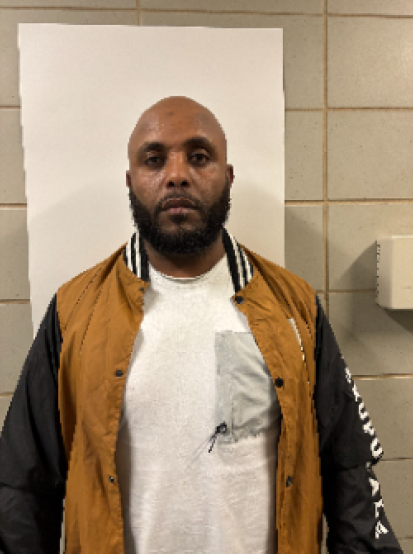
ETHIOPIAN HUMAN RIGHTS VIOLATOR, PARAMILITARY MEMBER & GENOCIDE INFLUENCER DEPORTED
Criminal illegal alien Solomon Bogale was denied immigration benefits and ultimately deported to Ethiopia March 5 by our Phoenix officers after ICE discovered numerous social media accounts where he openly identified himself as a member of Fano, a Tier III terrorist group.
Bogale’s posts called for persecution and violence against Tigrayans by “cleansing” them from Ethiopia.
Since 2003, ICE’s HSI-led Human Rights Violators and War Crimes Center has deported 1,178 known or suspected human rights violators and war criminals.
President Shavkat #Mirziyoyev visited the newly rebuilt Imam Bukhari Complex, where tribute was paid to the blessed memory of the great scholar.
The complex stands as a symbol of profound respect for Imam Bukhari’s legacy and our nation’s rich spiritual heritage.