Wrecking ball in your browser. Move it with your hand, all built by GPT-4.1 using MediaPipe and Matter.js.
GPT-4.1 is my favorite OpenAI model for creating such demos, and now that it’s rolled out in ChatGPT, I can keep experimenting.
My son going full QA mode on the demo.👨💻
@OpenAIDevs@edwinarbus
Continuing my experiments with Gemini 2.5 Pro. This time the idea came from my kid’s holiday homework. 😅
He got an image of a 30-Day Reading Challenge and I thought, why not turn it into an interactive app?
So I showed the image to Gemini and asked it to build a web app designed for young readers (ages 7 to 12).
The result is a fun 30-Day Reading Challenge app where kids can:
✅ Flip through daily reading tasks on bright, colorful cards
✅ Get age-appropriate book suggestions and examples
✅ Mark each challenge as complete
✅ Search for books online directly from the suggestions pop-up
Built with @GeminiApp. You can click Copy Canvas to build on top of it.
Just tweaked the prompt a bit, and now it recognises the book you're pointing at and gives a ultra short summary of its content. Such a cool experiment @tinaz0ne
In India, March is synonymous with exam season, and so I built a Study Assistant for my kid—thanks to @Gradio and Gemini 2.0 Flash.
Why Gradio?
• No complex UI coding! With just a few lines of Python, I could create an interactive chatbot that offers features like chat history, image uploads (for questions about pictures, charts, and diagrams), and a notepad for quick study notes.
Powered by Gemini 2.0 Flash
• Multilingual support - for Hindi
• Real-time Google Search Integration for current affairs and fact-checking.
• Kid-friendly—it filters out distractions like gaming and social media topics.
Will share the code along with a blogpost soon.
@_akhaliq@abidlabs@OfficialLoganK
Grok3: One shot simulation of water molecule
Done with both Grok3 and GPT 4o updated(next tweet)
Prompt: Create an interactive simulation that shows water molecules forming and breaking hydrogen bonds. The visualization should depict molecular motion, with oxygen in white and hydrogen in red. A temperature slider should control movement speed and bond stability. Use HTML, CSS, and JavaScript in a single file for real-time interaction
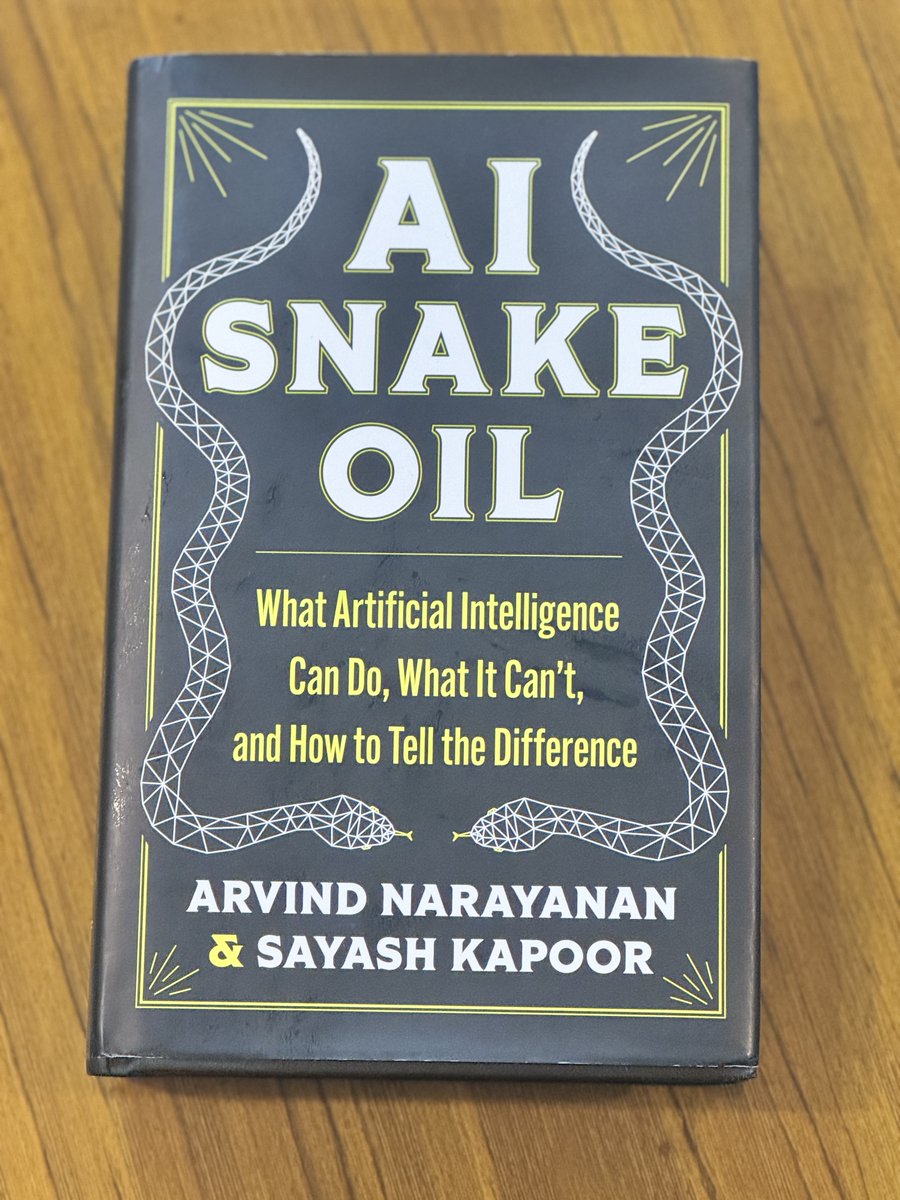
Just got my copy of the AI Snake Oil by @random_walker and @sayashk . I had been eagerly waiting for this one, especially as a subscriber to their newsletter. As expected, the content is solid, and the writing style is super engaging.
♥️ this line from the book :
"We need to be able to separate the wheat from the chaff if we are to make full use of what AI has to offer while protecting ourselves from its possible harms."
Machine Learning Street Talk has been dropping some seriously cool interviews back-to-back which I’ll highly recommend:
1️⃣ Prof. @rao2z spilling the tea on ChatGPT’s reasoning skills (or lack thereof).
2️⃣ @sayashk on AI existential risk and government policy
3️⃣ @sarahookr discussing two crucial topics:
• a) Why measuring AI risk by raw compute power (FLOPs) is overly simplistic. Spoiler: It's far more nuanced than that.
•b) “The AI Language Gap” — aka why our AI assistants are English snobs and the implications for global AI accessibility.
Props to @MLStreetTalk for these insightful interviews.
📺 : https://t.co/mK2auDSEde
The inaugural @iclr_conf Test-of-Time Award has been presented to "Auto-Encoding Variational Bayes" by @Kingma & @wellingmax.
The runner-up is the seminal paper "Intriguing Properties of Neural Networks" by @ChrSzegedy et al., which revealed neural networks' vulnerabilities to slight input modifications, paving the way for research on adversarial attacks and defenses.
Interestingly, if you recall the paper - Distributed Representations of Words and Phrases and their Compositionality" by Tomas Mikolov et al, won the NeurIPS 2023 Test of Time Award for introducing word2vec and advancing natural language processing.
A fascinating connection across these seminal works is the presence of Ilya Sutskever (@ilyasut ) as a co-author on both the ICLR 24 runner-up and the NeurIPS 2023 award-winning paper 👏
This article is based on the excellent paper by @AounonK and @hima_lakkaraju titled Manipulating Large Language Models to Increase Product Visibility. The article combines my notes from the paper along with my thoughts on the topic.
Here is a link to the article without the paywall: https://t.co/qdW5tdNgv2
This is a very good introduction to LLM security by @KleiberIngo.
It covers the following:
🤖 What LLMs are
🔒 Common security issues related to LLMs
🛡️ What LLM red teaming is
⚔️ Basic attacks against LLMs
https://t.co/GADjLXvmNb
Incase you are interested in using @h2oai H2O Automl, here is a curated list of all the awesome projects, applications, research, tutorials, courses and books that use H2O - https://t.co/XJNiE49jWM
🔥 The latest edition of My newsletter is out! 🔥 Some of the highlights are:
🪲 Zero-click worms targeting GenAI-powered applications
⚖️ Innovative frameworks for surfacing health equity harms in large language models
🌐 A novel browser extension to combat misinformation
🧑💻 Human-centered design in explainable AI interfaces
🎯 Defensive strategies against attacks on large language models
🔐 The red team philosophy at NVIDIA
🔍 Examination of LAION-5B,
📈 LLM benchmark and more
Link: https://t.co/VH5InGRxl7
The latest edition of my newsletter - Breaking the Jargons(BTJ) is out.
This week's newsletter explores a novel 'Mind Wipe' technique for safer AI, toxicity mitigation across languages, risk evaluations by GoogleDeepMind, privacy in LLMs, and a fresh perspective on Explainable AI.
Additionally, we explore the EU AI Act's impact by @WhyLabs, the urgent need for AI safety testing by Beth Barnes and her team at METR, a security flaw in chat models uncovered by @Dropbox researchers, and AGI debates by @MelMitchell1.
Link: https://t.co/rK9TM7kwir
Sharing my takeaways from an insightful talk by Angela Fan, where she delves into #Llama2's development.
Angela nicely summarises all the key points in this 30-minute talk.
https://t.co/NW4JEUDOWh
Awesome. Google's Gemini Pro and Gemini Pro Vision are now available on @kaggle at no cost.
There is also a notebook to help you get started: https://t.co/WZlc6PX5Ie
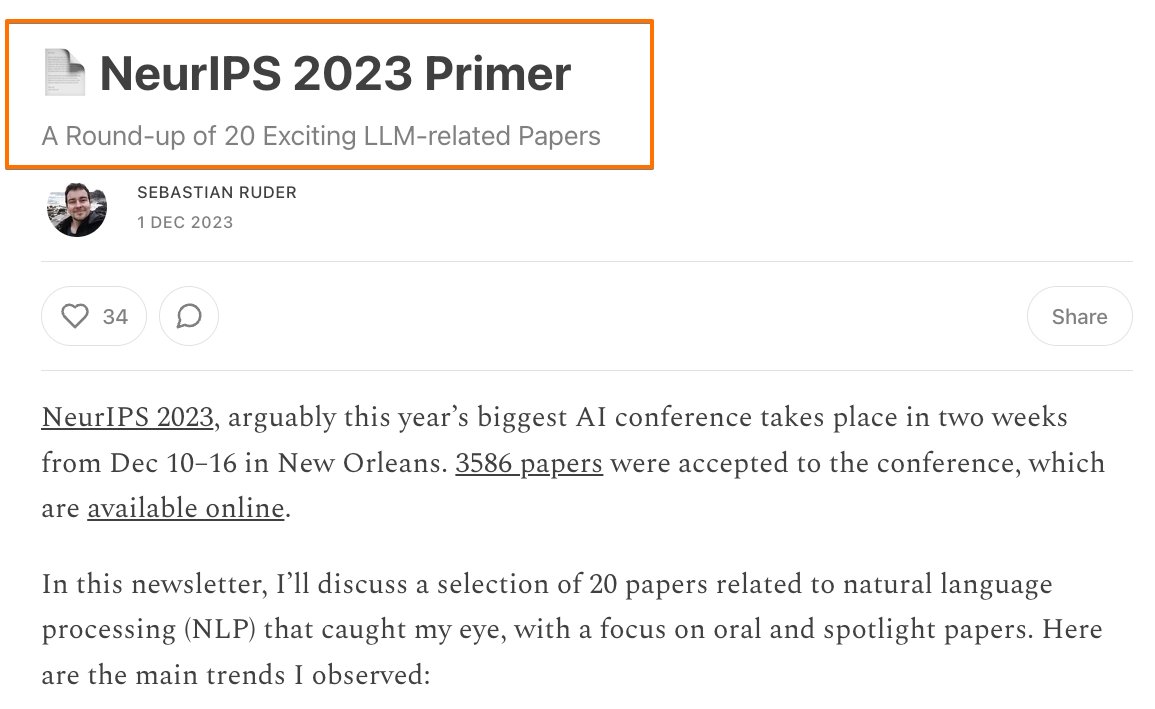
A Round-up of 20 Exciting LLM-related Papers by @seb_ruder
Sebastian has done an incredible job in sifting through 3586 papers to bring us a curated selection of 20 standout #NLP papers from #NeurIPS2023
Here's a quick glimpse into the main trends that are defining the future of NLP:
✅ LLM Dominance: NLP at NeurIPS is largely revolving around Large Language Models, showcasing their growing influence in the field.
✅ Synthetic LLM Analysis: There's a rising trend in using synthetic setups for LLM research, mainly due to the heavy computational demands.
✅ Human Preference Alignment: A key focus area this year is aligning LLMs with human preferences, and enhancing Reinforcement Learning from Human Feedback (RLHF).
✅ In-Context Learning Complexity: Unraveling the complexities of in-context learning in LLMs remains a challenging yet fascinating area of study.
✅ Reasoning Task Challenges: Improving LLMs in diverse and complex reasoning tasks is a major focus, pushing the boundaries of what these models can achieve.
✅ Use of External Tools: A notable trend is the integration of external tools to further enhance the reasoning capabilities of LLMs.
Link to the newsletter:https://t.co/rPUlme5EsD
In the latest GitHub Copilot update for #VSCode, VSCode can now automatically generate commit messages based on the pending changes
More details here: https://t.co/QIuZj8abdc
@code
Working on @kaggle 's #AIReport2023 was a great experience.
The essays submitted under #AIEthics provided not only a detailed discussion of ethical principles in AI, but also an exploration of the tools and strategies that can be employed for monitoring, understanding, and mitigating risks in high-stakes #MachineLearning applications
Link to report: https://t.co/ahY7DO2EAn
Great job by @madhumita29 and her team in employing visuals to elucidate the functioning of LLMs, with a special emphasis on the self-attention mechanism and the Transformer architecture.
Article on @FT : https://t.co/MbPgFwc1DA