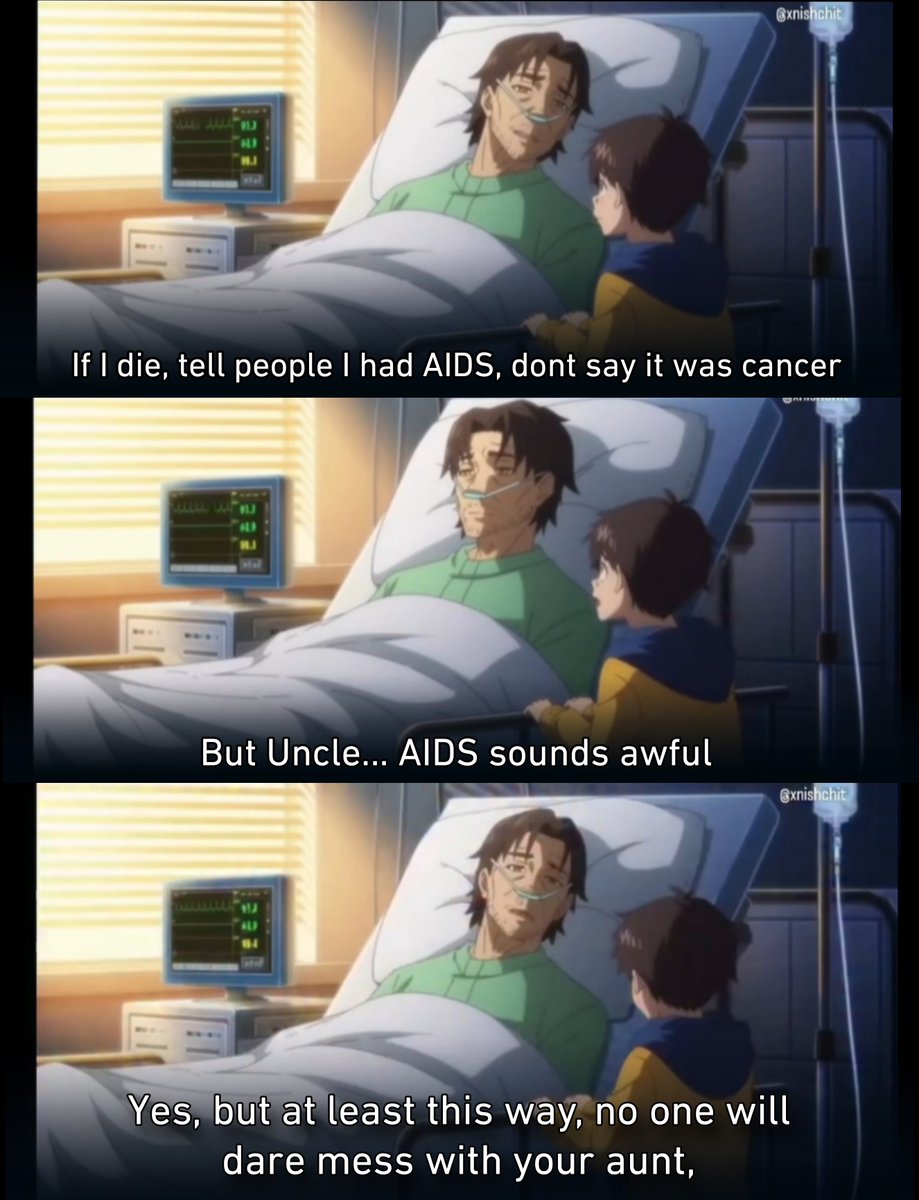
China has announced the ban on the existence of golf courses. It requires that all existing golf courses be incorporated into urban community parks and made accessible to all citizens. Moreover, it states that golf has no sporting value at all.
Gue dulu QC di pabrik sosis. Gue pikir kerjaan gue cuma ngecek tanggal kadaluarsa.
Waktu itu gue dipanggil senior. "Lo ke freezer, ada 200 pack daging beku udah 2-3 tahun. Cek satu-satu."
Gue kaget. "2-3 tahun Pak? Buat apa?"
"Buat campuran produksi"
Gue kira tinggal liat tanggal kadaluarsa. Ehh gak gitu ternyata.
"Cium baunya," kata senior gue. "Kalo masih bagus, pisahin."
Gue buka satu per satu. 200 pack. Gue cium, gue perhatiin tekstur.
Dari 200 pack, cuma 50 yg masih layak. Sisanya bau asem, tekstur hancur, warnanya berubah. Gue mual, pusing, hampir muntah. Tapi yaudah ini kerjaan.
Gue lapor ke senior. " Pak dari 200 cuma 50 yang layak."
Dia langsung masang muka gak terima. "Masa cuma 50? Lo yakin?"
Gue jawab, "Yakin Pak."
Dia agak kesel. "Sini gue cek sendiri."
Gue cuma bisa liat dia mulai buka pack satu per satu.
Gue kaget. Dengan percaya diri, dia bilang, "Ini masih bagus. Ini juga. Ini juga."
Padahal dari samping, gue udah liat teksturnya hancur dan baunya busuk.
Gue coba nyeletuk pelan, "Pak itu udah bau asem."
Gue sadar satu hal: di pabrik, uang lebih penting daripada kualitas. Daging beku 2-3 tahun yg udah bau dan hancur, tetep dipaksa buat diolah ulang. Demi untung.Gue gak tau daging itu akhirnya dipake atau engga. Tapi sejak saat itu, gue mulai mikir dua kali sblm beli produk olahan.Sosis, nugget, bakso. Apapun yang termasuk UPF. Di balik kemasan yang rapi, kadang ada cerita yg gak pernah kita tau.Gue udah gak pernah makan sosis lagi. Bukan karena gue vegan. Tapi karena gue tau apa yang ada di baliknya.Kalo lo bisa, mending masak sendiri atau beli produk yg lebih jelas asal usulnya. Kalo gak, setidaknya perhatiin label dan tanggal produksi.
cc: fimaa_id
coba kalian cek anak2 OSN itu, yang sampai tembus nasional...
coba bandingin berapa persen anak yang dari keluarga ekonomi menengah kebawah, sama yang dari keluarga ekonomi menengah keatas, OFC banyak yang dari menengah keatas lahhh...
makannya privilege tuh aslinya sengaruh itu....
Aku: mbah kakung dlu kerjanya apasi
Bunda: tukang kayu dlu, bikin lemari gitu2
Aku: kok ga jadi presiden ya
Bunda: mungkin krn ijazahnya asli
DI HARI RAYA
The tech stack of most startups:
- Frontend: React (because everyone uses React)
- Backend: Whatever the CTO knew from his last job
- Database: Postgres (or Mongo if someone watched a YouTube tutorial)
- Auth: Copied from a blog post
- Payments: Stripe (obviously)
- Deployment: "It works on my machine"
- Documentation: LOL
- Tests: "We'll add those later"
Valued at $10 million.
@MurtadhaOne1 Mantan presiden yg ilmu geopolitiknya mumpuni cuma SBY, harusnya Jokowi diwakili Retno Marsudi aja.
Jadi lain kali, milih Presiden yg bener wak, bukan cuma gemay gemoy all in oke gas, anak lu keracunan.
Since last year, I've arguably been wrongfully accused in a state corruption case.
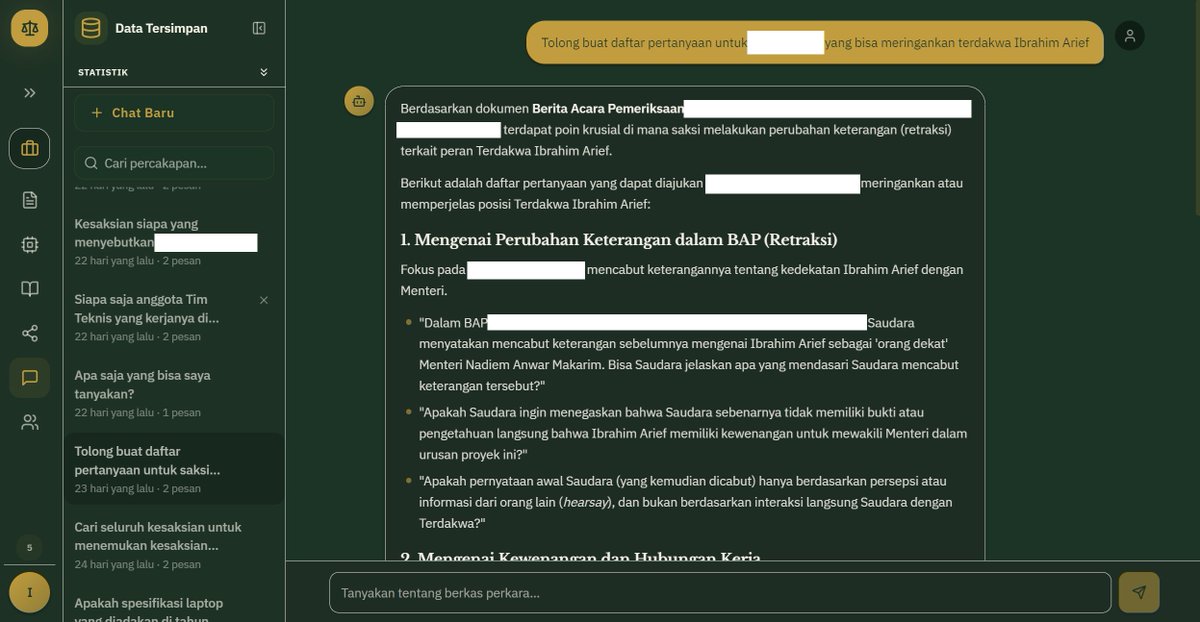
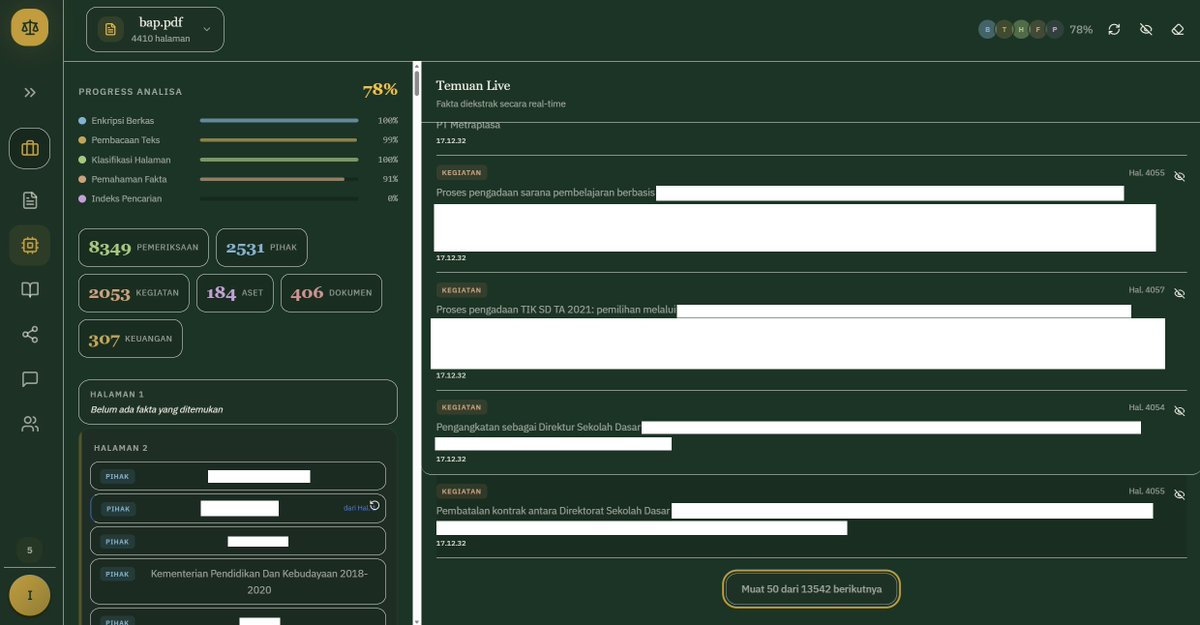
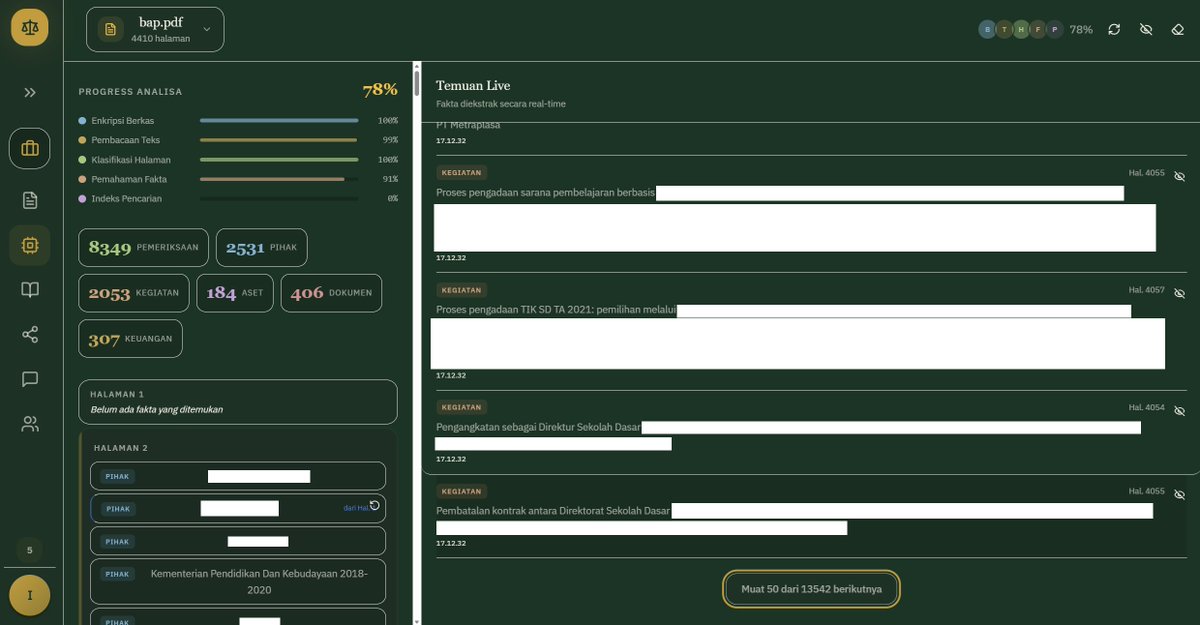
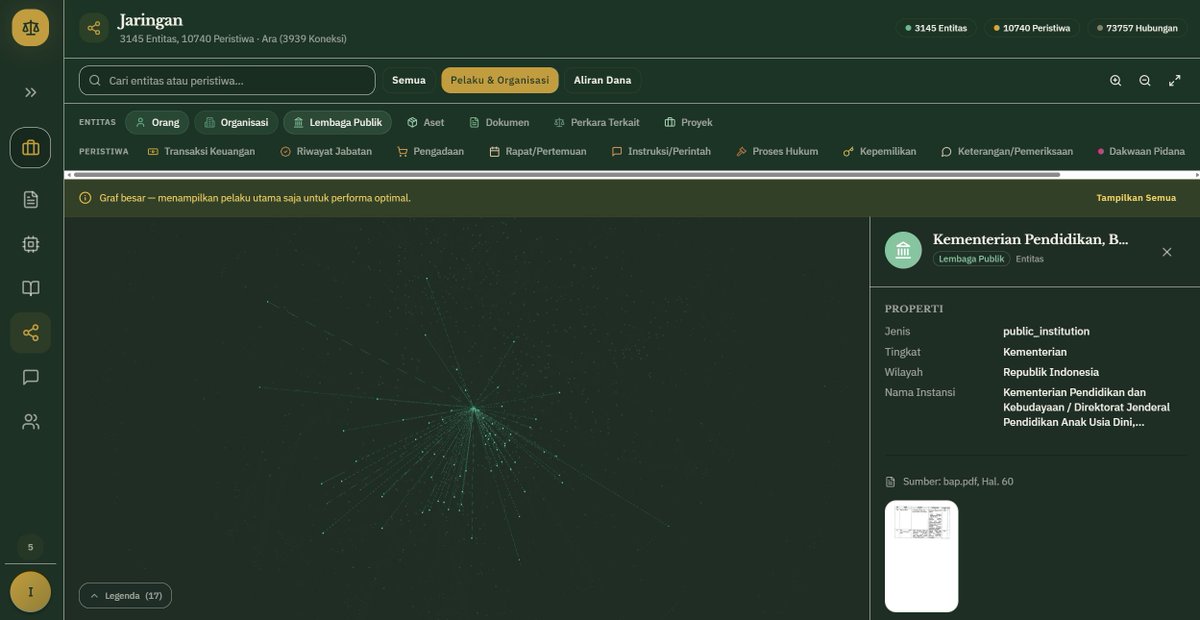
To defend my innocence, I spent past 6 weeks building an agentic AI swarm that:
Analyzed 4700+ pages court docs
Mapped 8900+ testimonies
Found dozens of contradictions
This is how I fight 👇🏼
First off, some context may be necessary.
Even though I'm accused in a state corruption case, I'm not a government official. I'm a software engineer. I spent over 15 years building large-scale tech systems across Europe and Indonesia. I've led engineering teams of up to 600 people and helped grow a small tech startup into a unicorn.
In 2016, I moved back from Europe to Indonesia, because I believe technology at scale could make a real difference to the millions of people in the nation.
Six years ago, working as a tech consultant under a nonprofit foundation, I started advising Indonesia's Ministry of Education on building large-scale technology platforms.
Public sector work pays significantly less than private sector, and I took close to a 50% pay cut to make the switch. I was fine with that. Using what I knew to help underserved communities in Indonesia felt like the right trade.
Our mission was to build a user-centric superapp for public education, specifically for teachers and public schools, the kind of work the private sector ignores because there's no money in it.
At some point, officials at the ministry asked for my input on one of their procurement plans. I helped them work through the technical details, shared what I knew, laid out the pros and cons, and recommended a set of tests they should run to determine which options were the most suitable.
By the time they made their final decision and executed the procurement, I had already resigned from the consulting work, so I didn't think much of it.
Fast forward to May 2025. My house was raided as part of a newly opened corruption investigation tied to that procurement. Two months later, I was named a suspect and placed under city detention due to my health.
The trial started in January 2026. We've been through more than a dozen sessions so far, and not a single piece of evidence or testimony has been presented showing I received a single cent from the procurement.
What came to light was the opposite: evidence and testimony that my recommendations were neutral and likely were ultimately ignored by the ministry's own team, who went ahead and made the call on their own.
So why am I the one on trial? Because the ministry officials who did take money from the procurement vendors needed someone to blame for the decisions they made. Blaming an outside consultant is the easy way out.
Witness testimonies in court has shown that the officials actively directed the procurement while claiming it was done on my instructions and even misled their own team within the ministry by saying I held a position of authority.
We needed evidence to dispute those accusations, questions to cross-examine the witnesses, and we needed them fast.
This is where my AI comes in.
A few days before the trial began, we received a 4400-page printed document containing all the witness statements collected during the investigation, plus several hundred pages of other related documents.
The information asymmetry is staggering. Those with deep enough pockets to hire large law firms can throw dozens of paralegals and associates at a document like that and mount a proper defense on short notice.
I didn't have that kind of money. By then, I had been out of work for more than six months. The AI startup I founded had to shut down. Our investors asked us to return their funding. I had to lay off the entire team.
Most of my lawyers are friends of my wife from her college days, who stepped up and waived most of their fees because they could see I was being railroaded.
The whole situation felt hopeless. But somewhere in the middle of the despair, a spark lit up.
Combing through and analyzing thousands of pages of documents is exactly the kind of problem AI was built for.
I've built AI systems before, so I know the key to applying AI to a real-world problem is understanding the strengths and limitations of the available models, and figuring out how to make things not just work, but work efficiently enough to put into production.
I was placed under city detention due to health issues with my heart, compounded by a tumor that has been growing rapidly over the past few months. But it also means I still have access to my dev PC.
So I started with small experiments. My lawyers found a printing service that could scan the thousands of pages in a couple of days. At first, I tried simply uploading the scanned PDF into existing chatbots like ChatGPT, but the file was far too large for anything they could handle.
Even when I managed to get it working through external cloud storage, the results were atrocious. Half of the strategies and "facts" the models surfaced were hallucinations. That wouldn't just be useless in court, it's actively dangerous and can jeopardize my defense.
My experience building complex AI systems told me that the key to reducing those hallucinations is better data preprocessing.
So I spent the first couple of weeks focusing on parsing the uploaded PDFs, running various kinds of text extraction, and eventually settled on building an agentic AI swarm that performs multiple layers of preprocessing and analysis.
This multi-step analysis by several AI agents that swarm the PDF and extract different aspects of the case produces a dense knowledge graph where we can even trace the flow of money involved.
My lawyers can now easily browse, filter, and search through nearly 9000 witness statements. We even discovered several witnesses with duplicate testimony, raising suspicion of coordinated efforts or tampering among them.
But I didn't stop there. The processing chain includes several higher-level intelligence layers that draw from all the signals in the extracted knowledge graph. These layers add semantic understanding that powers a Chat AI feature, where we can ask specific questions about the case and get grounded answers.
I even built a self-reflective sub-agent that automatically challenges and inspects the results to make sure there are zero hallucinations.
Overall, the AI has helped me and my legal team uncover the big picture of what actually happened, and build questions that span hundreds of separate testimony sessions, giving us an unprecedented ability to cross-examine witnesses in court and significantly improved our defenses.
But I have grander vision than just helping my own legal team. Indonesia's legal system is severely overburdened, with a huge number of cases flowing through the courts every year. This kind of AI could be a useful tool not just for lawyers, but also for judges and prosecutors trying to make sense of their caseloads.
With the cross-examinations we've conducted and the weight of evidence that has come to light, we are aiming for an acquittal.
Should that be the case, my pledge is to keep building this AI platform into something that can meaningfully improve the quality of justice in our legal system: by helping investigators analyze cases more thoroughly and shine a light on any potential crimes, by raising the standard of what prosecutors bring before a judge, and by giving lawyers the ability to uncover the truth in their clients' cases faster than ever before.
Because in the end, I want what I've built to help more than just myself. I believe it can ease the burden on our judges and raise the quality of justice across the system in Indonesia.
Rangkuman aturan yang dilanggar oleh @DitjenPajakRI, @kring_pajak.*
🏦 Berdasarkan Undang-Undang Nomor 25 Tahun 2009 tentang Pelayanan Publik.
sistem Coretax milik Direktorat Jenderal Pajak jelas melanggar bberapa ketentuan
Pertama, Pasal 4, Asas penyelenggaraan pelayanan publik yang mencakup kepentingan umum, kepastian hukum, kesamaan hak, keseimbangan hak dan kewajiban, keprofesionalan, partisipatif, persamaan perlakuan/tidak diskriminatif, keterbukaan, akuntabilitas, fasilitas dan perlakuan khusus bagi kelompok rentan, ketepatan waktu, serta kecepatan, kemudahan, dan keterjangkauan.
Kedua, Pasal 15, 20, 21 mengatur kewajiban penyelenggara untuk memberikan pelayanan berkualitas sesuai asas tersebut, menyusun standar pelayanan.
Ketiga, Pasal 20-21 mengharuskan maklumat pelayanan dan sistem pengaduan;
Terahir, Pasal 53-54 mengatur sanksi jika pelayanan tidak sesuai standar.
dampak buruk ini benar2 dirasakan publik, utamanya umbi @PNS_Ababil / @direktoridosen / @pppkguru & sektor private @hrdbacot
efek kacau nya layanan coretax adalah mengakibatkan kegagalan menyediakan pelayanan pelaporan pajak yang user-friendly,
alias niat gak sih bikin web...
dan menyebabkan kesulitan bagi wajib pajak dalam pelaporan SPT.
✅Langkah administratif yang bisa dilakukan.
ats implementasi Sistem Coretax yg masih ribet dengan lemot, sering error , navigasi kurang intuitif, dan bahkan kelompok terdidik spt pns dan profesional pun kesulitan lapor SPT.
Untuk langkah administrasi yang bs dilkukn oleh wajib pajak adl :
• lapor ke @OmbudsmanRI137 agar diperiksa secara independen.
• Lapor Inspektorat Jenderal Kementerian @KemenkeuRI untuk audit internal. kenapa ini perlu dilakukan? karna setelah datang ke kantor pajak pun, masalah tidak selesai.
• langkah ekstrim yang mungkin bisa dilakukan dgn bantuan @LBH_Jakarta atau @YLKI_ID. ajukan gugatan terhadap aturan yang mewajibkan lapor pajak via coretax, ke PTUN.
karna coretax tak sesuai dg prinsip pelayanan publik yg diatur oleh UU no 25 th 2009 ttg pelayan publik.
*) koreksi jika ada ada yang salah
Tolol banget malah anak LPDP dianggap layak diburu dg slogan Eat the rich😂
While pejabat, literally pesta pora dg APBN via MBG dimana pengelolaan dapur dibagi bagi saja sesukanya antara mereka. Ga peduli kualitas jelek
Padahal hidup sudah sgt kaya dikasih makan dr uang rakyat
Teruntuk adik-adikku, atau sesiapapun yang ingin berkuliah di luar negeri dengan beasiswa,
kalau kalian memang pintar dan punya potensi besar untuk dikembangkan dengan jalur pendidikan negara luar,
ada sedikit saran:
Berhubung negara ini dipenuhi orang-orang bermental kepiting, alangkah baiknya jangan ambil beasiswa dari LPDP.
Selain berat bebannya balas budi ke negara, belum lagi kondisi lapangan yang birokrasinya berantakan, kalian juga akan dipandang sebelah mata oleh sebagian rakyat pembayar pajak yang merasa berkontribusi besar untuk pendidikan kalian.
Carilah beasiswa lain atau beasiswa di negara tujuan. Tidak mudah memang, tapi itu lebih baik daripada harus menanggung beban berat, apalagi jika kontribusi tidak sesuai dengan pikiran mereka, akan dianggap kontribusi sampah.
Masuk ITB sekarang makin nyaman. Buat yang kelas 10, tinggal usahain aja belajar sampe medal OSN. Kalo nasib tidak mendukung, ilmunya bisa dipakai untuk belajar SNBT dengan lebih mudah karena logic sudah "lebih main".