China has 1.4 billion people and over a million foreigners.
But fewer than 20 foreigners do standup comedy in Mandarin.
I'm one of them.
A short film about my 100th show...in Chinese.
Thrilled to be building the How to AI community and courses for @rubenhassid.
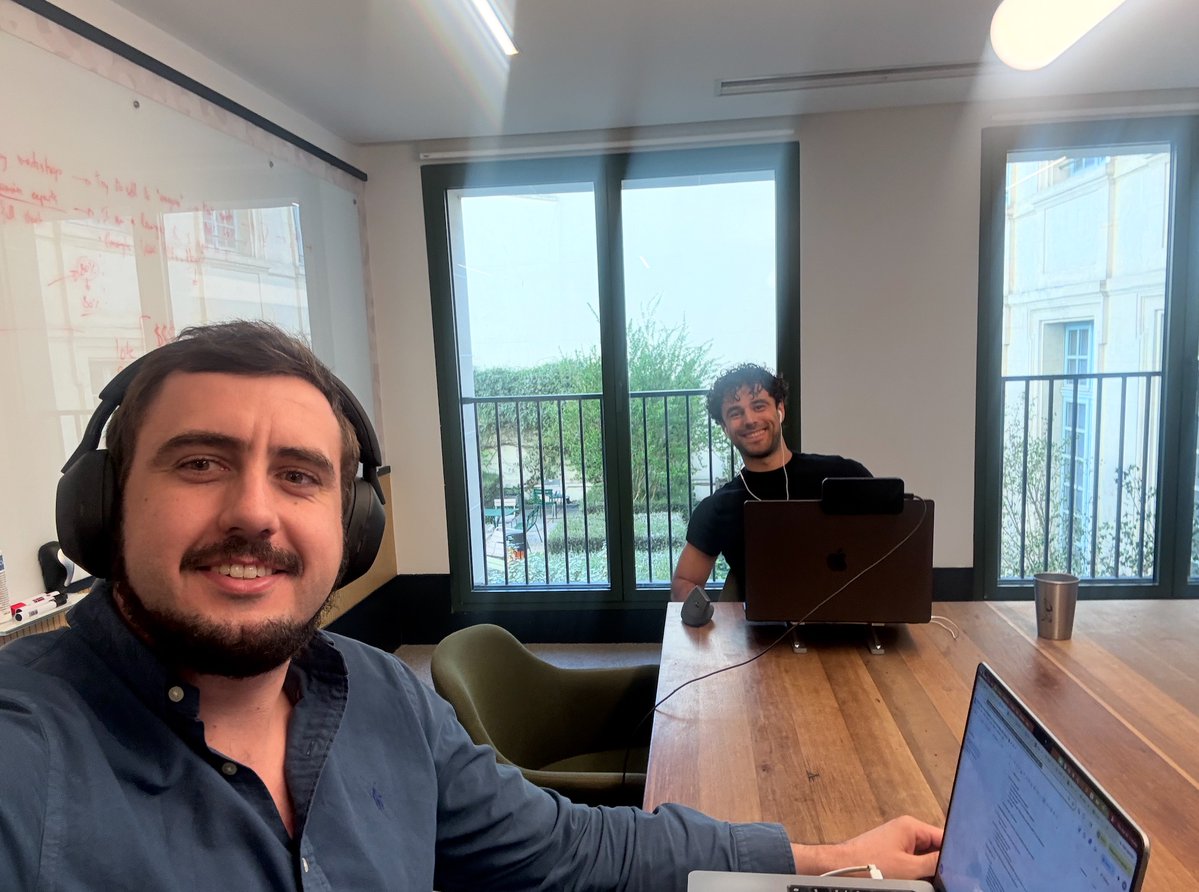
We met up in Paris recently to chat about his vision for his community and how the types of educational programs he's looking to create for his audience.
Ruben's audience is growing like I've never seen before. He's adding roughly 100k subs / month. His community and first workshops have now gone live, I can't wait to see what we build together
China has 1.4 billion people and over a million foreigners.
But fewer than 20 foreigners do standup comedy in Mandarin.
I'm one of them.
A short film about my 100th show...in Chinese.
Since I’m presently in the “blocked” phase of the Marc Andreessen block-follow-block-follow cycle, I’ll say my piece: part of what’s ridiculous about the “zero introspection” rhetoric—aside from the fact that it isn’t true—is that it is finally anti-entrepreneurial and pro-consumption.
Richard Sennett, summarizing Riesman’s The Lonely Crowd, explains the famous distinction this way: “Inner-direction suits societies which emphasize production, and other-direction suits societies which emphasize consumption. The inner-directed individual is hands-on and concrete about what he or she wants to achieve; he or she is a maker. Whereas other-direction suits a society of consumption in which fashion and advertising, the new-new must-have gadget, rules.”
Read: New-New Media.
“Zero introspection” sounds entrepreneurial, but it easily becomes the psychological posture of consumption: radar always turned outward, waiting to be told what matters next.
Communities can deliver transformation on multiple levels too:
- The front door transformation is the "secular value" that the community delivers, basically what's promised on the tin
- The side door transformation is the "sacred value" that members find when they feel themselves grow in unexpected ways, or make lasting friends by undergoing their transformation alongside others
The front door transformation is transactional and market-based, the side door transformation is grounded in social norms (and is the best fuel for word-of-mouth)
JaimeOrtega's post replies to a chart of Uber's $31B cumulative losses from 2014-2022 before four straight profitable quarters in 2023, analogizing the endurance needed for Tesla's autonomous driving profitability.
The attached image depicts Uber's stock plunging 64% in March 2020 amid COVID-19 lockdowns that halted ride-sharing, evoking shock at the sudden market reaction ("tf happened here").
This exchange underscores the high-stakes volatility in ride-hailing innovation, where Uber's recovery to $75/share by 2026 validates long-term bets despite early crashes, relevant to ongoing AV debates.
h/t @grok
Sick of these doomer takes about the West.
I've lived in China a lot recently, yes it's flashy and cool and yes I'll spend more time there. But I am a westerner through and through and my heart is and always will be with the West.
So our systems are lagging? Let's build new ones! That's what I'm doing. Live Transformational Learning is the future of education and I'm helping to build that future.
New institutions for the way the world is and will be.
Don't complain or retreat permanently to Asia.
Stay here and build. the. new.
Honestly, having lived in both the West and Asia for perhaps equal parts of the last 6–7 years, I really do think the West is cooked. Asia is mostly full of optimism. It’s young, vibrant, and international.
The West is absolutely lagging in the things that were once its points of difference (tech, quality of living, education), to the point that in a globalised world, apart from some very specialised services (think health, etc.), there’s no clear edge.
High-speed internet access, and the growth of Chinese GDP and subsequent FDI via Belt and Road, have basically made Western standards of infrastructure seem “oriental” in comparison.
Why rot away in a 3–4k a month apartment in your white trash republic when you could afford a two-storey loft in the inner ring of a high-end designer suburb in Asia for that same capital outflow?
If it weren’t for the physical shackles of jobs, I could see a mass exodus or reverse brain drain from the West in the coming five years.
Seriously, forget Dubai, it’s a soulless hellscape. East/SEA/China max and chill.
A prediction of mine is that live experiences will become 2x more valuable in the world of AI
This includes office meetings, sales pitches, events, comedy shows, sports games, and so on
The amount of content on social media and the internet is going to explode because of AI agents
Once it’s good enough, no one will be able to tell the difference between human and AI
As supply increases, people will reach a point of fatigue from these platforms. We will always crave authenticity and human interaction, rather than AI slop
The only competitive moat left will be in person and live experiences that turn occasional fans into loyal customers
If you are a business or creator, that is probably where the biggest opportunities will be in the next couple of years
In the evening I have a headache and I'm lying on the couch with Johanna, talking about autonomy.
One way to think about human beings, at a very abstract level, is that we're information processing systems born with certain needs into a certain world. To meet our needs in this world, we have to build various mental models—both of how we work, what our needs are, and how the world works. We build mental model whose goal is to predict the world and ourselves well enough that we can make decisions that meet our needs. We try, in various ways, to seek pleasure and minimize pain, and so on.
A lot of this happens through reinforcement learning. We cry, and then we notice that the people around us get stressed and can't meet our needs, so after a while we iterate our way to a different strategy, which is to suppress our tears. We crack a joke and nobody laughs and it's uncomfortable, so next time we do it a little differently.
The goal of this process isn't to find "the truth" or the "optimal strategy," but simply something that's good enough for us to keep our system in some sort of reasonably satisfactory equilibrium.
And the result of this kind of reinforcement learning is often something resembling those videos from 2015, when DeepMind first used reinforcement learning to teach 3D figures to walk. By giving them reward when they managed to walk further, the system could learn to walk, but there were often very strange artifacts—hands spinning around in the air, bizarre flailing of the upper body.
I think many of us look like that on the inside too: we can make our way through life, but the way we walk is a bit jerky and peculiar, and it's far from ideal. Maybe we've iterated our way to alcohol as a way to regulate our negative emotions, or we do it by scrolling social media. We have various strange thought loops circling around in our heads, and so on. Different coping mechanisms that are good enough for us to avoid pain and live in relative equilibrium. They're not the strategies that would, objectively speaking, best help us meet our needs. But as I said, the algorithm we're running isn't searching for the objectively best—it's searching for what minimizes various signals (pain, prediction error, and so on), so it's easy to get stuck in these kinds of local maxima.
Let me say the same thing again in slightly different words. What we call coping mechanisms are local maxima; they're solutions we've iterated our way to by trying different things and moving toward something that works better. Everything is a coping mechanism, even the most successful life strategies—the only difference is that those are coping mechanisms that are better at meeting our needs in both the short and long term, closer to the global maximum, the theoretical point where our mental models and behaviors are as good as they can be and everything we do is aligned with our needs and an accurate understanding of how the world works.
To move toward that the ideal is "freely flowing information." That is: a state where we take in as much information as possible about the world—unfiltered, without biases, without avoiding things that are uncomfortable but true—so that we can efficiently update our world model and make more informed decisions; and also a free flow of information internally, where we don't suppress any feelings or needs within ourselves, but see everything as potential sources of useful information that can let us keep moving toward a deeper understanding, better decisions, and a richer life. To grow, in other words, we need to make sure this reinforcement learning process doesn't converge too early, leaving us stuck in the psychological equivalent of arms flailing in the air, but instead keeps moving forward toward a deeper understanding of ourselves and the world.
And there are certain coping mechanisms, certain ways of relating to the pain that arises as you move through life, that are better at letting information flow, and those are the coping strategies worth cultivating. Instead of numbing yourself by scrolling social media, you want the coping mechanism where, when you feel stressed and bad, you get curious about the feeling. Instead of getting defensive when it turns out you're wrong, you want the coping mechanism where you get interested in your mistake and try to figure out why you were wrong. And so on. I'm not trying to say these are the optimal coping strategies—you can refine and deepen your mental models of how to handle negative emotions and feedback endlessly. What I'm describing here is just a kind of first step: coping mechanisms that lead to continued learning so you can gradually move toward even better ways of handling the situations.
On Scott Adams.
A man finds, to his astonishment, that he exists. After the elation of childhood wears off, he asks, who am I, why am I here, how does this work? These are hard questions, so after a brief struggle, he selects a readymade answer and goes about the motions of life.
Scott Adams was not such a man. He was a live player, ever curious, intent on figuring out this simulation that he found himself in. From first principles, Scott unraveled, understood, and ultimately controlled his own reality. He hacked himself with affirmations, others with persuasion, the world with simultaneous sips. He explained people as moist robots, two movies happening on one screen, his world as Gods’ debris. He carved a personal mission to “be useful,” and made us all better writers, public speakers, and persuaders. He preached the footwear theory of motivation, the Adams Law of slow-moving disasters, the skill stack, systems over goals, and of course, the Dilbert Principle.
Besides cartooning, philosophizing, and teaching, Scott rose to the occasion and displayed, “the one virtue that cannot be faked” - courage. Scott had the courage to speak honestly as he saw it - about Trump, about his nation, and about his time, even though it cost him friends, audience, money, and his ticket to polite society. Scott had true courage, the kind that makes you unpopular, the kind that is always and everywhere in short supply,
At the end, as any hacker of reality, Scott covered all of his bases - he left as a Buddhist, a Christian, and a player in the Simulation.
Scott, we didn’t get enough time with you, but you were a mentor and a marvel. You were useful and you were courageous. You were incompressible and indivisible. One of a kind, and generous with your drawing, writing, and speaking. Unlike your squealing critics in the chattering class, you will be read generations from now.
On this earth there are many long-lived hells but no lasting heaven. Each heaven must be created and nurtured, ex-nihilo, from mind and from mud. Scott, you created a small heaven for us all, and to a larger heaven you go.
A man finds, to his astonishment, that he no longer exists. He asks why, what it was for, and how will the new reality work? When the rest of us get there, we’ll find Scott, ever useful, ready to explain, having figured it all out.
Notes:
• First line paraphrasing Schopenhauer.
• Courage quote via Taleb.