Founder and CEO @SearchPilot, founded @distilled (acquired by @Brainlabs)
Interest in basketball, whisky, cooking, auction theory
Views may not be orgs'
I am very interested in @randfish's recent research into the growth of LLMs, their impact on people's search habits, and their impact on Google.
My summary:
1. Google is still growing, not shrinking as some would have you believe
2. Not everything people do on LLM-based chat platforms are "searches"
3. Even if you are fixated on AI-powered discovery, Google is the biggest for *that* too
This is not to say we should ignore the growth of the others, or get complacent, and in fact I think there's a lot of scope to test the impact of our activities on other LLM recommendations, but we should keep things in perspective.
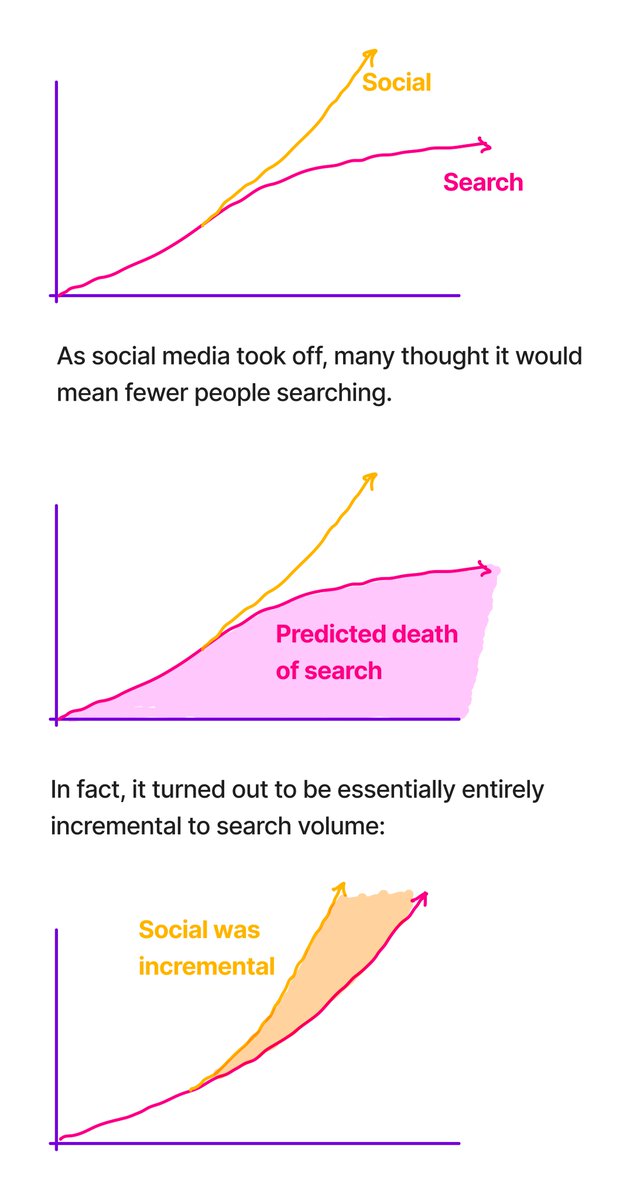
It reminds me a lot of the growth of social media circa 2007. It was clearly a coming revolution, and there was noise about it being catastrophic for search because people were making the argument that users would prefer to ask their friends where to eat rather than searching for restaurants. It turned out, of course, that they did both.
NEW Research: https://t.co/p6OmMQUffb
If we include ChatGPT, what is Google's *REAL* market share of search?
After years of speculation, we finally have enough reliable data to build high quality numbers for both.
Massive SEO News: Google is launching the most requested report in Google Search Console ever. A new AI performance report!
Here's what we know so far:
• It will include dedicated reports for both Search and Discover
• The data will be reflected within Search for AI Overviews and AI Mode, alongside AI features in Discover
• The report will only be focused on impressions within generative AI features, not clicks
• The rollout will start with a subset of websites, allowing thorough testing (so keep an eye out!)
There are some major limitations to this initial testing phase, where the actual queries that users are searching won't show in the report, with only impressions for pages, countries, devices, and dates.
Though the dataset will be limited, this is certainly a step in the right direction!
I will be covering this rollout within my newsletter, so make sure to subscribe if you aren't already: https://t.co/J6GbI1tB27
@Sachalaurentt I agree, but the key is having targets that align with real business goals. Traffic can be a vanity metric in retail if you're not careful
Too much SEO reporting compares this year to last year. Seems reasonable until you consider how much changed in between.
My colleague Demetria broke it down in her webinar last week and you can rewatch the whole thing for free. Here's a clip. Full link below.
I made my first little personal disposable app to put my claude usage limit in my mac toolbar so I don't keep having to root around to find out how close I am.
@TheStalwart@tracyalloway I loved the interview with @collision. At the end, you said you should do an episode on what retailers are doing to be legible to and visible in AI. I vibe-coded a pitch for why I'd be the perfect guest: https://t.co/NlZMmiZ0cV
I hope you like it.
This is not the case out in the real world where AI sentiment is net negative afaik. I was expecting more balance in a working age tech adjacent big city cohort but not such a positive skew
I was on a panel the other day in front of a small audience (30-40 people).
I got everyone to close their eyes and raise their hand to vote for these options re AI out of 5 (no 3 allowed):
The audience was not all tech - it included creatives and content people as well as brand marketers etc. BUT I had to tell them they were not normal. Literally 2 of the audience were 1 or 2.
Introducing Roughdraft!
A new open source project designed to make collaboration with agents better.
The idea is to bring commenting and suggested changes to markdown (e.g. plan docs) in a nice interface.
Free, local, etc.
👉 https://t.co/J3YOOpL5ES 👈
Today, we share a breakthrough on the planar unit distance problem, a famous open question first posed by Paul Erdős in 1946.
For nearly 80 years, mathematicians believed the best possible solutions looked roughly like square grids.
An OpenAI model has now disproved that belief, discovering an entirely new family of constructions that performs better.
This marks the first time AI has autonomously solved a prominent open problem central to a field of mathematics.