We’ve found 160 Florida registered voters in Pinellas County that have self-identified as non-citizens & voted in federal elections.
I’m submitting reports for each of them.
Der Kapitalismus produziert so viel Wohlstand, dass selbst Sozialisten genug Freizeit haben, um auf ihren iPhones über das System zu jammern, das ihnen genau diesen Luxus überhaupt erst ermöglicht.
6,608 people in McKinney, Texas signed a petition to recall the mayor and council members who approved a new mosque.
Good. We need more of this. That's what happens when you forget who you work for.
Keynesian stimulus is a wealth transfer engine disguised to look like public welfare. The transfer runs in one direction: from you, through the government, to whoever holds political favor when the checks clear.
The process works like this: Congress authorizes spending, the Treasury borrows, and the Federal Reserve monetizes the debt. New money enters the economy at specific injection points, not diffused equally across 330 million Americans. Defense contractors in Virginia, solar panel manufacturers in California, and regional banks with the right lobbyists receive the fresh dollars before prices adjust. By the time inflation reaches your grocery bill or your rent, the purchasing power advantage has already been captured. Economists call this the Cantillon effect. Richard Cantillon described it in the 1730s, and the math has not changed.
The 2009 American Recovery and Reinvestment Act, $831 billion authorized by February of that year, illustrates this cleanly. Solyndra received $535 million in loan guarantees and went bankrupt by 2011. Its executives drew salaries and its investors recovered partial capital through the political process, while you absorbed the loss through your tax burden and the diluted dollar in your wallet. The program worked exactly as the incentive structure intended it to.
Keynesians insist that aggregate demand is a problem and government spending is the needed accelerant. Demand is not an abstraction floating above the economy. Demand is specific people wanting specific things, expressed through prices that coordinate production. When the government substitutes its judgment for that price system, it redirects capital toward politically viable projects rather than economically sound ones. Capital systematically flows toward industries with organized lobbying, geographic concentration in congressional districts where votes are competitive, and executives who rotate between agency positions and corporate boards.
The 2020 and 2021 stimulus packages, totaling roughly $5.2 trillion, produced the same pattern at a larger scale. Private equity firms and publicly traded companies accessed Paycheck Protection Program funds through established banking relationships. Small independent businesses without those relationships waited in queues until the money was gone. By 2022, inflation hit 9.1 percent annually, the highest rate since 1981. Working-class households, with no hedge assets and no political access, absorbed that inflation through reduced real wages.
Stimulus spending has never created any resources, and never will, it redirects them down the path of political gravity, and that path runs straight to the well-connected.
Our next paper DEMOLISHING
THE CLIMATE SCAM JUST DROPPED
🚨 NEW PAPER: The isotopes just said NO.
Fossil-fuel dominance of rising CO₂ is falsified. Again.
The test is simple. If fossil fuels drove the rise, the isotopic signature of the carbon entering the atmosphere (δ¹³C_I) must swing strongly negative during the highest-emissions window on the Law Dome / Cape Grim record.
It went the other way.
+2.94‰ per decade, 1977 to 1996.
Natural-variability band: [−1.26, +1.24]‰ per decade.
More than twice the band's upper edge. p < 10⁻⁴.
Wrong sign. Far outside natural variation. Falsified.
Cohler & Soon, Science of Climate Change 6(4), 2026
https://t.co/itJ81m4NBa
This paper is one more in a series taking modern climate science apart, one lie at a time:
🔹 KEELING: Five centuries of constant δ¹³C_I while fossil-fuel emissions rose about 10,000-fold. The fossil-fuel fraction of the CO₂ rise is ≈ 0. Not "nearly all." Zero.
https://t.co/LlTg4a1FQE
🔹 OHC: The IPCC's Earth energy-imbalance number rests on Argo float data that misses half the ocean. Honest uncertainty puts it statistically indistinguishable from zero.
https://t.co/K8hNkGIFdu
🔹 GMST: "Global temperature" does not exist.
https://t.co/K1lERQQxWj
🔹 PTT: The formal proof of why. Averaging an intensive quantity across a non-equilibrium system gives a number with no physical referent.
https://t.co/7fBUbtqciL
Global temperature.
Ocean energy imbalance.
Fossil attribution.
Permanent CO₂.
The facade is coming down.
Lots more coming soon!
It was Eugen von Böhm-Bawerk who first, and most devastatingly, demolished Karl Marx's economic theory. His most important criticism was of the labour theory of value: if actual prices systematically diverge from labour values, then labour time no longer explains the proportions in which goods exchange.
Marx had claimed that the value of a commodity is determined by the socially necessary labour time required to produce it. In Volume I of Capital he treated this as the regulator of exchange. In Volume III, however, he acknowledged that, under competition, prices of production equalise rates of profit across industries with different ratios of constant to variable capital. Goods that require more constant (non-labour) capital receives more profit than the surplus value generated directly within it and hence sell at prices above their labour values; goods that require less sell below them. The deviations are not random or temporary; they are systematic and persistent.
Böhm-Bawerk's point was that this concession empties the theory of explanatory power: once prices are admitted to diverge regularly from labour values, the claim that labour time determines exchange proportions cannot be maintained. The transformation procedure Marx offered - converting values into prices of production - did not restore the link, because it presupposed the very prices it was supposed to derive. If the observed rates of exchange are governed by the equalisation of profit rates rather than by embodied labour, then labour time has ceased to be the explanation of those rates. At most it becomes a magnitude from which prices are calculated after other factors have already been taken into account.
The criticism struck at the centre of Marx’s account of exploitation, surplus value and the laws of motion of capitalism: it all rested on the premise that labour values regulate exchange. If that premise fails whenever capital compositions differ, the subsequent analysis loses its foundation in actual market proportions. Böhm-Bawerk’s point was not that labour is irrelevant to production, but that a theory which cannot account for the prices at which goods actually trade has simply failed.
Every dollar the Federal Reserve prints dilutes the purchasing power of every dollar you already hold. This is not a bug in the system; it's the entire reason it exists.
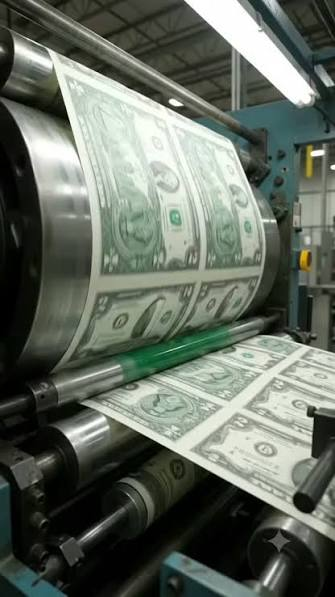
Fiat currency, unbacked by gold or any commodity, gives central banks the power to expand the money supply at will. The Fed created $4.5 trillion in new money between March and June 2020 alone, more than doubling its balance sheet in three months. No wealth was produced to match it. The Fed simply conjured digits, and the existing pool of dollars became worth less the moment it did.
The process works through what is called the Cantillon effect, named for Richard Cantillon, the 18th-century banker who noticed that new money never enters an economy uniformly. It enters at a specific point: the Treasury, the primary dealers, the connected banks. Those institutions spend the fresh money before prices have adjusted upward. They buy assets, properties, equities. By the time that money filters down to wage earners and savers, prices have already risen. You absorb the inflation without ever touching the stimulus.
Redistribution by stealth. No congressman votes to cut your purchasing power by 8.3 percent (as happened in 2022). The Federal Reserve does it administratively, and your savings account takes the loss while bond markets celebrate cheap credit.
Then there is the problem of malinvestment. When the Fed holds interest rates artificially below their market-clearing level, it sends a false signal. Entrepreneurs borrow heavily and deploy capital into projects that only appear profitable under cheap-money conditions: speculative tech startups in 2021, subprime mortgage securities in 2006. When the rate cycle eventually turns, those projects collapse, and real resources have been wasted. Workers trained for industries that should never have existed. Buildings half-finished. Capital burned.
Sound money advocates have traced this boom-bust pattern across every major cycle since the Federal Reserve's founding in 1913. The institution was sold to the public as a "stabilizer," but the dollar has lost over 97 percent of its purchasing power since then. Judge it by results, not intentions.
The exit from this system is straightforward in principle and politically radioactive in practice: separate money from state control, return to a commodity anchor, and strip central banks of the authority to manufacture purchasing power from nothing.
“Los capitalistas facilitan el entramado económico moderno, al ahorrar para comprar bienes de capital y pagar a los trabajadores antes de la venta. Esto permite que la producción continúe, beneficiando a toda la economía.”
Murray Rothbard
Once you recognize that socialism empowers the political class at the expense of the working class, the incentives become clear. Politicians gain more from keeping you dependent on their promises than from making you independent of them.
Socialism deserves condemnation for more than failing to deliver. It actively worsens the problems it promises to solve, then uses that worsening hardship to demand more money and power.
Even changing the politicians’ incentives wouldn’t fix the economics. Good intentions don’t erase the consequences of restricting production, punishing success, and replacing voluntary trade with political dictates.
Wool is the most vegan thing in your wardrobe, and vegans have banned it.
A sheep does not moult. We bred that out thousands of years ago, and the fleece now grows until somebody takes it off. Leave it on and you get Shrek, a New Zealand merino who hid in a cave for six years and came out in 2004 under 27kg of wool, looking like a cloud with a face. Or Chris, found near Canberra in 2015 carrying 41kg and barely able to walk.
So once a year a sheep gets a haircut. It takes about two minutes. Nothing dies. She walks off several pounds lighter, looking faintly embarrassed, and starts on the next one. In Britain the fleece usually sells for less than the shearer charges, so the farmer is paying for the haircut out of concern for the client.
That is the cruelty.
The approved alternative is a fleece made of plastic. Polyester, acrylic and nylon are oil, drilled, refined and spun into thread, and they shed fibres by the hundred thousand in every wash. About a third of the microplastic going into the sea comes off somebody's clothes. A wool jumper buried in the garden is soil in a year or two. An acrylic one will see out the next ice age.
One fibre needs an oil rig. The other needs grass, rain and an animal that carries on with its day.
The objection is that the sheep cannot consent. True. It also cannot consent to flystrike, heatstroke, or rolling onto its back under the weight and dying there, which is what the unshorn version of freedom consists of.
Veganism has looked at an animal that needs a haircut and decided the kind thing would be for it never to have existed.