Strong disagree.
Problem 1: Your understanding of "meek" is a translation problem !!!
I hate when I see this line misquoted like this. I am going to go deep on the etymology here so I apologise in advance for the length but it's worth going into detail here.
This passage is first written using the Hebrew word "anav" which means "those bowed down" and refers to devotion to the Lord rather than capability. You can be strong and still bow down to God. This word is also used to describe Moses in Numbers. It calls Moses the meekest man on earth. Bear in mind that Moses is the man who killed an Egyptian slave driver, confronted Pharaoh to his face, and led a nation out of an empire. Whatever the Bible means by meek, it does not mean weak.
We also see how wrong the modern interpretation of "meek" is when we look at the Greek translation, "praus". This was the word Aristotle used for the virtue of controlled anger: the man who can feel anger and act on it, but keeps it under command. The Greeks used the same word for a trained animal. All the strength is still there. It just answers to a master now.
Meekness in Scripture is strength that submits to God instead of to appetite. It is the man who has power and does not use it for himself. That is why turning the other cheek is a virtue: it only counts if you could have hit back. A weak man declining a fight is not meek. He is just weak. Jesus himself is the model. He calls HIMSELF praus, and the same man made a whip and drove the money changers out of the temple, then walked into a death he could have avoided at any point. None of that is passivity. It is power held under perfect command.
Problem 2: The idea that Christianity celebrates weakness is a modern misconception.
Look at who Christians actually celebrated for 2000 yrs.
The martyrs were not killed for being harmless, in fact the opposite really.
The missionaries were not timid either. One walked into pagan Germany and cut down Thor's sacred oak in front of the tribe that worshipped it. Patrick went back to the island that had enslaved him and converted it. These men took a continent without an army.
The Church canonizes soldiers, like Joan of Arc, a teenage girl who led armies. Its most famous image of an angel is Michael with a sword at Satan's throat. Its own name for believers on earth is the Church Militant. Paul tells Christians to put on armor and fight the good fight. None of this is the vocabulary of a religion that celebrates weakness.
The modern conception of a "meek" Jesus is a modern invention. "Gentle Jesus, meek and mild" is a children's hymn from 1742. The harmless Jesus came out of the modern nursery, not the ancient Church, and Nietzsche took the nursery version at face value and built "slave morality" on top of it.
So, to Augustus' question, how do we reconcile these two things? Who has done it before?
The Medieval concept of Chivalry!
The medieval knight was the deliberate fusion of Homer and the Gospel. C.S. Lewis wrote a great essay on this (https://t.co/yWMNVCocwH). His point was that the knight is not a compromise between fierceness and gentleness, some watered down average of the two. He is maximally fierce in battle and maximally gentle at home, at the same time, in one man. That is Christian meekness in practice: the full Homeric capacity for violence, brought under command.
So the claim that no one has reconciled them because they are not reconcilable is just wrong as history. The Middle Ages did it at civilizational scale and held it for centuries.
Hiring an EA
Travel to far away lands, prep and shadow me in smoky room negotiations
Manage my schedule and run extremely inconvenient errands to the DMV
Intimately see how Rainmaker built the team and tech to terraform Earth
Must be maniacally focused, tactful
DMs open
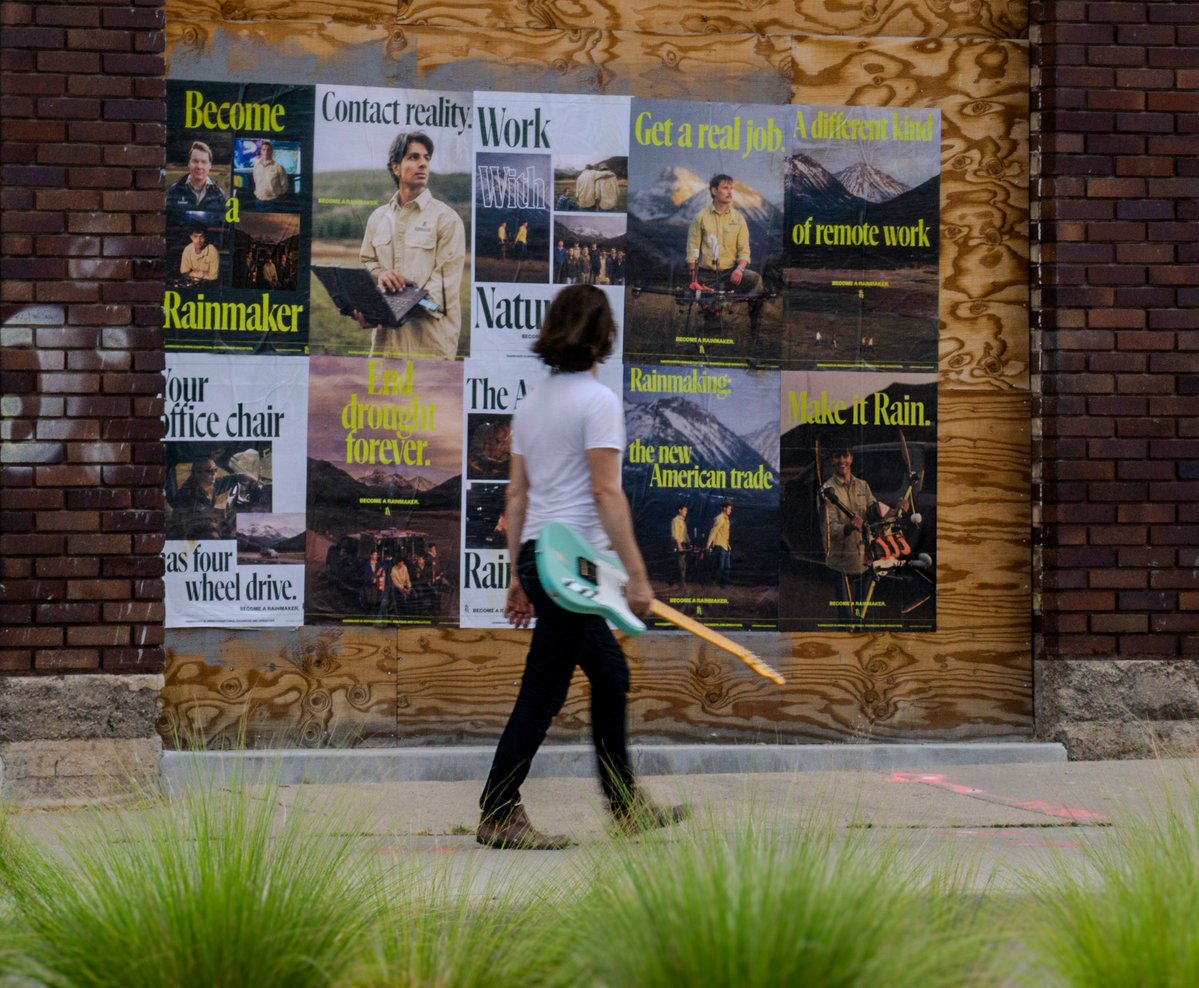
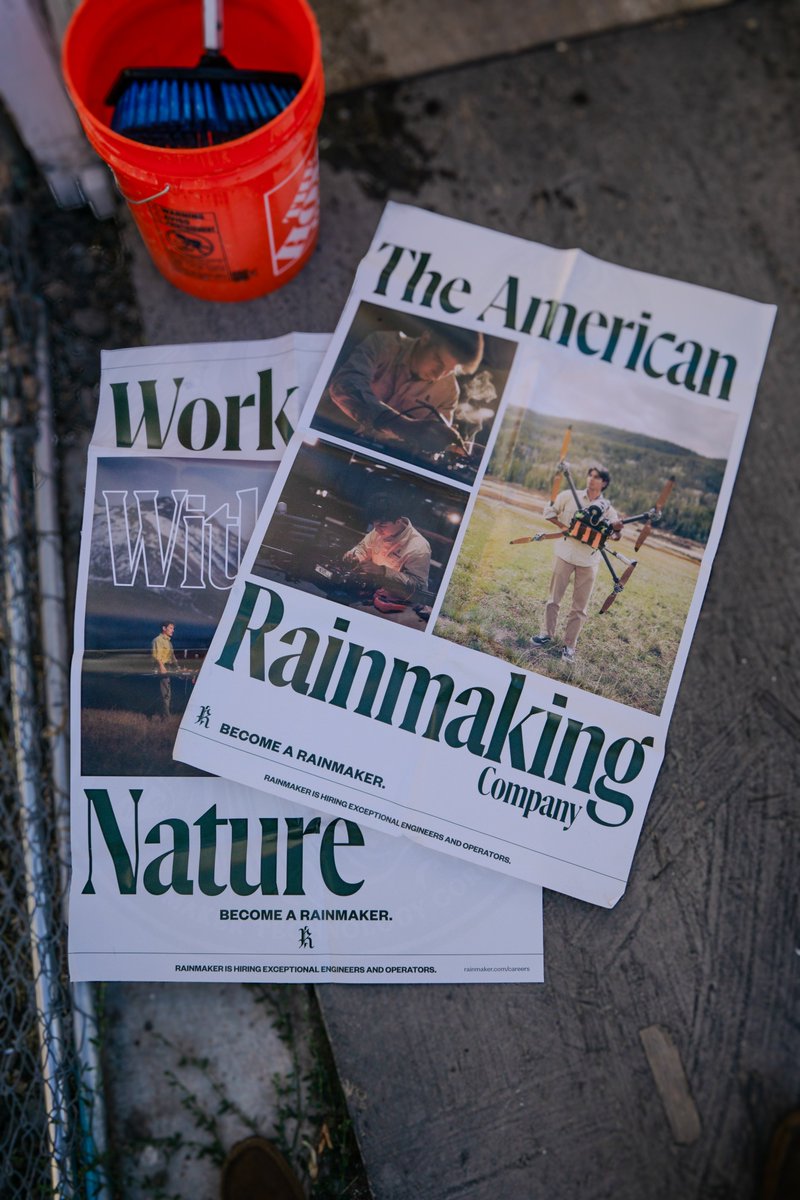
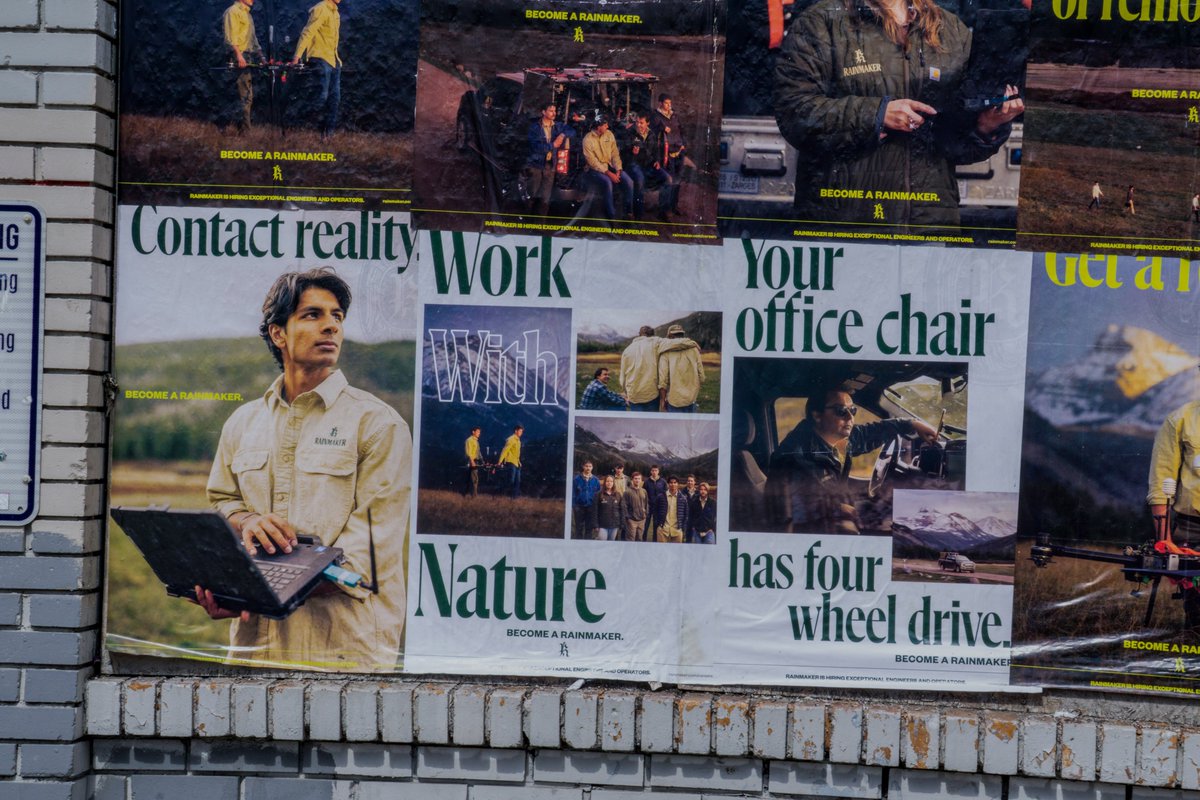
Today we placed posters around the country telling the story of what it means to Become a Rainmaker.
Modifying the weather requires frontier research.
Meteorology, physics, machine learning, solid state radar and optics systems, we are hiring for across all these disciplines
But, no amount of novel hardware or hours spent in the lab can actually modify the weather unless our systems are tested and deployed by humans in the field
Until teams of gritty, relentless, disciplined mountaineers deploy our tech in remote locations during freezing snowstorms—it’s all just theory.
And Rainmaker is in the business of contacting reality.
So we are hiring teams of Forward Operating Specialists to bring theory into practice again this coming winter.
In the hardest conditions imaginable, the FOS is responsible for using all the systems Rainmaker has built.
They are Rainmakers in the truest sense of the word.
They are the ones who work with nature.
They are the ones who modify the weather.
Their field work is the final factor determining whether our operations produce more water.
It is a tough job in service of a beautiful mission.
We are in search of gritty, soulful, dutiful people who want to work with nature, harness the elements, befriend the locals, and bring water where it’s needed most.
Become a Rainmaker.
More info in the replies.
BIG NEWS: Oklo's Groves isotope test reactor has cleared @ENERGY's final major safety approval.
With the Documented Safety Analysis approved, Groves now enters the final phase before startup, including DOE's readiness review, fuel loading, and criticality in July.
Less than a year after breaking ground, Groves is demonstrating that advanced reactors can be built on privately owned land with commercially sourced fuel, equipment, and systems. As the first project to reach this milestone under DOE's Reactor Pilot Program, it provides a blueprint for future commercial deployment.
Read more:
https://t.co/TJJX1UYjVd