Most Web3 angel advice is noise. Real insider edge? SAFTs with vesting cliffs. Founders dump at TGE, angels exit locked. Ask for 12-month cliff or walk. Alignment beats hype every time.
What kind of operational infrastructure does coordination across the healthcare value chain actually require?
Eight years of building clinical programs across Southeast Asia, working with governments, hospital networks, and pharmaceutical companies, produced one consistent finding: the challenge is not the absence of capable AI. It is the absence of operational infrastructure that makes coordination reusable across programs.
Without that infrastructure, coordination remains highly program-specific, especially in drug development, where multiple key players must work together across the development process.
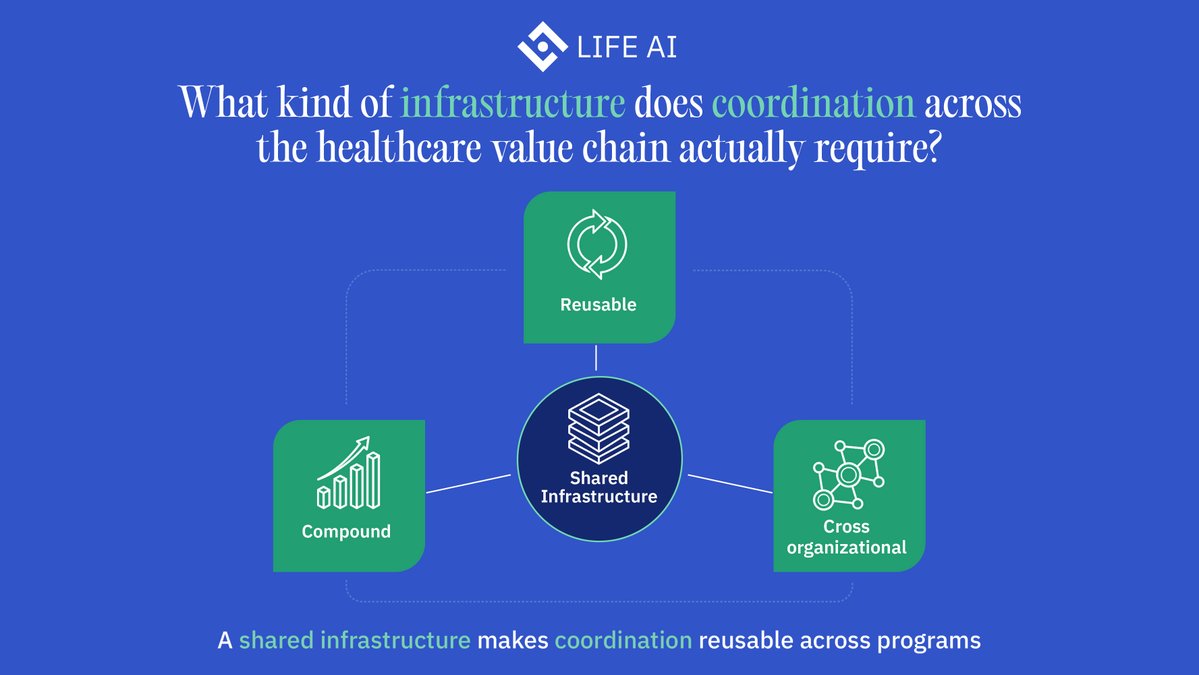
The infrastructure this requires has three properties.
It has to be reusable. Clinical programs should move from bespoke projects to reusable rails, with shared coordination rails replacing bespoke integration at every site.
It has to compound. Every application should strengthen the model, the network, and the protocol, building greater capacity across the ecosystem over time.
It has to enable coordination among independent actors. Hospitals, doctors, labs, pharma sponsors, regulators, patients, and AI builders can contribute services, validation, and clinical execution without surrendering operational sovereignty.
At Life AI, we are building an operating infrastructure for drug development around these requirements, bringing together AI-driven discovery, wet-lab screening, and clinical validation.
What kind of operational infrastructure does coordination across the healthcare value chain actually require?
Eight years of building clinical programs across Southeast Asia, working with governments, hospital networks, and pharmaceutical companies, produced one consistent finding: the challenge is not the absence of capable AI. It is the absence of operational infrastructure that makes coordination reusable across programs.
Without that infrastructure, coordination remains highly program-specific, especially in drug development, where multiple key players must work together across the development process.
The infrastructure this requires has three properties.
It has to be reusable. Clinical programs should move from bespoke projects to reusable rails, with shared coordination rails replacing bespoke integration at every site.
It has to compound. Every application should strengthen the model, the network, and the protocol, building greater capacity across the ecosystem over time.
It has to enable coordination among independent actors. Hospitals, doctors, labs, pharma sponsors, regulators, patients, and AI builders can contribute services, validation, and clinical execution without surrendering operational sovereignty.
At Life AI, we are building an operating infrastructure for drug development around these requirements, bringing together AI-driven discovery, wet-lab screening, and clinical validation.
Patience pays. Watching price bleed toward that level I already marked. No urge to catch the knife. When it triggers, I'll know. Until then, the chart is just noise.
Hot take: speed is useless without shippable founders. If AI compresses discovery but your team still ships quarterly, you lose. If founders iterate weekly, you win. Fund the operators, not the hype.
the $62B by 2030 forecast assumes synthetic personas scale, but 57% integrating creator measurement suggests humans stay the benchmark, not the next layer
AI Influencers are moving into the performance economy.
What started with synthetic personas is expanding into something much bigger: systems that can discover audiences, run workflows, engage communities, and optimize outcomes.
AI is already entering influencer marketing operations, from creator discovery and campaign workflows to measurement and optimization.
In 2026, 74% of influencer marketers reportedly use AI in some part of campaign operations, based on eMarketer data cited by Storika.
The virtual influencer market is projected to grow from $15.9B in 2026 to $62.67B by 2030, as reported by The Business Research Company.
At the same time, creator marketing is becoming increasingly measurable.
44% of paid media creative assets among surveyed brands now come from creator content, while 57% of surveyed marketers have fully integrated creator marketing into the same measurement framework as their broader paid media programs, according to CreatorIQ’s 2026 research.
The evolution is happening across three dimensions:
Persona → Performance
Content → Workflow
Influence → Measurable Impact
This is where AI Influencer Agents become interesting.
They can connect the pieces around influence into a continuous operating loop:
Discover → Create → Engage → Measure → Optimize
Not simply an AI that looks like a creator.
An intelligent system that operates like one.
That is the infrastructure opportunity emerging across the creator economy.