@blueicehiggins Relating high weathering rates measured via cation loss in field to measurement of cation + alkalinity concs in watershed (which should go up a lot!) is a piece of the puzzle that’s missing, and not satisfying without. Tracing sec. processes downstream/ocean is a sleepless night!
Check out our latest paper in ES&T. We take a granular approach to quantify the secondary processes that impact carbon removal downstream of an enhanced rock weathering site. Measuring cation loss from feedstocks on the field isn't enough!
https://t.co/eqBqUyLB00
This work was made a lot of fun by collaborating with a group of excellent people. Travelling to @SUERC1 to perform radiocarbon analyses was a great highlight! Thanks all.
@dpcarrington Study relating to this article suggests 14kg of CO2 is removed per 1000 kg of glacial flour applied per hectare, not including emissions from transport and spreading. This is a negligible sink of CO2… perhaps even a source of CO2 once fully audited?
https://t.co/C8zVLuS8g1
Just 🚨 one more day 🚨 to submit an abstract to session 9G, exploring the importance of timescales in carbon cycling - shaping up to be a great session!
Carbon; it's about time!
The carbon cycle operates over a range of timescales, from slow tectonic uplift, to rapid strong acid reactions. If you're interested in what makes the carbon cycle tick, submit an abstract to session 9G @goldschmidt2023!
https://t.co/vrk21Ewq20
We are hiring! Vacancy for a Grade 6 Technician in our group. Duties include technique/method development, training PhD students/ project staff, and radiocarbon sample processing. Full 14C training available. *Deadline 22nd March* See: https://t.co/I0Tu4GWB1L @SUERC1@UofGlasgow
Carbon; it's about time!
The carbon cycle operates over a range of timescales, from slow tectonic uplift, to rapid strong acid reactions. If you're interested in what makes the carbon cycle tick, submit an abstract to session 9G @goldschmidt2023!
https://t.co/vrk21Ewq20
Good to be at the @UKERW_GGRD Annual Meeting today discussing the latest outputs from our #ERW#FieldTrials. Here Ros Rickaby from @OxUniEarthSci discusses the potential fate of carbon transported as alkalinity in rivers (using the recent paper by @WillKnapp18 & @UCam_RiverWATCH)
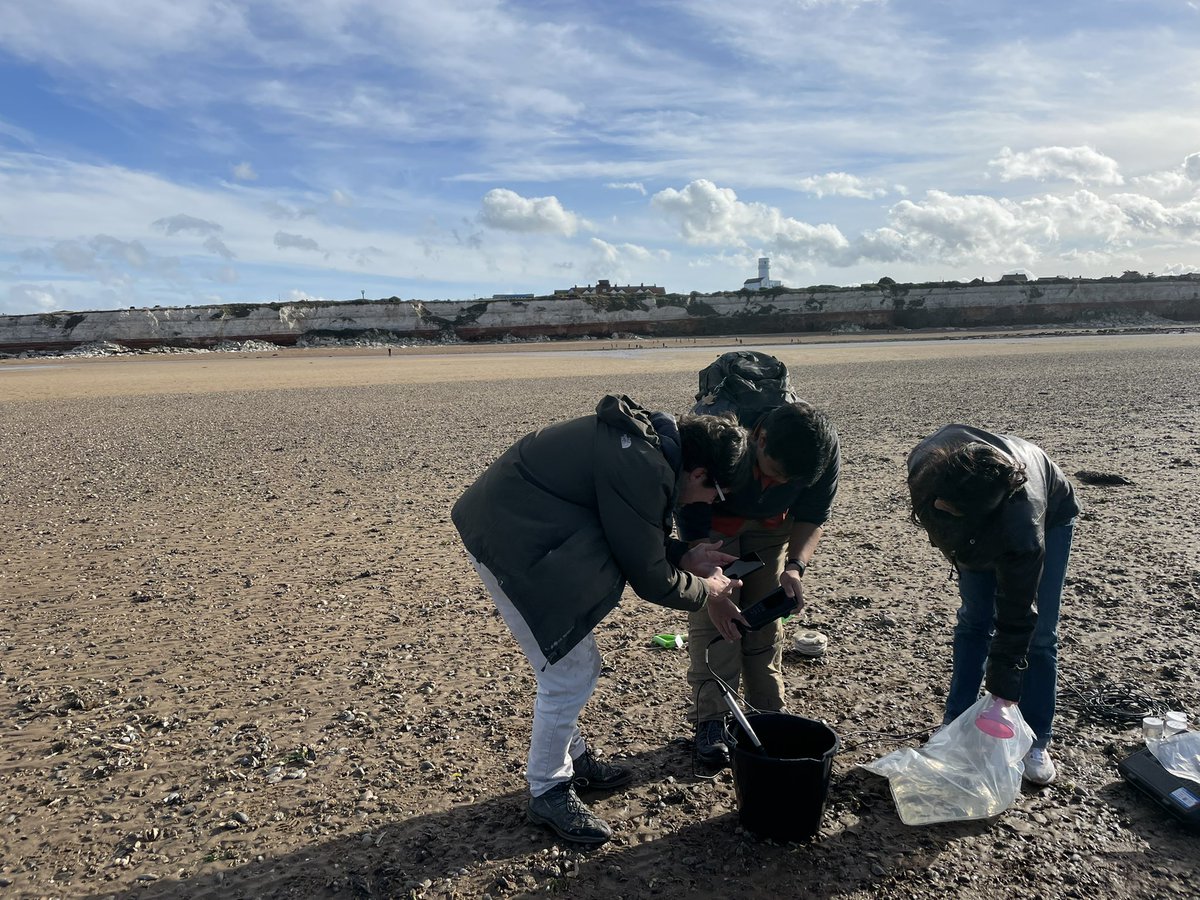
Riverwatch gets salty with a day at the beach! Collecting seawater for masters student Tian’s project, trying to understand the fate of riverine DIC in estuarine environments #35PSU
New research led by Christina Larkin @cslarkin1, with Alex Piotrowski & @UCam_RiverWATCH🎇
An historic ‘weather map’ of ocean currents in the North Atlantic 🌊🗺️ The high res Nd isotope study gives a new angle on deep water formation during the LGM.
👉https://t.co/crb25L1t3B
A fun afternoon coring through travertines formed rapidly following carbonation of waste material from the steel industry to think about how to reduce CO2 emissions from industry with @WillKnapp18
…why we campaign to save our rivers…
This is what an unpolluted river looks like: River Ribnik, Bosnia
No intensive agri
No sewage discharges
Treasured & nurtured
Highly protected
This is what the #riverwye looked like before @AvaraFoods@thenoblefoods@Tesco came along