@literalbanana Acute social pain is like acute physical pain and has its uses. Chronic social pain is like chronic physical pain and is less useful per unit pain
@JonathanEgeland Evolution didn’t teach us to do calculus instead evolution gave us general purpose reasoning which enabled us to get to calculus. When we use general purpose reasoning to arrive at or confirm moral beliefs that is some evidence of truth of those beliefs
@heddamorch I appreciate your work, Do you believe phenomenal powers are an exception to the known laws of physics? Or is there some deep way in which they are consistent with the known laws of physics?
@kareem_carr If an rct shows that nonresponders to the previous treatments experience improvement on average with the new treatment, that helps. If you try stopping tx and pt gets worse until resuming tx, then yeah. But if all you have is low p value, my bet is this is from confounding
@robinhanson Antidepressants improve depression by 1.8 HAMD points (24 is severe depression) https://t.co/wCGxckG5Sj. This is less than doctors think, but enough for me: the diff e.g. btw weeping and nightly insomnia vs merely saying “I’m sad” and occasional insomnia. https://t.co/G5pmcbhjSO
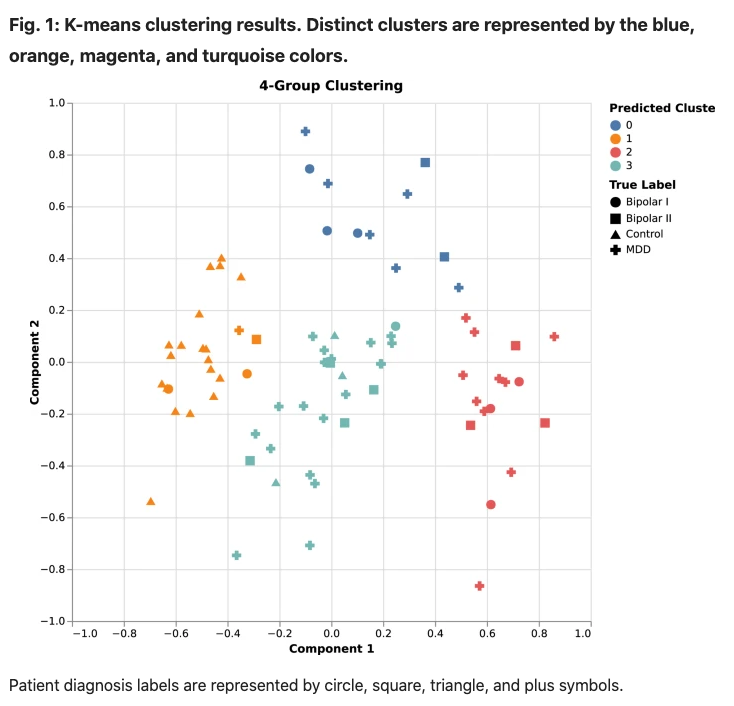
Through an ongoing partnership with Mayo Clinic and John Hopkins, we used mindLAMP to classify and cluster bipolar vs depressive disorder patients vs controls using digital phenotyping data. New in @npjDigitalMed: https://t.co/fFRRniHqH6
Thank you to my mentor Rick Hoyle for supervision on this project, and the editor and reviewers for making it stronger. I am also permitted to acknowledge ZB, who provided a patient perspective on a draft of the manuscript. [8/8]
Why do some acute COVID-19 patients get long COVID but others do not? I’m not an immunologist, but I do work with big social media data which offers one perspective on this key public health question. Now published in @PLOSONE. https://t.co/ghs1Q6ZVLi [1/8]
The fact that some ME/CFS-identified pts sought mutual support on a long COVID forum speaks to the long-suffering experience of these people who do not feel listened to by segments of society and healthcare. Listening to patients is something I always strive to do better. [7/8]
@AlanMCole When I first learned about Napoleon as a child, my brother pranked me by teaching me something like that and I was amazed (and sorely disappointed when I learned the truth)
For another take on similar data using different assumptions, we recommend reading Stone et al. https://t.co/wCGxckG5Sj. The present study was only possible because Stone et al. generously shared their aggregate data with us.
10/10
Our paper “Use of Quantile Treatment Effects Analysis to Describe Antidepressant Response in Randomized Clinical Trials Submitted to the US Food and Drug Administration” is now published in @JAMANetworkOpen. w/ Carl Pieper and Rick Hoyle. It’s free
https://t.co/IpSofIzv7c
1/10
Limitations of the study include lack of study-specific, drug-specific, and demographic information, lack of long-term outcomes, lack of side effect information, and the fact that our results heavily depend on reasonable but unproven statistical assumptions.
9/10