This is one of the most memorable scenes in Amadeus, often cited when discussing the performance that earned F. Murray Abraham the Academy Award for Best Actor for his portrayal of Antonio Salieri.
Abraham brings remarkable depth to Salieri, while Tom Hulce is equally unforgettable as Mozart. Only one could take home the Oscar, but both delivered performances that remain unforgettable.
The Mysterious Cities of Gold is a classic 1982 cartoon adventure show, running for 39 episodes. Set in the 16th century that follows three kids searching for lost treasure and their missing parents in the New World. A classic adventure series with another memorable theme tune
We congratulate Levent Alpöge and Tristan Buckmaster on their remarkable mathematical work.
We (the researchers and the agents) did not see any of their work through any means until they released it publicly — in particular, no specific user data was accessed in order to solve this problem.
While unlikely, we cannot rule out that de-identified data derived from their usage of our products helped improve our models.
However, our proofs differ significantly and even the precise results proved are different in the Euler case (forced vs. unforced).
We’re sharing a solution to the Navier-Stokes Millennium Prize Problem, one of the deepest problems at the frontier of mathematics.
The proof was produced by a group of agents, using an OpenAI next-generation model significantly more capable than GPT-6 Astra.
The problem concerns whether the description of smooth three-dimensional fluid motion modeled by the Navier-Stokes equations can break down. It has remained unresolved for roughly 90 years.
An American soul song became an unlikely a cappella classic for The Housemartins. Originally recorded by Isley-Jasper-Isley, “Caravan of Love” was completely stripped of instrumentation for the Hull band’s 1986 version, putting their vocal harmonies at the centre. The single went on to become The Housemartins’ only UK No. 1. Performing it on The Tube in 1986, the band showcased a very different side from their usual jangly guitar pop.
As part of the GPT-6 Astra launch, we announced that Astra had given an improvement to the longest gap between primes by roughly a log log n factor; the first such improvement since the 1930's! (More recent progress by subsets of Ford, Green, Konyagin, Maynard and Tao and more recently by GPT 5.6 Sol were by logloglog n factors.) (1/4)
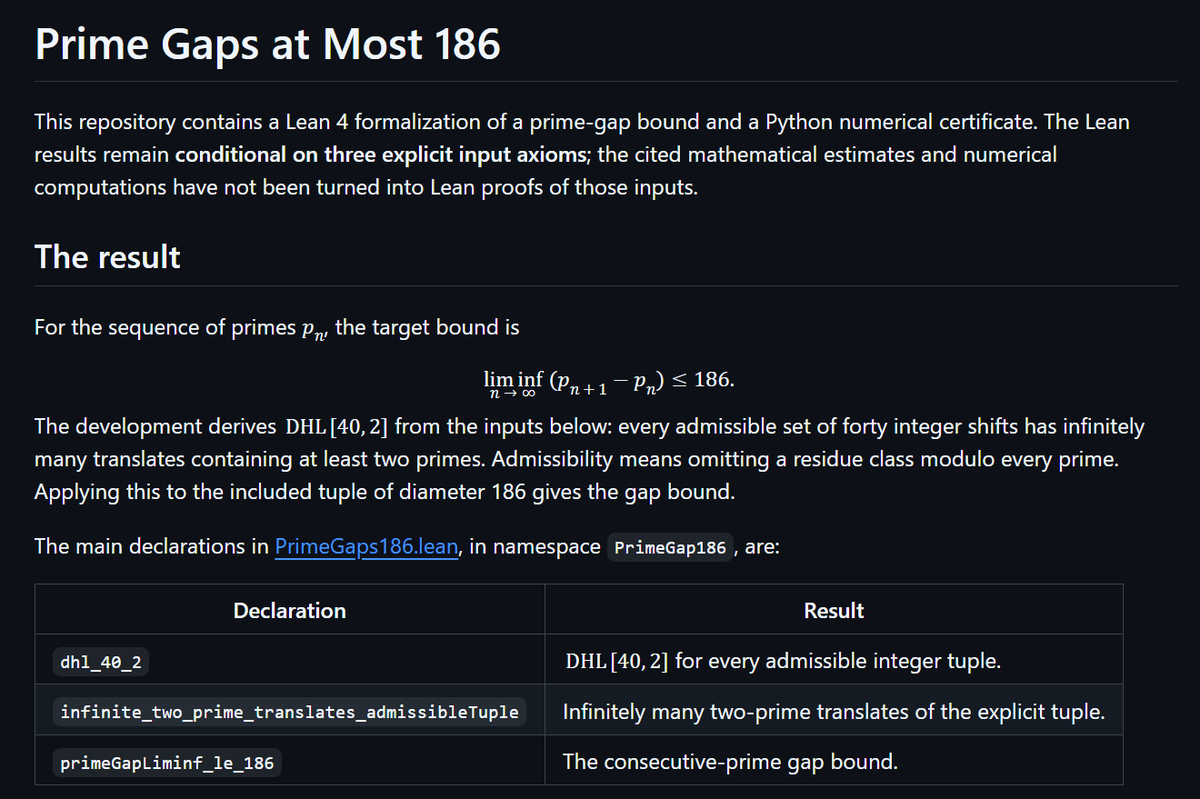
New OpenAI repo with a Lean formalization by GPT-6-Astra proves that there are infinitely many pairs of consecutive primes whose distance is at most 186
https://t.co/kegFNJKQrq
Very nice!! GPT 5.6 has broken the record on large gaps between primes.
The new bound saves a factor of ≈ log_3(n) over the prior record by Ford-Green-Konyagin-Maynard-Tao from 2018. The result is also now formalized by Alexeev in Lean.
here’s the pdf: https://t.co/y6j9sXiw1T
maybe my favourite part of this construction is that i love triangle groups, and especially universal families of tori (okay, i admit, not algebraic) over their corresponding stacky \P^1s, and it’s precisely such a family that one compactifies to conclude here!!
the main thing is making sure \pi_1 vanishes and one has the right homology, since there aren’t any exotic spheres in six dimensions and obviously the relevant poincare inputs are known. that’s a finite computation in terms of the matrices, which is why i hope it’s reasonable to verify from the two pages
S^2 and S^6 were the only spheres admitting almost complex structures (obviously S^2 = \P^1(\C)) and people long wondered how to find some invariant like nijenhuis ruling out complex structures when the space of almost complex structures was nonempty. Maybe we should reverse our intuition and suspect there are way more complex structures than we thought:))
We asked an unreleased research version of Claude to take a stab at the Riemann hypothesis.
It didn’t solve it, but it did make strides on a related problem: it increased the lower bound for the fraction of zeros of the Riemann zeta function that satisfy the hypothesis from 41.6% to 67.2%.
https://t.co/aZDvqqhHRi
British Pupil Wins International Maths Olympiad, Becomes Most Decorated Participant of All Time
Alex, who is in Year 13 at Tonbridge School, came joint 1st with a perfect score of 42/42, earning his fifth Gold medal at this year’s edition in Shanghai.
These 5 Gold medals, along with 2 Silver medals, means Alex is now the most successful participant of all time in the world’s most prestigious school-age academic competition, which has been running since 1959.
Read more: https://t.co/eo45d8u39Z
hello there the jacobian conjecture is false thanx to my close friend akhil for asking about it and my other close friend fable for working during the world cup final
((1+xy)^3 z + y^2 (1+xy) (4+3xy), y + 3 x (1+xy)^2 z + 3 x y^2 (4+3xy), 2 x - 3 x^2 y - x^3 z): \C^3\to \C^3, has jacobian determinant -2, and sends (0, 0, -1/4), (1, -3/2, 13/2), and (-1, 3/2, 13/2) to (-1/4, 0, 0)
This is quite a remarkable result:
Posed in 1939, the Jacobian conjecture is one of the central open problems in algebraic geometry, but was just disproved by Alpoge, Matthew, and Claude Fable 5.
The Jacobian conjecture roughly says that a multivariable polynomial F has an inverse function (made out of polynomials) provided the Jacobian is non-singular (i.e. matrix of partial derivatives has non-zero determinant). This condition is neccessary by the Inverse Function Theorem from multivariable calculus. The hard question is whether it is also sufficient.
Evidently, Fable found that
F(x,y,z) = ((1+xy)^3 z + y^2 (1+xy) (4+3xy), y + 3 x (1+xy)^2 z + 3 x y^2 (4+3xy), 2 x - 3 x^2 y - x^3 z)
has det(J_F) = -2 non-zero. However F is not invertible, since F sends three different pts (0, 0, -1/4), (1, -3/2, 13/2), and (-1, 3/2, 13/2) to the same image (-1/4, 0, 0).
Beyond the disproof itself, it would be value to know if a suitably refined conjecture is recoverable. Per @Acer, GPT5.6 has proposed:
"A constant-Jacobian polynomial local biholomorphism with no loss of sheets at infinity—e.g. a proper Keller map—is an automorphism."
I would be interested to know if any algebraists (e.g. @levent@littmath) have a reaction to this...
A further twist to the story:
Not only was the Jacobian conjecture one of the central open problems in algebraic geometry, it was (a special case of) Yitang Zhang's PhD problem!
The catch was that Zhang's advisor had him solve it, assuming a lemma of his advisor. But that lemma turned out to be false! As a result, Zhang's thesis crumbled and he then struggled to get recommendation letters and a permanent academic position. Despite all this, Zhang went on to prove bounded gaps between primes!
This is one of the most inspiring stories in modern mathematics, and was a motivation for me to work in the same area for my doctorate.
James Maynard has been appointed new Regius Professor of Mathematics in Oxford. One of the outstanding talents in mathematics today, James is currently Professor of Number Theory in Oxford. He will succeed Andrew Wiles, our inaugural Regius Professor.
https://t.co/BDeykynVOl
James Maynard: The Prime Number Genius Who Conquered the Fields Medal
James Maynard (b. 1987) is an English mathematician and Professor at Oxford University, renowned for his groundbreaking work in analytic number theory.
In 2013, he revolutionized the study of prime gaps by developing a powerful new multidimensional sieve, proving that there are infinitely many prime pairs differing by at most 600 (later improved to 246). This was a major leap toward the Twin Prime Conjecture.
His further breakthroughs include results on large gaps between primes, bounded intervals containing prime clusters of any fixed length, and solving the Duffin-Schaeffer conjecture. These achievements earned him the Fields Medal in 2022.