DAC 2026 takeaway: the AI-EDA startup wave has split into 4 camps — foundation models that build their own chips, agentic flow enablers, TAM expanders (genAI RTL/debug), and head-on flow challengers. The winners look more like design/IP companies than traditional EDA. A golden age of IC design is here. #DAC26
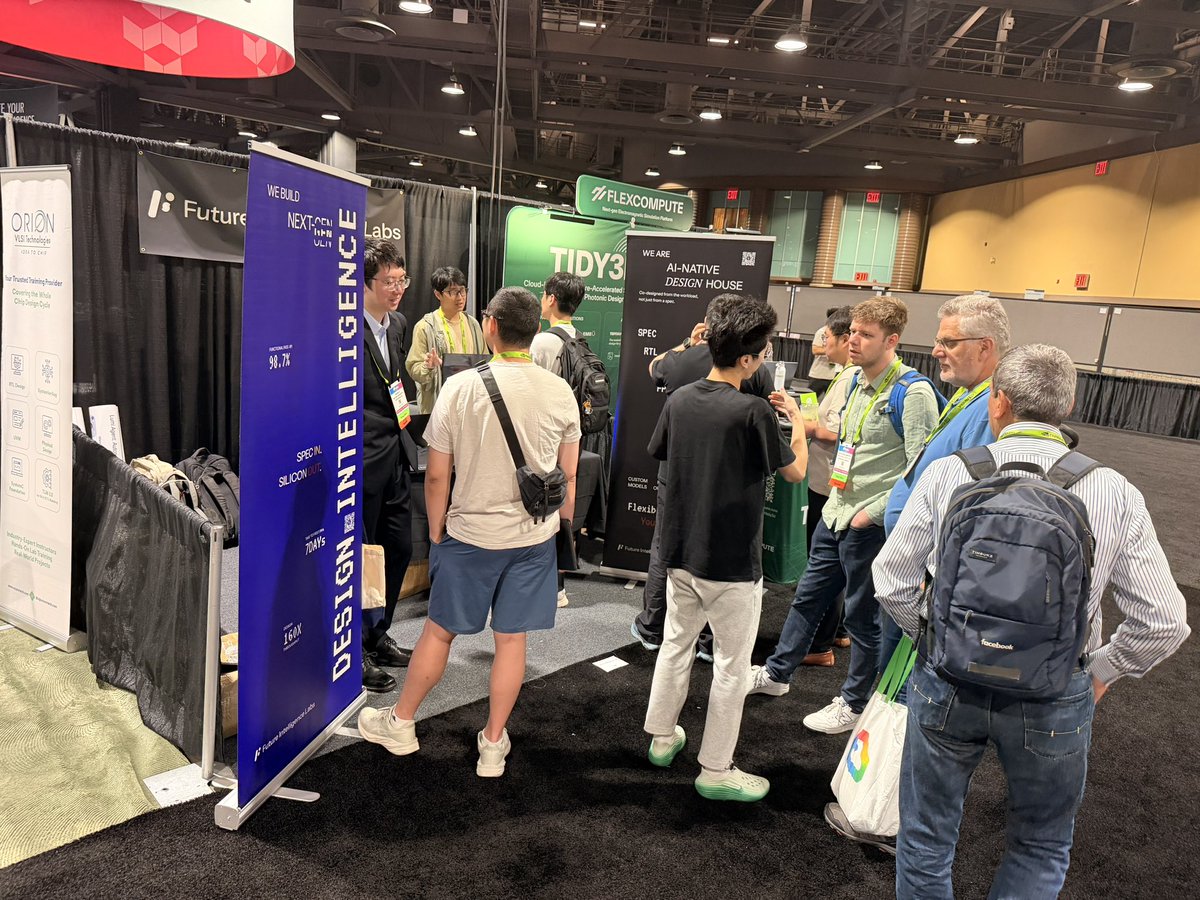
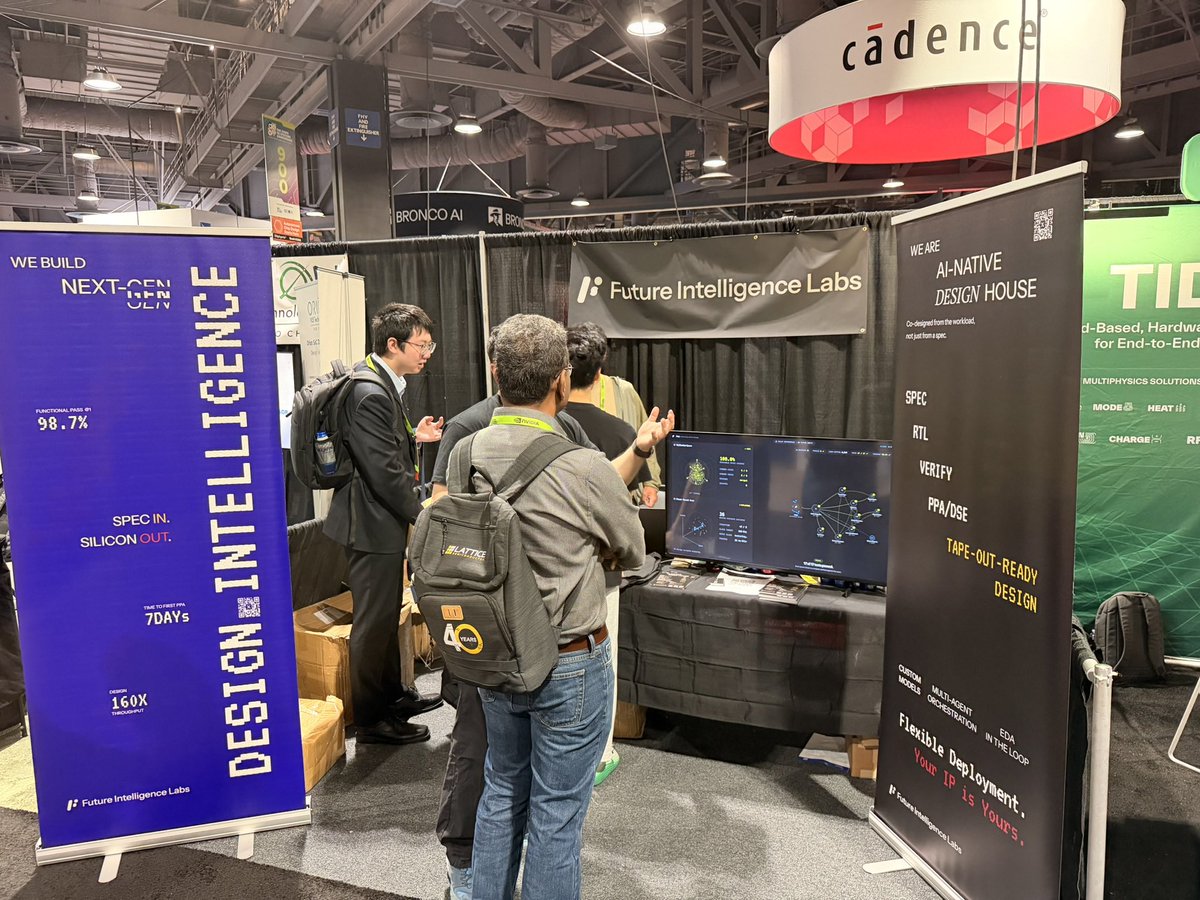
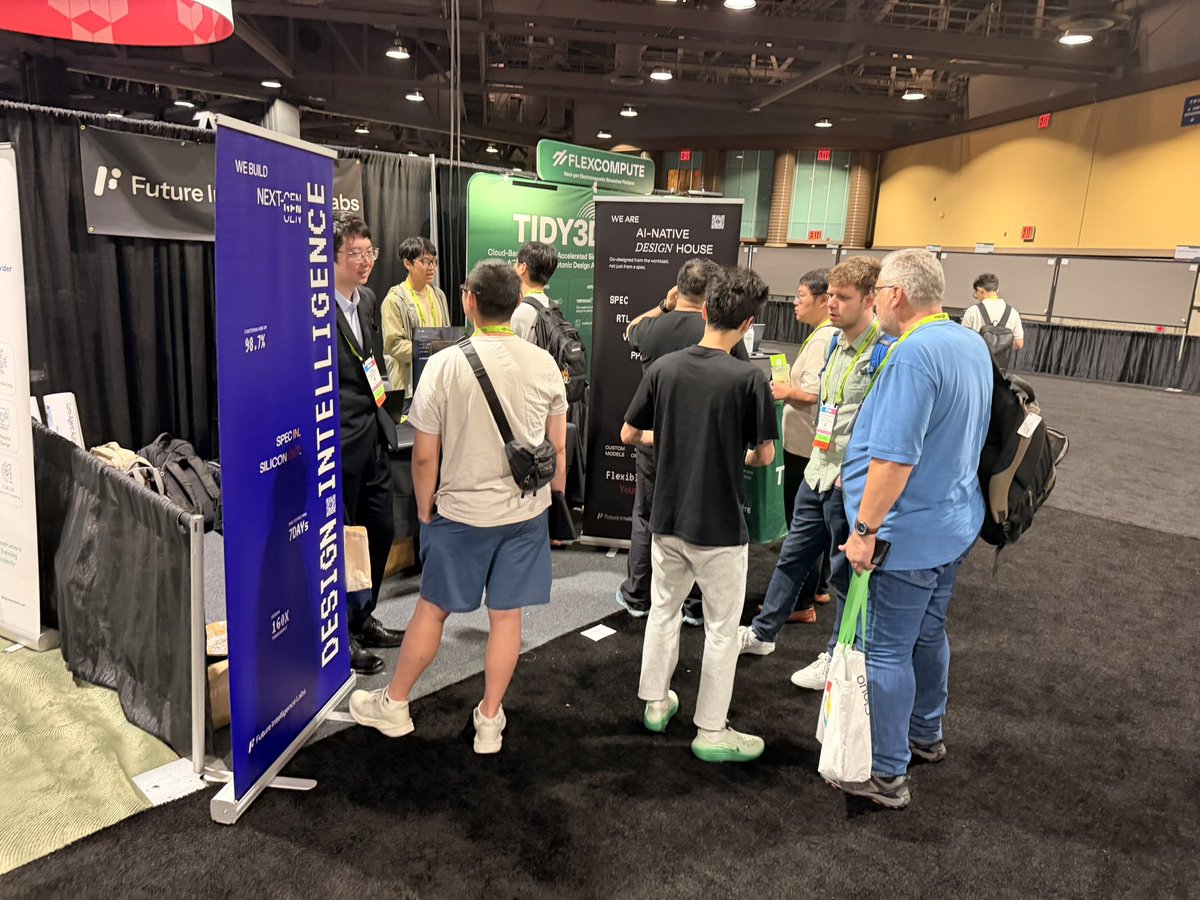
Future Intelligence Labs is exhibiting at #DAC2026 in Long Beach!
📍 Booth 729, Long Beach Convention Center
🗓 July 27–28, 10:00 AM–6:00 PM
🗓 July 29, 10:00 AM–4:00 PM
Stop by and meet the team.
#EDA#ChipDesign#Semiconductor#AgenticAI
If this report is accurate, the story is not just the delay.
It shows AI hardware moving from chip-level performance to rack-scale execution.
At that scale, the system around the silicon must be manufactured, integrated, and operated reliably.
Although I cannot physically join the conference, I am very happy to discuss online about my paper, future collaboration and internships🥳! Feel free to contact me via email ([email protected])!
Link to my CV: https://t.co/qhNqKurSP9
Google Scholar: https://t.co/7ghQjPAbB7
Custom silicon is becoming more important as AI workloads diversify.
But the pressure is not only on architecture.
More design variants mean more specs, more verification, more PPA trade-offs, and a stronger need for models that can work inside the design flow.
[3] GUI-Spotlight: Adaptive Iterative Focus Refinement for Enhanced GUI Visual Grounding
Time: Tue, Jul 7, 2026 • 2:00 PM – 3:45 PM (Seoul Time)
Location: Hall A #1209
‼️ MLLMs power today's GUI agents, but they still can't reliably point. On dense, high resolution professional screens, mapping "click the Send button" to exact pixels breaks down, and recent 7B grounding models stall around 50% accuracy on ScreenSpot Pro.
🚀 We introduce GUI-Spotlight, a think with image grounding model that iteratively narrows its focus like a spotlight. It invokes crop, extract, and color tools to home in on the target, trained with a stabilized multi tool RL pipeline built on GSPO. On ScreenSpot Pro it achieves 52.8% accuracy using only 18.5K training samples, beating V2P 7B (50.6%, 9.6M samples) and GTA 1 7B (50.1%, 1.56M samples) with up to 500× less data, while staying competitive with 72B scale models!
🔥Paper: https://t.co/DTRFblXxnp
🔥Code: https://t.co/WCrq3U5tXI
[4] StitchCUDA: An Automated Multi-Agents End-to-End GPU Programing Framework with Rubric-based Agentic Reinforcement Learning
Time: Thu, Jul 9, 2026 • 3:00 AM – 4:45 AM
Location: CDTHALL A #115
‼️ LLMs are getting good at writing single CUDA kernels — but real ML workloads aren't single kernels. End-to-end GPU programs depend on fusion boundaries, launch configs, CPU↔GPU sync, and data movement.
🚀 We introduce StitchCUDA, a multi-agent framework integrated with rubric-based agentic RL for end-to-end GPU program generation. On KernelBench it achieves 90% success rate and 1.5× avg speedup over PyTorch eager — 1.72× over multi-agent baselines and 2.73× over RL model baselines — with a 32B Coder that beats GPT-5.2!
🔥 Paper: StitchCUDA: An Automated Multi-Agents End-to-End GPU Programing Framework with Rubric-based Agentic Reinforcement Learning
🔥 Code: https://t.co/jmJIwSdSVM
I will be at ICML and together with my students and collaborators we will present the following works. I will be at the conference on the opening day.
If you're attending, please stop by our posters, and we'd love to discuss optimization, reinforcement learning, LLMs, and AI systems!
Excited to be presenting our work on Stitch CUDA at #ICML2026! 🎉
If you’re attending, I’d love to chat about LLMs for GPU programming, code generation, and software systems. Come stop by our poster!
Poster Session 8 #115
07/09 5:00 - 6:45PM









![MingyiHong01's tweet photo. [4] StitchCUDA: An Automated Multi-Agents End-to-End GPU Programing Framework with Rubric-based Agentic Reinforcement Learning
Time: Thu, Jul 9, 2026 • 3:00 AM – 4:45 AM
Location: CDTHALL A #115
‼️ LLMs are getting good at writing single CUDA kernels — but real ML workloads aren't single kernels. End-to-end GPU programs depend on fusion boundaries, launch configs, CPU↔GPU sync, and data movement.
🚀 We introduce StitchCUDA, a multi-agent framework integrated with rubric-based agentic RL for end-to-end GPU program generation. On KernelBench it achieves 90% success rate and 1.5× avg speedup over PyTorch eager — 1.72× over multi-agent baselines and 2.73× over RL model baselines — with a 32B Coder that beats GPT-5.2!
🔥 Paper: StitchCUDA: An Automated Multi-Agents End-to-End GPU Programing Framework with Rubric-based Agentic Reinforcement Learning
🔥 Code: https://t.co/jmJIwSdSVM](https://pbs.twimg.com/media/HMjZwM7bIAAue7k.jpg)


