On games of chance vs. games of skill
First, you must identify which game you’re playing. If you don’t, you won’t know the rules to win—and you might even confuse it for a different game entirely. Simple approach from first principles:
• What defines "winning"?
• Most importantly: In a game where the rules aren’t fixed, how do I redefine what it takes to win?
• What systems can I build to thrive when the rules are never permanent?
• What assumptions am I making that might be wrong?
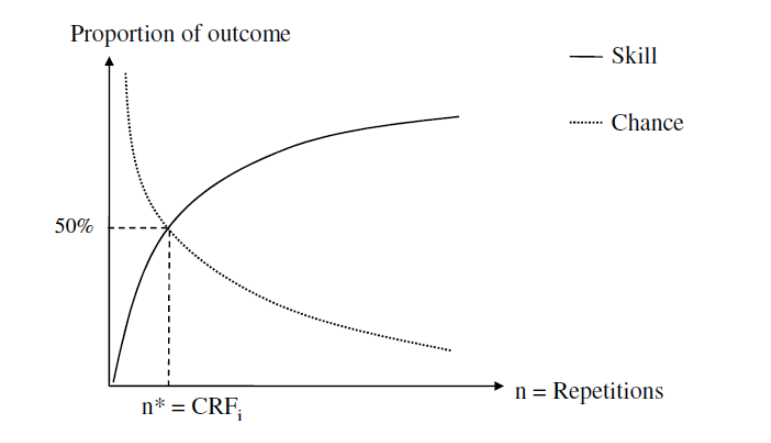
Understanding Critical Repetition Frequency (CRF) as a mental model helps you identify whether skill or luck governs a game.
CRF is the number of times you need to play a game before skill starts to matter more than luck. It is the "tipping point" where skill becomes the main factor in winning. Before that, luck rules; after that, skill does. Think of it like this:
• At first, luck heavily affects who wins
• But the more you play, the more skilled players can consistently outperform others
I don’t ask to crunch numbers— simply stay alert to how repetition amplifies skill. In a game of pure chance (like flipping a coin), skill never matters—it’s always 100% luck. In chess, skill matters immediately—you don’t need to play 100 games to see who’s better. Games like poker fall in the middle. Early on, luck dominates, but after many rounds, skilled players rise to the top.
Some games inherently require more repetition for skill to outweigh luck.
suffering is the best teacher for those who are willing to learn.
most continue to stay in a loop - the time lost and resources lost on the inability to learn from the same lesson is expensive.
“the longer you stay on the wrong train, the more expensive it is to get home.”