ADA, AVAX, SUI, JUP, AND IMX: WHICH TOKENS ARE MOST VULNERABLE TO LIQUIDATION CASCADES?
A market with good spot liquidity is not necessarily safe when derivatives leverage increases.
ㅤ
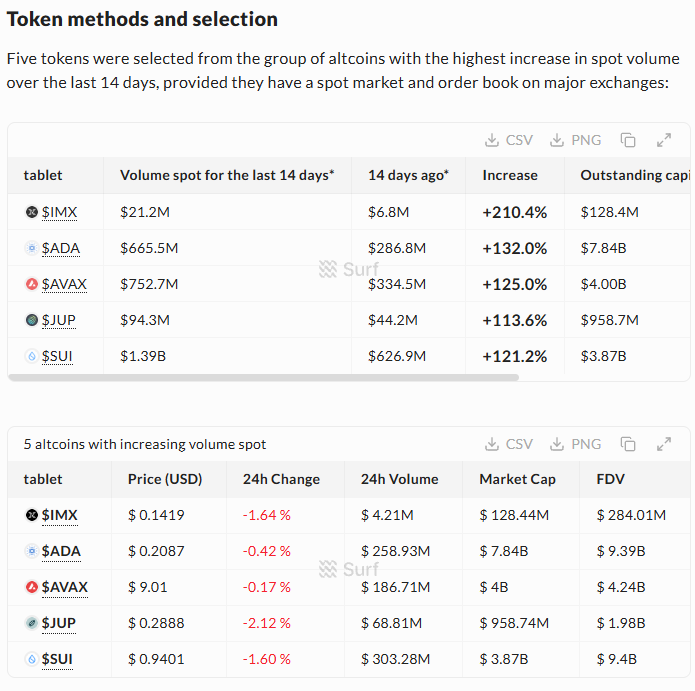
- Surf's October 25 research combined order book data with open interest and funding for five altcoins on Binance.
ㅤ
📊 SUI had approximately $100.7 million in OI, the highest in the group. Positive funding of 0.002956% every 8 hours indicates that longs were paying funding, while bid depth within 1% was only around $637,000.
ㅤ
📊 AVAX had $89.4 million in OI and slightly positive funding. Its relatively strong spot liquidity across multiple exchanges gave the market better order absorption capacity than JUP and IMX.
ㅤ
📊 ADA had $69.3 million in OI, slightly negative funding, and the deepest order book among the tokens studied.
ㅤ
JUP deserves closer attention.
ㅤ
Its OI was only around $14.8 million, but funding reached +0.005% every 8 hours, the highest in the group. Meanwhile, bid depth within 1% on Binance was only approximately $100,400.
ㅤ
If prices fall quickly and many long positions are liquidated, selling pressure could greatly exceed the visible buying liquidity.
ㅤ
IMX, meanwhile, had lower OI of approximately $3.4 million, but a very thin order book. Its main risk is prices moving through multiple levels when large orders appear, not necessarily a large-scale derivatives liquidation event.
ㅤ
- Surf ranked executable liquidity quality in the sample as follows: ADA > AVAX ≈ SUI > JUP > IMX.
ㅤ
This is not a ranking of upside potential. It shows order absorption capacity and vulnerabilities during market volatility.
ㅤ
High OI does not automatically cause liquidation cascades, but when combined with thin order books and concentrated leverage, price movements can become much more severe.
@SurfAIHQ
🔥 2.39 BILLION CAKE BURNED, BUT SUPPLY FELL BY ONLY 20 MILLION?
An impressive number. But looking only at burned tokens can lead to a completely misleading picture of tokenomics.
ㅤ
PancakeSwap data analyzed by Surf, updated through October 13, 2026, shows:
ㅤ
🔥 Total CAKE burned year to date: approximately 2.39 billion
📈 Total new CAKE issuance: approximately 2.37 billion
📉 Net supply reduction: approximately 20 million CAKE
ㅤ
In other words, most of the burned tokens were offset by new issuance.
ㅤ
Even so, PancakeSwap still recorded a net supply reduction of approximately 5.65%, according to its dashboard. This is an actual result, not merely an announced buyback plan.
ㅤ
- The important point in Surf's analysis is the difference between gross burn and net deflation.
ㅤ
A project can burn billions of tokens while supply decreases only slightly if emissions remain high. Conversely, a relatively modest burn can still be effective when new issuance is controlled.
ㅤ
Therefore, the number worth watching is not only the total tokens burned, but the actual supply reduction after accounting for all new issuance.
ㅤ
Tokenomics should not be evaluated by the biggest numbers, but by their real impact.
@SurfAIHQ
Mainnet Has Only Just Begun, and TVB Has Already Taken Another Step Forward
ㅤ
🔥On October 20, 2026, Optimum officially brought mump2p into operation on Ethereum Mainnet, with approximately $3.4 billion in Total Value Boosted reported at launch.
ㅤ
- And now, the project has provided another update showing an additional 135,000 ETH, equivalent to approximately $324 million, since the first day.
ㅤ
These two milestones tell a story that is still unfolding.
ㅤ
- Initially, the focus was on bringing Random Linear Network Coding technology into a production environment. What follows is tracking the scale of staked value associated with the acceleration network as the system continues operating.
ㅤ
- Notably, Optimum did not build a new blockchain to attract this amount of ETH. mump2p operates as an additional transmission layer for Ethereum's existing infrastructure.
ㅤ
🚀 TVB growth is a signal worth watching, but long term effectiveness still needs to be evaluated through actual networking measurements.
ㅤ
- The next stage of Optimum's journey will become more interesting as deployment scale and network performance data are monitored together.
@get_optimum
Total Value Boosted has grown by 135,000 $ETH ($324M USD) since launch day. 📈
Track TVB and network performance metrics on the Optimum Hub. https://t.co/RpBy96dVcR
Tonight, the Mic Is Mine! 🎤😎
The Optimum Vietnam Karaoke Night was all about singing our hearts out and having an amazing time!
Who says work is only about deadlines?
Tonight, it was all about music, laughter, and unforgettable performances. Optimum Vietnam, 10/10 no notes!
@get_optimum
22,000 Validator Keys Is a Large Number. But Its Meaning Needs to Be Understood Correctly.
ㅤ
✅In its Ethereum Mainnet announcement on October 20, 2026, Optimum reported an mump2p deployment scope involving approximately 22,000 validator keys, 16 node operators, and more than 1.4 million staked ETH.
ㅤ
These figures reflect the scope of infrastructure participating in the deployment, but they do not mean that all 22,000 validators are directly generating the same amount of data traffic.
ㅤ
✅A validator key represents an identity participating in consensus. Meanwhile, block exchange takes place through node infrastructure and the networking connections used by operators.
ㅤ
This distinction is very important when analyzing the adoption of a new protocol.
ㅤ
📌 The number of validator keys helps illustrate the scope of related staking activity.
ㅤ
📌 The number of node operators indicates the level of participation among operating organizations.
ㅤ
📌 Actual traffic and performance data are what help evaluate the protocol's usage and impact.
ㅤ
✅Optimum has achieved an important deployment milestone on Ethereum Mainnet, but the process of evaluating the technology does not stop at the initially announced figures.
ㅤ
✅What is worth monitoring next is mump2p usage over time, network scalability, and measurable improvements in block distribution operations.
ㅤ
✅A deployment milestone shows that the technology has entered production. Long term operational data is what helps determine how much sustainable value the technology creates.
@get_optimum
🔥 2.39 BILLION CAKE BURNED, BUT SUPPLY FELL BY ONLY 20 MILLION?
An impressive number. But looking only at burned tokens can lead to a completely misleading picture of tokenomics.
ㅤ
PancakeSwap data analyzed by Surf, updated through October 13, 2026, shows:
ㅤ
🔥 Total CAKE burned year to date: approximately 2.39 billion
📈 Total new CAKE issuance: approximately 2.37 billion
📉 Net supply reduction: approximately 20 million CAKE
ㅤ
In other words, most of the burned tokens were offset by new issuance.
ㅤ
Even so, PancakeSwap still recorded a net supply reduction of approximately 5.65%, according to its dashboard. This is an actual result, not merely an announced buyback plan.
ㅤ
- The important point in Surf's analysis is the difference between gross burn and net deflation.
ㅤ
A project can burn billions of tokens while supply decreases only slightly if emissions remain high. Conversely, a relatively modest burn can still be effective when new issuance is controlled.
ㅤ
Therefore, the number worth watching is not only the total tokens burned, but the actual supply reduction after accounting for all new issuance.
ㅤ
Tokenomics should not be evaluated by the biggest numbers, but by their real impact.
@SurfAIHQ
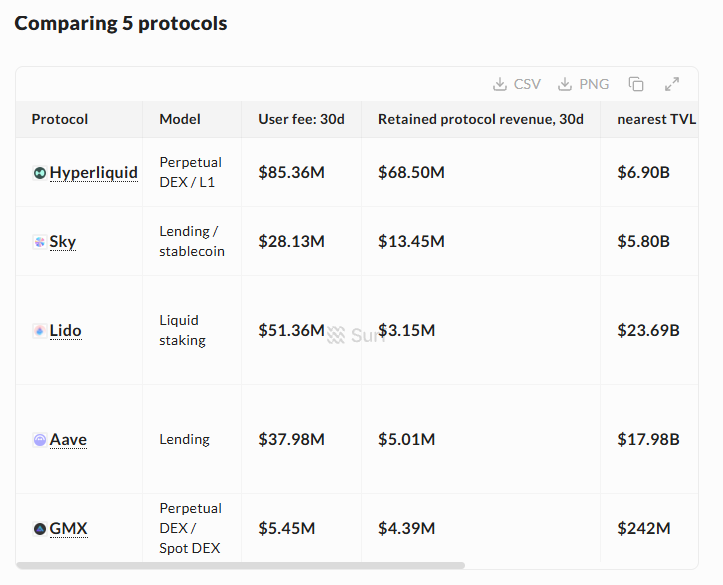
💰 I JUST USED SURF TO COMPARE REVENUE ACROSS 5 DEFI PROTOCOLS
Previously, when looking at a DeFi project, figures like TVL or trading volume often caught my attention. But this time, I wanted to know how much revenue the protocol actually retains.
ㅤ
I used Surf to analyze Hyperliquid, Sky, Aave, Lido, and GMX over the past 30 days.
ㅤ
The results were quite interesting:
ㅤ
🔥 Hyperliquid led with $85.36 million in fees and $68.5 million in protocol revenue.
ㅤ
🏦 Sky generated $13.45 million in revenue, while recorded incentive costs were only around $1,690.
ㅤ
🌊 Lido had the largest TVL at $23.69 billion, but its protocol revenue was only approximately $3.15 million.
ㅤ
What caught my attention most while using Surf was the difference between asset scale and revenue generation.
ㅤ
A protocol with tens of billions of dollars in TVL does not necessarily retain more revenue than a trading platform with a smaller TVL.
ㅤ
After this research, I believe evaluating DeFi requires looking beyond TVL. User fees, retained protocol revenue, and the value actually transferred to tokens all matter.
ㅤ
Surf helped me better understand how DeFi business models operate instead of focusing only on large numbers in rankings.
@SurfAIHQ
22,000 Validator Keys Is a Large Number. But Its Meaning Needs to Be Understood Correctly.
ㅤ
✅In its Ethereum Mainnet announcement on October 20, 2026, Optimum reported an mump2p deployment scope involving approximately 22,000 validator keys, 16 node operators, and more than 1.4 million staked ETH.
ㅤ
These figures reflect the scope of infrastructure participating in the deployment, but they do not mean that all 22,000 validators are directly generating the same amount of data traffic.
ㅤ
✅A validator key represents an identity participating in consensus. Meanwhile, block exchange takes place through node infrastructure and the networking connections used by operators.
ㅤ
This distinction is very important when analyzing the adoption of a new protocol.
ㅤ
📌 The number of validator keys helps illustrate the scope of related staking activity.
ㅤ
📌 The number of node operators indicates the level of participation among operating organizations.
ㅤ
📌 Actual traffic and performance data are what help evaluate the protocol's usage and impact.
ㅤ
✅Optimum has achieved an important deployment milestone on Ethereum Mainnet, but the process of evaluating the technology does not stop at the initially announced figures.
ㅤ
✅What is worth monitoring next is mump2p usage over time, network scalability, and measurable improvements in block distribution operations.
ㅤ
✅A deployment milestone shows that the technology has entered production. Long term operational data is what helps determine how much sustainable value the technology creates.
@get_optimum
Mainnet Is Live. Which Metrics Will Show Whether the Technology Is Truly Effective?
ㅤ
- Optimum bringing mump2p to Ethereum Mainnet creates an opportunity to evaluate the technology using real operational data rather than relying only on test results.
ㅤ
To fully understand the effectiveness of a block distribution protocol, several groups of metrics are worth monitoring.
ㅤ
① Block arrival latency
ㅤ
The time between when a block is broadcast and when a validator receives it. This is a direct indicator of transmission speed.
ㅤ
② Tail latency
ㅤ
Instead of looking only at average values, it is important to observe the slowest block transmissions, such as those at the 95th or 99th percentile.
ㅤ
③ Bandwidth consumption
ㅤ
A protocol that transmits data faster but consumes excessive bandwidth may create significant operational costs.
ㅤ
④ CPU and memory overhead
ㅤ
Network coding uses algebraic operations, so computational resources must also be considered.
ㅤ
⑤ Reliability under network disruption
ㅤ
How the system behaves when some peers disconnect or connection quality deteriorates.
ㅤ
- Optimum has published initial Mainnet results regarding block propagation speed and variation in block arrival times.
ㅤ
However, the remaining metrics still need to be evaluated using appropriate data before drawing comprehensive conclusions.
ㅤ
️ A successful networking technology must not only transmit data quickly under ideal conditions but also demonstrate resource efficiency and the ability to operate consistently over long periods.
@get_optimum
@NinhNinh99QN@aave@Morpho I'm especially curious about what SpoutFi is building on Solana. RWA is moving fast, and I hope the team brings something really exciting soon 👀
💰 I JUST USED SURF TO COMPARE REVENUE ACROSS 5 DEFI PROTOCOLS
Previously, when looking at a DeFi project, figures like TVL or trading volume often caught my attention. But this time, I wanted to know how much revenue the protocol actually retains.
ㅤ
I used Surf to analyze Hyperliquid, Sky, Aave, Lido, and GMX over the past 30 days.
ㅤ
The results were quite interesting:
ㅤ
🔥 Hyperliquid led with $85.36 million in fees and $68.5 million in protocol revenue.
ㅤ
🏦 Sky generated $13.45 million in revenue, while recorded incentive costs were only around $1,690.
ㅤ
🌊 Lido had the largest TVL at $23.69 billion, but its protocol revenue was only approximately $3.15 million.
ㅤ
What caught my attention most while using Surf was the difference between asset scale and revenue generation.
ㅤ
A protocol with tens of billions of dollars in TVL does not necessarily retain more revenue than a trading platform with a smaller TVL.
ㅤ
After this research, I believe evaluating DeFi requires looking beyond TVL. User fees, retained protocol revenue, and the value actually transferred to tokens all matter.
ㅤ
Surf helped me better understand how DeFi business models operate instead of focusing only on large numbers in rankings.
@SurfAIHQ
💰 1 DFX for Every 1 USDT Lost. It Sounds Like Full Repayment, but the Reality Is Not That Simple.
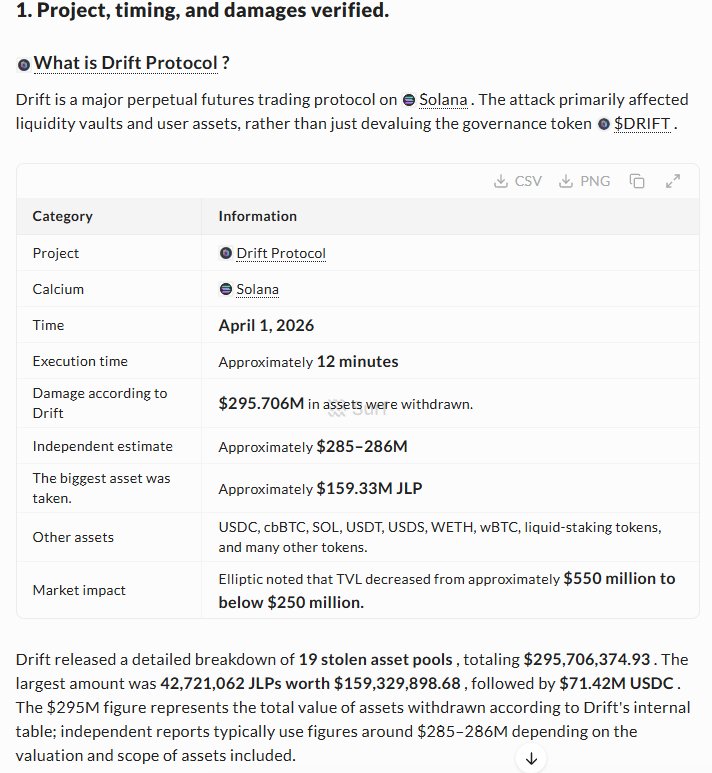
- Following the Drift Protocol attack, which caused approximately $285 million to $296 million in losses, the project opened DFX claims and redemptions on October 1, 2026.
ㅤ
- Surf highlights one crucial detail: DFX represents a claim on the Recovery Pool, not USDT that is fully backed at the moment the token is received.
ㅤ
At the time of the announcement, the Recovery Pool held approximately 3.1 million USDT. Additional funding is expected to come from protocol revenue, support commitments, and assets potentially recovered from the attacker.
ㅤ
This means the actual redemption value depends on the Recovery Pool balance and the amount of DFX in circulation.
ㅤ
- Surf's research shows the significant difference between a project announcing a compensation plan and users actually recovering all their assets.
ㅤ
Notably, the announced DFX claim deadline extends to 00:00 UTC on January 1, 2028.
ㅤ
- Surf helps clarify an important lesson following crypto hacks: examine the recovery mechanism, redemption ratio, and actual funding sources instead of focusing only on the number of compensation tokens distributed.
@SurfAIHQ
Mainnet Is Live. Which Metrics Will Show Whether the Technology Is Truly Effective?
ㅤ
- Optimum bringing mump2p to Ethereum Mainnet creates an opportunity to evaluate the technology using real operational data rather than relying only on test results.
ㅤ
To fully understand the effectiveness of a block distribution protocol, several groups of metrics are worth monitoring.
ㅤ
① Block arrival latency
ㅤ
The time between when a block is broadcast and when a validator receives it. This is a direct indicator of transmission speed.
ㅤ
② Tail latency
ㅤ
Instead of looking only at average values, it is important to observe the slowest block transmissions, such as those at the 95th or 99th percentile.
ㅤ
③ Bandwidth consumption
ㅤ
A protocol that transmits data faster but consumes excessive bandwidth may create significant operational costs.
ㅤ
④ CPU and memory overhead
ㅤ
Network coding uses algebraic operations, so computational resources must also be considered.
ㅤ
⑤ Reliability under network disruption
ㅤ
How the system behaves when some peers disconnect or connection quality deteriorates.
ㅤ
- Optimum has published initial Mainnet results regarding block propagation speed and variation in block arrival times.
ㅤ
However, the remaining metrics still need to be evaluated using appropriate data before drawing comprehensive conclusions.
ㅤ
️ A successful networking technology must not only transmit data quickly under ideal conditions but also demonstrate resource efficiency and the ability to operate consistently over long periods.
@get_optimum
Validators and the Benefits of Earlier Block Arrival
- 22,000 Validator Keys Are Within the Scope of mump2p Deployment on Ethereum Mainnet
ㅤ
This figure reflects the deployment scale announced by Optimum on October 20, 2026, spanning 16 node operators and representing more than 1.4 million staked ETH.
ㅤ
But why is data transmission technology important for validators?
ㅤ
Because when a new block appears, validators need to receive the information early enough to perform tasks related to attestation.
ㅤ
If a block arrives late, the processing window becomes narrower, and the likelihood of missing opportunities to participate on time may increase.
ㅤ
- Optimum uses mump2p to improve block distribution, aiming to reduce the disadvantages caused by networking latency.
ㅤ
During the initial Mainnet deployment, https://t.co/AABAai3I9l also required all 12 of its node operators to use this protocol.
ㅤ
This is a concrete application of data acceleration technology in staking operations.
ㅤ
However, earlier block arrival does not automatically guarantee higher staking rewards. The final outcome also depends on many other operational factors.
ㅤ
- The next important area to monitor for Optimum is the actual improvement in attestation timeliness, head vote accuracy, and validator operational efficiency as mump2p continues to be used on Mainnet.
@get_optimum
16 NODE OPERATORS. ONE MILESTONE TO BE PROUD OF! 🏆
ㅤ
Some achievements deserve celebration not only because the technology is ready, but also because real organizations have decided to use it.
ㅤ
And this Mainnet launch by Optimum is exactly such an occasion.
ㅤ
🎊 16 Ethereum node operators have participated in the deployment of mump2p.
ㅤ
They include names such as Blockdaemon, Everstake, https://t.co/EerCxORJeI, Stakefish, Luganodes, and InfStones.
ㅤ
Notably, https://t.co/AABAai3I9l has required all 12 of its node operators to use mump2p.
ㅤ
From research and testing to adoption by real operators, this is a step forward that truly deserves recognition.
ㅤ
Congratulations to the Optimum team for bringing its technology to such an important milestone! 💜
ㅤ
Hopefully, this collaboration will continue to expand, bringing more opportunities for cooperation and even more positive results to the Ethereum ecosystem.
ㅤ
💐Congratulations to everyone who helped make this Mainnet milestone possible!
@get_optimum
💰 1 DFX for Every 1 USDT Lost. It Sounds Like Full Repayment, but the Reality Is Not That Simple.
- Following the Drift Protocol attack, which caused approximately $285 million to $296 million in losses, the project opened DFX claims and redemptions on October 1, 2026.
ㅤ
- Surf highlights one crucial detail: DFX represents a claim on the Recovery Pool, not USDT that is fully backed at the moment the token is received.
ㅤ
At the time of the announcement, the Recovery Pool held approximately 3.1 million USDT. Additional funding is expected to come from protocol revenue, support commitments, and assets potentially recovered from the attacker.
ㅤ
This means the actual redemption value depends on the Recovery Pool balance and the amount of DFX in circulation.
ㅤ
- Surf's research shows the significant difference between a project announcing a compensation plan and users actually recovering all their assets.
ㅤ
Notably, the announced DFX claim deadline extends to 00:00 UTC on January 1, 2028.
ㅤ
- Surf helps clarify an important lesson following crypto hacks: examine the recovery mechanism, redemption ratio, and actual funding sources instead of focusing only on the number of compensation tokens distributed.
@SurfAIHQ
Where Can an NFT Take Its Owner Beyond the Marketplace?
It could be a real world event, a gaming world, a manga series, or an exclusive experience.
ㅤ
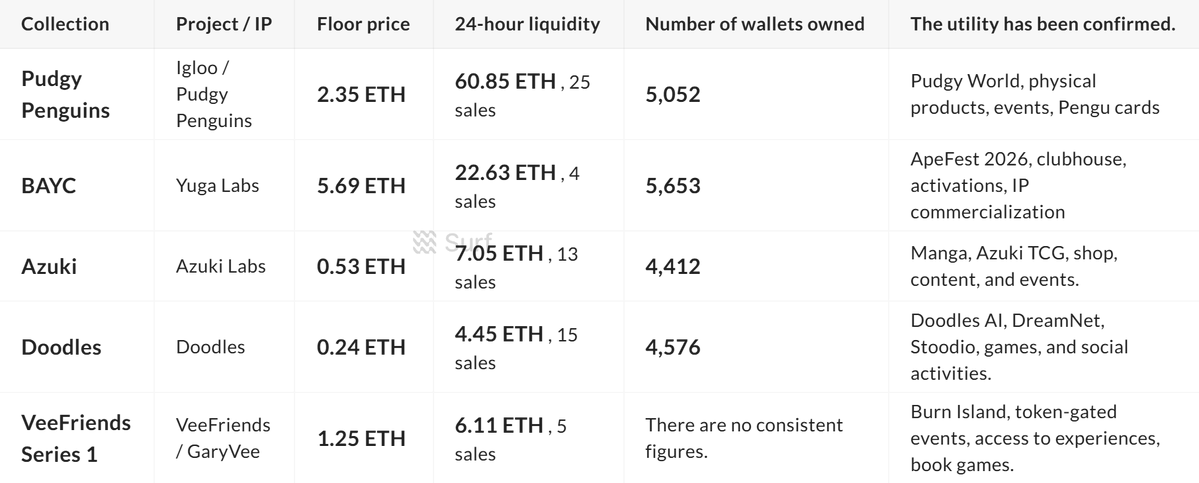
Surf's new report on five NFT collections in 2026 reveals very different development directions.
🐧 Pudgy Penguins has expanded its brand into toys, physical products, and Pudgy World, a browser game that is already operating.
🎟️ BAYC continues building its community through ApeFest 2026, held from October 15 to 18 with various in person activities.
🎴 Azuki is developing manga, animated content, and Azuki TCG, expanding NFTs into an entertainment ecosystem.
ㅤ
Interestingly, Surf examines not only the products that already exist but also distinguishes them from benefits reserved specifically for NFT holders.
ㅤ
A free game or a product belonging to the same brand does not necessarily require NFT ownership to use.
ㅤ
That is also what makes Surf's research noteworthy: NFTs are expanding beyond profile pictures, but ecosystem value and direct holder benefits remain two separate matters that need to be evaluated.
@SurfAIHQ