I’m still learning, but I want to build with purpose.
Not to prove myself, but to create things that help people work smarter, think more clearly, and solve problems that actually matter.
Unlock the power of autonomous workflows with Startup School: Agentic AI.
Join @GoogleCloud experts to discover how to build, deploy, and scale sophisticated #AIagents that drive real business impact. Ready to innovate? Register here ➡️ https://t.co/QzUDNTjYzt
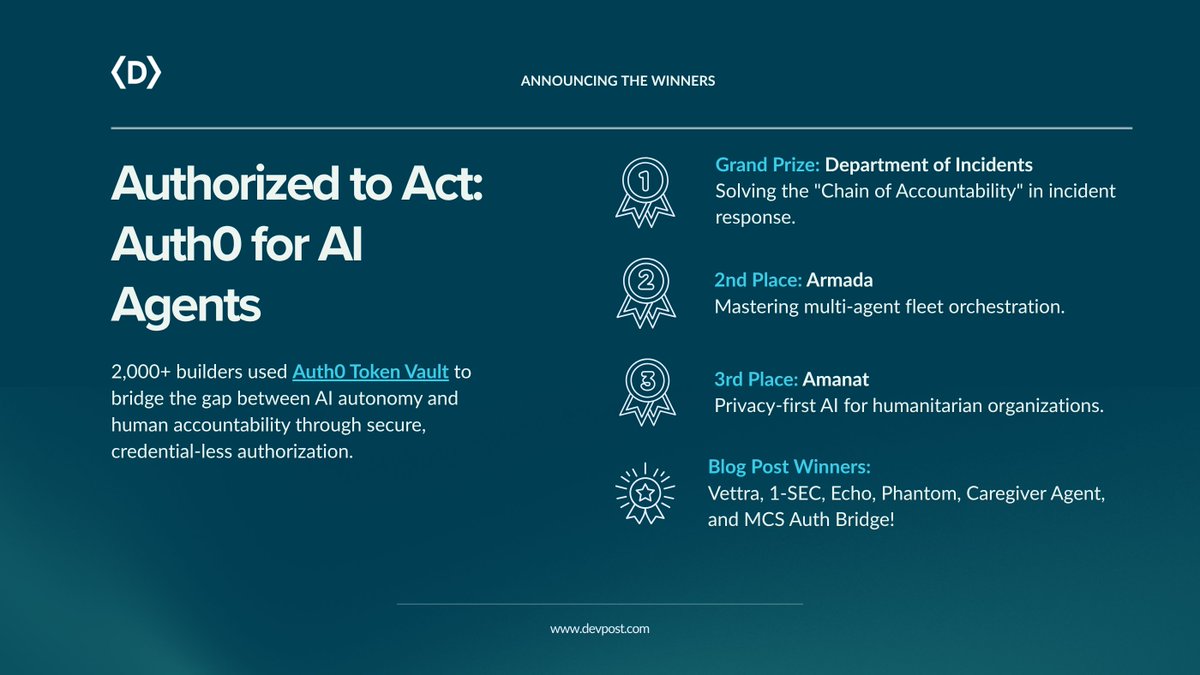
Using @Auth0 Token Vault, 2,000+ builders bridged the gap between AI autonomy and human accountability. Meet the winners of the #AuthorizedToAct Hackathon with @auth0 and @okta !
Check out all the projects and blog posts in the project gallery: https://t.co/A2mFQZuzCC
Physicians override about 90% of drug-drug interaction alerts in clinical decision support systems (Felisberto et al., 2024). Not because they are careless, but because most modern checkers fire the same context-free warning every day, with no mechanism, no priority, and no patient-specific reasoning. The tools designed to protect patients have become background noise.
The cost is staggering. The WHO estimates medication errors at $42 billion annually, with half of all preventable harm in healthcare tied to medications. Nearly 40% of adults aged 60 and older take five or more drugs at once (Wang et al., 2024). Among hospital inpatients, that figure climbs to 52% (Kim et al., 2024). Every additional medication compounds interaction risk, but the tools clinicians actually use still operate as pairwise database lookups.
So I built ARIA: a clinical reasoning engine for polypharmacy.
ARIA does not just check drug pairs. For a real patient regimen, it returns a patient-specific risk score adjusted for renal function, age, and hepatic status. It builds a force-directed interaction graph with critical and emergent multi-drug links. It explains the molecular mechanism behind every interaction. It computes cumulative anticholinergic, sedation, and QT prolongation burden across the whole regimen. It models a temporal risk timeline showing when danger peaks across the first two weeks. It generates a prioritized deprescribing plan that quantifies the expected risk reduction at each step. And every alert is evidence-graded and linked to real PubMed citations, so clinicians can triage by confidence instead of treating every alert as equally urgent.
The unique part is reasoning about the regimen as a whole. Pairwise checkers cannot see that three drugs are converging on the same enzyme, that today's interaction will not peak until day six, or that one substitution can remove 15% of total risk while keeping anticoagulation intact. ARIA does.
The stack is three languages on purpose. A Rust MCP server runs ten clinical tools, fast and type-safe. A Python LangGraph agent orchestrates the eight-step reasoning pipeline and exposes it over A2A v1.0, with agent card discovery, SHARP and FHIR R4 context propagation, and Markdown artifact rendering. A Next.js frontend with React Three Fiber renders everything as an interactive 3D clinical workspace. Gemini 2.5 Pro on Vertex AI handles the clinical reasoning.
ARIA runs live on Google Cloud Run and Vercel, registered as a specialist agent on the Prompt Opinion marketplace, so any A2A-compatible client can call it end-to-end without custom integration.
This is what an AI agent looks like when it thinks like a clinical pharmacologist instead of a database.
@devpost
#HealthcareAI #AIAgents #AgenticAI #Polypharmacy #PatientSafety
AI agents shouldn’t be trusted by default.
That’s why I built Vettra.
Grateful to see it recognized at the Auth0 AI Agents Hackathon.
Thanks to @auth0 for putting this together.
AI agents today can act on your behalf with far more access than you realize. Give them your Gmail credentials and they can read, send, delete, and forward messages on your behalf.
I built Vettra to fix that.
Vettra is a real-time authorization middleware for AI agents. Every action is intercepted, risk-scored, and routed through a policy engine before it executes.
• Low-risk → approved automatically
• Sensitive → requires human approval
• High-risk → denied outright
The agent never touches credentials.
Auth0 Token Vault with RFC 8693 token exchange issues scoped, time-limited tokens only after explicit approval.
No static API keys.
No leaked secrets.
No blank checks.
What the demo shows:
• Real-world threat simulation
• Human-in-the-loop approval queue
• Hash-chained audit log with SHA-256 integrity verification
• Live Auth0 Token Vault integration
• Rust WASM policy verifier
• One-line protect decorator
Built with:
• FastAPI on Google Cloud Run
• React and Vite on Vercel
• Auth0 Token Vault
• Rust to WebAssembly via wasmtime
• WebSocket for real-time approval
• SHA-256 hash-chained audit log
Core ideas:
• Every action is scored from 0 to 100
• Human approval for sensitive steps
• WASM sandbox for policy integrity
• Zero credential exposure to agents
• Authorization as a real-time decision, not static configuration
Who this is for:
• Teams building AI agents with real-world access
• Engineers using LangChain, LlamaIndex, or custom frameworks
• Security and platform teams managing agent risk
• Anyone who wants control before an agent takes action
🔗 YouTube: https://t.co/FENY7Akqg8
🔗 Medium: https://t.co/es4jfrPIJw
🔗 Live demo: https://t.co/qT2Lx2o2Oq
🔗 GitHub: https://t.co/LdUgouykVC
@auth0@Auth0Lab@devpost
#AIAgents #AISecurity #Auth0 #Rust #WASM #ZeroTrust #BuildInPublic
LLMs can reason.
But can they act securely? 🤖🔐
The Authorized to Act by @okta hackathon is underway.
Use the @auth0 for AI Agents Token Vault to close the agent “trust gap” — with Secure Tool Calling + MCP support built in.
💰$10K in prizes.
🗓️Deadline April 6.
⬇️Details
Every production outage I've investigated had the same root cause.
Not a bug. Not a typo. An assumption.
"This API always responds under 500ms."
"Payments never fail on the first try."
"Uploads will never exceed 10MB."
No one writes these down. No one tracks them.
They just sit in the code until production proves them wrong.
This is assumption debt.
And every codebase has more of it than most people think.
So I built Assumption Miner.
A GitLab Duo Agent that catches the invisible logic your linters miss and your code reviews rarely question.
🧬 DNA Fingerprinting. Every assumption gets a stable identity that survives refactors, renames, and merges. Nothing gets lost between sprints.
🔮 Predicts what breaks next. Powered by a Rust + WASM scoring engine with Monte Carlo simulation, it forecasts codebase health 2 to 4 sprints ahead.
🛡️ Maps each assumption to real risk. CWE, OWASP Top 10, SOC2, PCI-DSS, GDPR. Your tech debt becomes a compliance report.
🛠️ Generates fixes automatically. Opens a branch and merge request.
🚦 Runs in your CI/CD pipeline. Health score drops below the threshold? Merge blocked.
Open a merge request. Get a health score, risk breakdown, and fixes, all without leaving GitLab.
🔗 https://t.co/Oip6bK92zO
🦊 https://t.co/vuBFjfw2Lz
▶️ https://t.co/vnVNuoVaaF
Built for teams tired of postmortems ending with "we assumed it would never happen."
For the engineer paged at 3am because of a hardcoded timeout.
For the tech lead inheriting a codebase full of silent assumptions.
For teams that want to move fast without getting paged at 3am.
Assumption debt is real.
Now you can see it before it breaks you.
@gitlab@devpost #GitLabAIHackathon #buildinpublic #devtools #AI #opensource #gitlab #gitlabduo #GitLabAI
Just updated the demo video with proof of Google Cloud deployment. I also wrote a quick Medium article about how VoxGuard works.
Demo: https://t.co/CO6xZsvryD
Article: https://t.co/SUpTjph7m0
#GeminiLiveAgentChallenge
Every 30 seconds, someone loses money to a phone scam.
Scams don’t work because people are careless. They work because pressure works. Scammers create urgency, fear, and false authority, and in that moment, even someone who knows the risks can still hand over what should never be shared.
That’s where most anti-scam advice fails. It doesn’t fail before the call. It fails during the call, when pressure takes over and rational thinking starts to break down.
And that gap is far bigger than any one person can handle.
According to the FBI IC3 2024 Annual Report, internet crime losses in the United States hit $16.6 billion in 2024. In its 2024 report, the Global Anti-Scam Alliance estimated global scam losses at more than $1.026 trillion over the past year.
So I built VoxGuard solo for the Google Gemini Live Agent Challenge.
VoxGuard is a real-time multimodal AI agent that detects scams and intervenes as they’re happening. Built with Gemini Live API, Gemini 2.5 Flash, Google Cloud Run, React, and Rust WebAssembly, it analyzes live audio and visual signals, raises a threat score in real time, detects manipulation patterns like Authority, Urgency, and Fear, delivers natural voice warnings, and generates a personalized recovery plan after Safe Exit.
I built VoxGuard for people who knew better and still got scammed.
GitHub: https://t.co/kGK8PJBUPs
Live Demo: https://t.co/8SlPJNDVl5
#GeminiLiveAgentChallenge #GeminiLiveAPI #GoogleCloud #MultimodalAI #ScamDetection #Rust
🚨 High-stakes decisions fail for boring reasons: information overload, hidden assumptions, time pressure, and zero audit trail. Then you’re in the worst meeting of your life: “why did we decide this?” and nobody can explain it 6 months later.
So I built Grounds solo for the Google Gemini 3 Hackathon (Dec 18, 2025 – Feb 10, 2026).
✅ The solution: Grounds is a decision intelligence workspace that turns messy decision inputs into clear, auditable briefs in under 60 seconds. It’s a mirror, not a verdict.
Powered by Google Gemini 3, Grounds includes:
- 🎤 Voice input with live transcription
- 🔍 Gemini Critic for hard-edge critique and blind spot detection
- ⚖️ Multi-AI provider comparison for cross-model consensus
- 🎭 Aspect-based sentiment analysis
- ��� Deep adversarial stress testing with robustness scores
- 📊 3D decision landscape + radar visualizations
- 📄 PDF & HTML export with full audit trail
- 🧠 Gemini Grounding with Google Search for real-time research
- 📂 Google Workspace export (Docs & Sheets)
- 🏗️ Rust WASM scoring engine for deterministic quality metrics
🛠️ Built with: TypeScript (Next.js 15), Rust (WASM), Python backend.
🎯 Who it’s for: CEOs and exec teams, healthcare boards, finance teams, legal & compliance, government/education leaders, and any team making consequential calls.
👉🏻 Try it live (free tier API keys, may hit rate limits): https://t.co/HF5714FaU8
🌟 GitHub: https://t.co/80VfTw107H
@devpost @GoogleDeepMind @GeminiApp
#Gemini3Hackathon #GeminiAI #DecisionIntelligence #AI #Hackathon #Gemini3
🚨 I built REFLEX to solve a problem I’ve lived through. As a software engineer, I’ve dealt with stale runbooks, broken commands, and 3 a.m. incidents where the docs made things worse, not better. Nearly every team has a story like this. One outdated runbook can turn a quick fix into a prolonged outage.
⏱️ That’s why I built REFLEX solo in just 48 hours during the @MistralAI hackathon.
💡 REFLEX is more than a hackathon project for me. I’ve been through way too many 3 a.m. incidents because the runbooks were absolute garbage. If this can help even one other engineer avoid that nightmare and actually get some sleep, then it was worth every hour of it.
🤖 REFLEX reads real code and generates production-ready incident runbooks via the Mistral API (Mistral Large 3) using function calling.
🧩 Supports 6 programming languages: Python, JavaScript, TypeScript, Go, Java, and Rust.
⚡ Rust WASM powers sub-millisecond failure simulation, blast radius analysis, and cyclomatic complexity scoring, entirely client-side.
🌍 Outputs can be translated into 18 languages.
👷 Built for on-call engineers, SREs, and platform teams.
🗣️ Your code already knows how it will fail. REFLEX makes it tell you.
👉🏻 GitHub: https://t.co/shHMSkNSmb
#MistralAI #MistralHackathon @wandb@nvidia@awscloud@HackIterate
Just applied to the Mistral Worldwide Hackathon as an online participant. Waiting on approval.
Already cooking up ideas for a fast MVP.
48 hours. Lock in. Let’s build. 🚀
Lowkey, it’s peaceful staying in my lane and moving at my own pace. I’m not tryna prove anything fr. Just shipping, learning as I go, and minding my business. That’s deadass it. 😌
GitLab AI Hackathon is live 🚀
AI writes code. That’s expected.
Build the agents that handle everything after.
Build AI agents that handle planning, security, compliance, and deployments inside your @gitlab workflows.
��� $65K prizes
📅 Mar 25, 2026
⬇️
X might open-source the rec algorithm soon.
Lowkey I’m less interested in the code itself tho, and more in the write-up: goals, assumptions, trade-offs, all that.
Curious what they actually drop first 🤔