I have begun publishing my free article series on the fundamentals of meditation practice. None of this was written by AI. It is just someone who used to teach programming taking a similar approach to sharing what I have practiced and learned for over a decade.
Part 1: Risk and rewards of meditation practice.
https://t.co/9j4e6DUjH9
After dealing with hip issues on and off with both of my hips, as well as my lower back, I finally said fuck it, and am spending as little time as possible sitting during the day.
At 32 years old, I was always one day of too much sitting away from hobbling around the next day.
I do all kinds of physio and mobility work every day, so this was not the issue.
I don't know if sitting for 12-15 hours a day was actually the problem, but I will find out soon. I'm now sitting less than two hours per day. So far, hips are feeling much better, but my lower back at the bottom of the lumbar spine has been tight almost constantly since starting this.
Fun little experiment.
I've made a practice for a few years, where I just instantly mute/block creators who use overtly dumb or controversial statements for clicks.
It is just one small way to balance out the universe; even just one less pair of eyeballs and 1/1000th of 1% less algorithm favour.
It seems like for me, 30 minute sessions is plenty of time to develop refined mental states (samatha jhana) in meditation practice.
60 minute sessions seem to be much more ideal for development of insight (mind seeing its true nature).
This is for at home practice as someone who lives a busy homelife.
It's a very loaded topic. Some people like myself, and apparently @danielmingram (I asked him about this exact topic in a meeting recently), find it quite straight forward to group jhana by attentional shape. Some emphasize other markers or say "if you don't have all of these qualities, it's not jhana". This is too rigid for me but to each their own.
Speaking personally and not parroting anyone else's opinion, attentional shape is the most consistent and discrete way I have to measure jhana. Other aspects, like sensations (Piti, Sukkha, Upkhekka, etc.), the degree to which one state can be sustained, and the degree of percieved mental activity, are all quite variable. That part is where I agree with Daniel and many other in the pragmatic dharma crowd about this concept of "hard" versus "soft" jhana.
To me, a "hard" J4 would feel something like this:
- Attentional shape encompasses at least the whole body in an effortless space of awareness.
- Mental chatter actually ceases. This is rare and very noticeable for me.
- There may be some bodily sensation but it is extremely subtle, perhaps just on the pleasant side of neutral.
- The mind sits in that state, unperturbed, for at least a few minutes.
- The physical body is very relaxed to the point of almost slumping over.
A "soft" J4 for me might be:
- Attentional shape encompasses at least the whole body in an effortless space of awareness.
- Mental chatter, images, music, and so on may be chittering away but the mind is not clinging or pulled away by that.
- The sense of having a body in space, and the physical sensations related to that, are obvious if attended to.
- This could be quite short lived, like 30 seconds, before it shifts back into J2 or does something else.
I am piling up EEG readings of both hard and soft jhanas so hopefully this will become clearer with lots more data.
@Pranshul_01 I'll report how it is. I tried it for some coding tasks this morning and it was helpful but did make a few mistakes that seemed pretty basic. This with Sonnet model.
Last year I had to navigate a very tricky refactor estimation and process for one of the most important clients that my company has.
If you are curious about how to deal with those situations yourself (as a developer, PM, or Client), give this a read.
https://t.co/HC2PMh35sJ
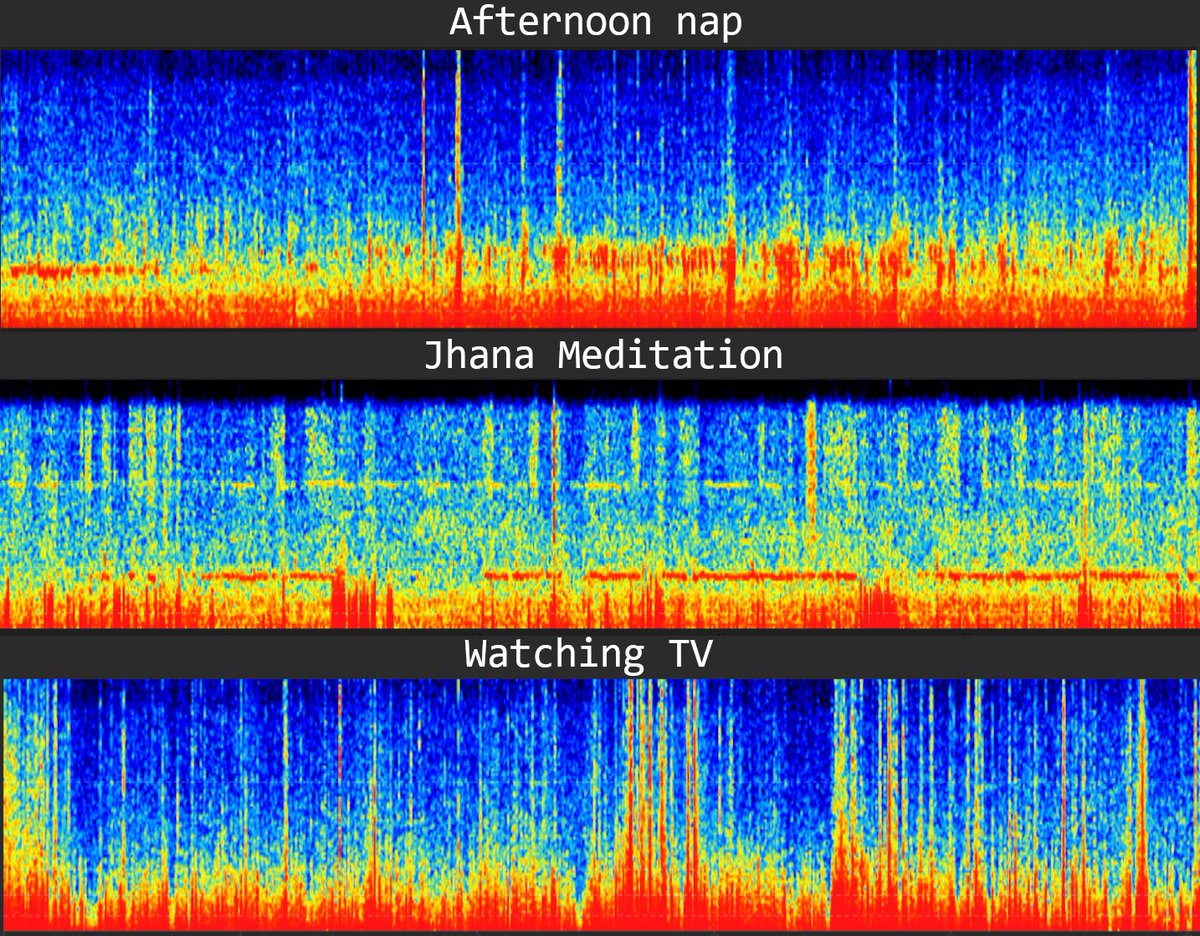
Still in early data collection phase, but we already have some interesting results. Plausible "Jhana Spindles" in the Jhana eeg session, sleep spindles in the nap EEG session, and a notable absence of spindles in the baseline EEG session.
There also was a bit of "jhana spindles" in the nap session. For now, I would explain that by saying that it can be hard for me to not "meditate" at rest these days.
Around whatever happened to me on retreat in October, a huge part of it was steeped in the perception of experience as being a 3D space. There also seems to be a pattern where experiences that seem in the ballpark of "cessations" for me, occur within the following order:
- Mind is in a mode of perception where the 3D aspects of conscious experience are extremely well developed
- All contents within the space have a meta-quality of impermanence and ownerlessness the is unquestionable (i.e. the kid screaming outside and the sensation of perspective behind the eyes all feel equal with respect to any sense of ownership or "self")
- Mind then begins to drift just a bit, moving from this hyper-clear 3D thing into a slightly more dreamy... hypnagogic, forgot what it is doing
- Bam, thing happens (something gets ripped away, collides together, or there's just a full shutdown).
I don't get these often but I had another this morning, and so far the entry point into that has been consistent.
Anyways, I am not an expert here but I also agree that whatever insight experience that was on retreat, it permanently changed how I even approach questions of consciousness; particularly looking at specific regions of the 3D space and making strong judgements about which of those regions are/aren't "conscious".
It is tough to be optimistic living in or next to the US right now, but I do think there's a possibility that this could be a good thing ultimately.
What we are learning is that, in the information age, it is extremely difficult for criminals, pedophiles, liars, morons, and other bad actors to cover their tracks.
So, the way I see the next couple years is that this could go one of two ways:
- The criminals, pedophiles, liars, morons, and other bad actors are powerful enough to carry on like this is normal, acceptible, and nothing can be done about it
- They are eventually brought to justice and it becomes ever more difficult to be that openly immoral and self interested, at least for a time
I don't know how things will end but there is some hope here. Best of luck to my American friends.
Most people do not know that mindfulness/meditation practice can cause everything from bizarre experiences to full blown psychosis. Though high intense practices to tend to make this more likely, it can happen even with low-dose McMindfulness stuff!
https://t.co/hzApDWrCtc
Part 7: Daily Effort, Practice, Conduct
How to be consistent with meditation even if you live a busy life and are not gifted with boundless effort, motivation, and energy. I also explain how morality works using a concrete example from programming (instruction set).
Part 6: Developing Liberating Insights
The last, and to some, most important axis of development in meditation is referred to as insight in some circles. It is developing the capacity to see behind the curtain of conciousness.
https://t.co/YrzC2RUmtF
Part 6: Developing Liberating Insights
The last, and to some, most important axis of development in meditation is referred to as insight in some circles. It is developing the capacity to see behind the curtain of conciousness.
https://t.co/YrzC2RUmtF
Part 5: Developing Mental Wellbeing
You do not need liberating insights or deep concentration to develop the ability to feel good. You just need to practice the skill.
Fortunately, practicing that skill may lead to insights and concentration.
https://t.co/xTjuVoukaI
Part 5: Developing Mental Wellbeing
You do not need liberating insights or deep concentration to develop the ability to feel good. You just need to practice the skill.
Fortunately, practicing that skill may lead to insights and concentration.
https://t.co/xTjuVoukaI
Part 4: Developing Refined Mental States
In this part, I explain how I approach and understand the mental states of tranquility, bliss, and absorption developed through meditation.
If you are familiar with Samatha Jhana, this is the same concept.
https://t.co/sLaIc1rsJO
Part 4: Developing Refined Mental States
In this part, I explain how I approach and understand the mental states of tranquility, bliss, and absorption developed through meditation.
If you are familiar with Samatha Jhana, this is the same concept.
https://t.co/sLaIc1rsJO
Part 3: Practical Tips
Here I answer common questions and address roadblocks I came across as a beginner.
- Meditation Postures
- Monkey Mind
- Distraction vs Mindfulness
...and more.
https://t.co/izuHED2QXx
Part 3: Practical Tips
Here I answer common questions and address roadblocks I came across as a beginner.
- Meditation Postures
- Monkey Mind
- Distraction vs Mindfulness
...and more.
https://t.co/izuHED2QXx
Part 2: Maps of the Mind
This part lays out basic aspects of the mind which most people work with in meditation practice. Of particular importance is working with spotlight attention, broad awareness, and how they interact with the senses.
https://t.co/xDpHVtmu05