🧵
The Access Grant Mechanism of @idOS_network
Access control is what makes idOS truly user-centric.
When an app wants your data, it must request an Access Grant.
You review the request → approve → idOS re-encrypts your data for that app’s public key.
That app can now decrypt — but only what you shared.
You can revoke that grant anytime, instantly cutting off access.
Consent becomes cryptographic, not checkbox-based.
That’s how idOS turns “I agree” into verifiable credentials.
Should consent online always be cryptographically verifiable?
All User Check Your $SST Allocation 🚀🚀
Get $SST Airdrop token according to your x account performance...
Do task by submitting your EVM address
https://t.co/r36yuiwkO5
- JUST CONNECT TWITTER
- CHECK ALLOCATION
- COMPLETE TASK
- SUBMIT ETH ADDRESS DONE
- Claim very soon
1/ AI’s next leap won’t come from bigger models; it’ll come from better data.
Transparent. High-quality. Human-verified.
That future starts today with the launch of the Perle Labs beta 🧵👇
https://t.co/QseMctgRT6
1/ AI’s next leap won’t come from bigger models; it’ll come from better data.
Transparent. High-quality. Human-verified.
That future starts today with the launch of the Perle Labs beta 🧵👇
https://t.co/QseMctgRT6
your KYC data shouldn’t live in someone else’s database.
idOS(@idOS_network) encrypts all credentials under your private keys — even network nodes can’t read them.
If you had total control of your identity data, how would you use it?
The wait is over. The Perle Labs beta is now live.
AI doesn’t train itself. Every model learns from human insight, and now that layer is finally being recognized and rewarded.
Built on @solana. Powered by contributors like you.
The wait is over. The Perle Labs beta is now live.
AI doesn’t train itself. Every model learns from human insight, and now that layer is finally being recognized and rewarded.
Built on @solana. Powered by contributors like you.
🧵
idOS (@idOS_network ) Architecture Explained
Let’s break down the idOS architecture.
It’s a layered system for encrypted identity management.
Three main layers:
🧱 Storage Network (Kwil-based L1)
🔑 Access Layer (permissions)
🧩 SDK Layer (integration for apps)
1/ Data lives encrypted in the storage network — never in plaintext.
2/ Access control runs on smart contracts and key management logic.
3/ Developers plug into the SDK layer to issue credentials, request access, and verify identities.
Every component designed for zero trust — no single point of control.
That’s how idOS decentralizes identity from the ground up.
💬 Which part of the architecture interests you most — storage, access, or SDKs?
@wallchain
gidOS everyone!
KYC isn’t meant to block you.
With @idOS_network it powers you 🫵
Your identity becomes a passport.
Apps stop asking, they just verify.
That’s Web3 done right.
➟ I believe in @idOS_network 💚
➟ I believe in the power of decentralized identity for Web3.
➟ I believe in a future where trust is onchain, not assumed.
➟ I believe in builders shaping value, not chasing trends.
➟ We’re not just building projects, we’re building the next digital legacy.
Pass it on 🫡
My data’s travel to more places than I have.
@idOS_network finally gave it a passport.
Now it travels chain to chain, safe and verified.
No visa, just cryptography
Quack idOS on Wallchain
gidOS 💚
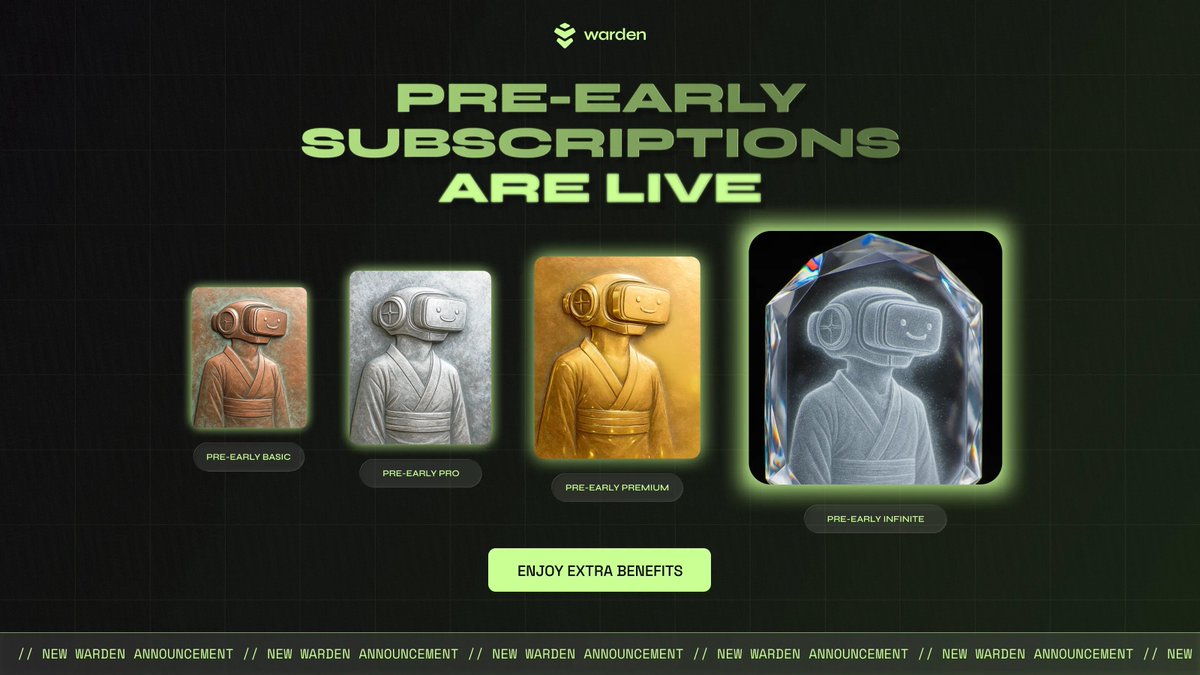
Pre-Early Subscriptions are now LIVE 🔥
Secure your multipliers, unlock premium features, and claim your place in Warden's future.
Four tiers, massive benefits, limited time window 👇
Pre-Early Subscriptions are now LIVE 🔥
Secure your multipliers, unlock premium features, and claim your place in Warden's future.
Four tiers, massive benefits, limited time window 👇