@KCBCare why do I always have a challenge accessing my money through your 522 mobile banking services? As of now, I keep getting the "sorry, service not available" response.
What a shame!!
If Africa has learned anything, it is that major foreign interests rarely arrive announcing themselves for what they are. They usually arrive wrapped in the language of partnership, development, security and helping us solve a problem🚶🏿♀️
@USForeignAssist@lindahoguttu@StateDept@IMC_Worldwide Leave Kenya out of this nonsense 🚶🏿♀️
Pay Kasongo what you’re paying him and fly your minerals from DRC to US through Laikipia Air Base in peace…hizi story mingi pelekeni kwenyu
Kenyans deserve justice that is transparent, reasoned, and accountable.
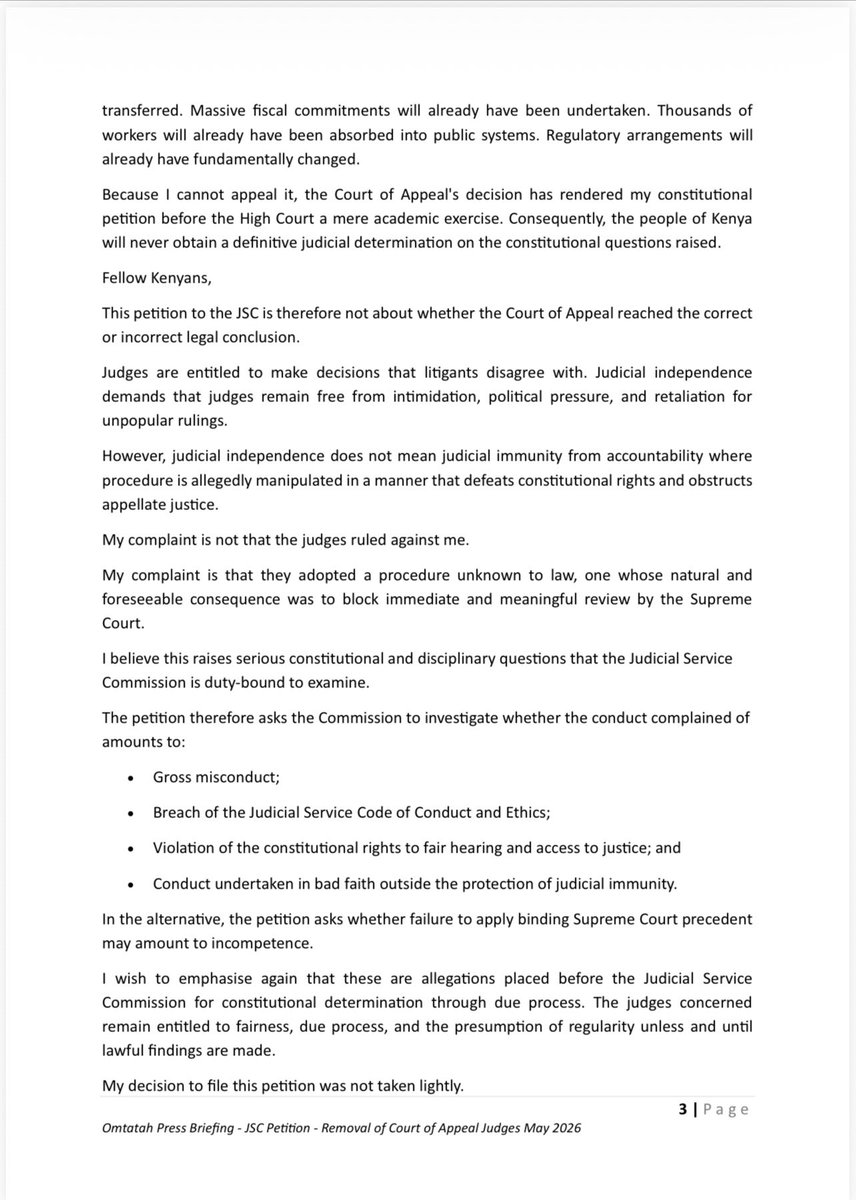
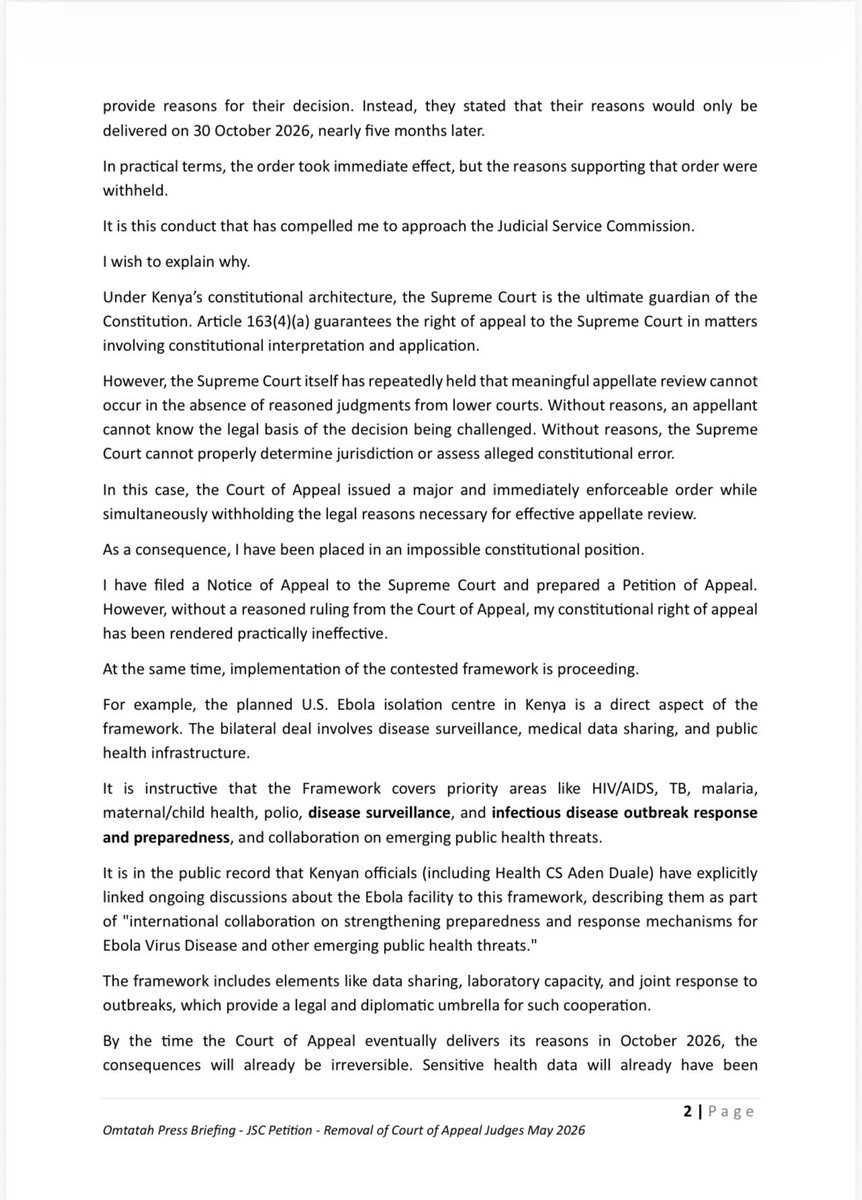
Today, I have petitioned the Judicial Service Commission @jsckenya to investigate three Court of Appeal judges who suspended High Court orders blocking the Kenya-US Health Cooperation Framework, but withheld their reasons for doing so until October 2026.
My concern is not that they ruled against me. It is that an immediately enforceable decision was issued without reasons, effectively frustrating a timely appeal to the @THE_SCOK and denying Kenyans meaningful access to justice.
Judicial independence must be protected. But independence and accountability must go hand in hand. No institution is above the Constitution.
THE HUMBLE PETITION OF OKIYA OMTATAH OKOITI LINK>
https://t.co/36xc3OZdNh
The Ruto government is just too much. These guys wake up every single day just to conjure up more ways to cause pain to Kenyans. I know we are expected to keep government in check as opposition but it’s literally impossible to keep up with the breadth and depth of the capacity for evil these guys have. It doesn’t have to be like this bwana. When we tell you just kicking Ruto out solves 80% of our problems you best believe! Just like he did with Haiti and now Ebola, for the right amount, this one can sell us to the devil himself!
As Murkomen holds a presser announcing that the matatu strike has been suspended for seven days to allow talks, UDA and Hassan Omar are on the other side threatening a crackdown on the same matatu sector.
This is what happens when a regime loses direction. One side is pretending to negotiate, the other side is issuing threats, and nobody is addressing the real economic pain that caused the strike in the first place.
When the President is busy stealing and surviving on confusion, the entire government starts speaking in contradictions.
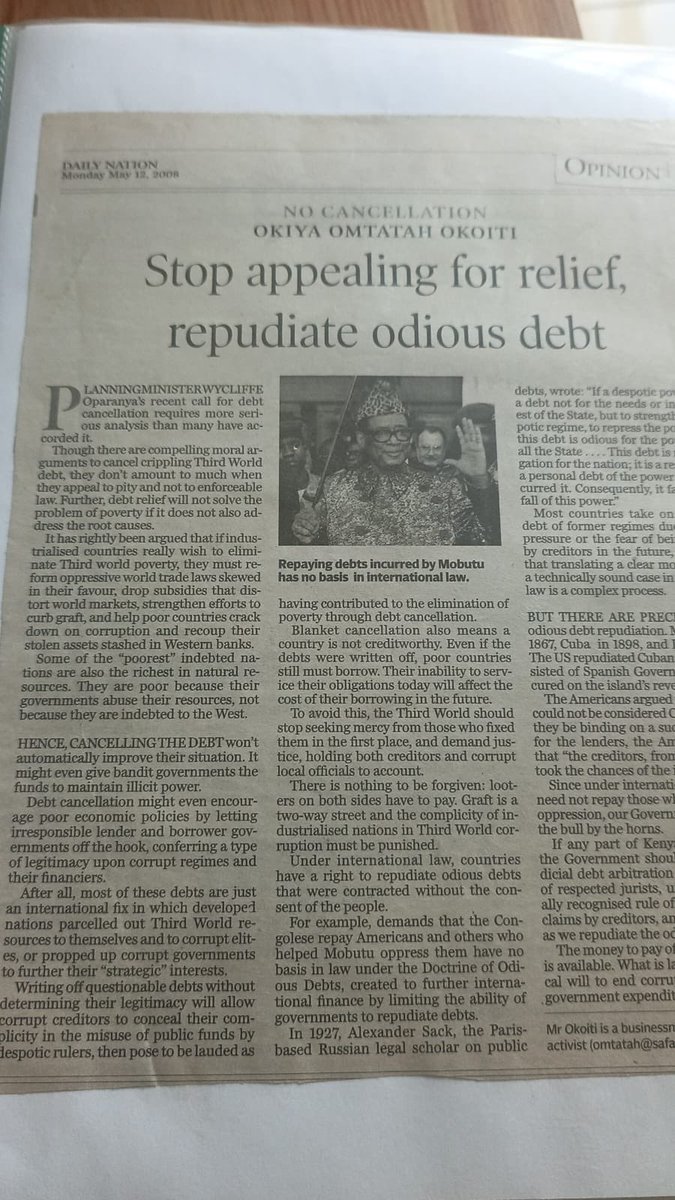
On this day, 18 years ago, on 12 May 2008, I published my first article in the @NationAfrica challenging the injustice of odious debt.
I argued then, as I do now, that debts incurred against the interests of the people cannot morally or legally be imposed on generations that never consented to them.
Africa must stop begging for relief from debts designed to enrich a few and impoverish millions. We must audit, question, repudiate, and prosecute where necessary.
Odious debt is not development. It is economic capture. The struggle continues.
#DeniBandia #ReKe #OdiousDebtKe
I don’t even blame Macron for telling “ill mannered Africans” to shut up😏
I blame any African that attended that event thinking France can help Africa move “Forward”
Ya’ll deserve to be treated like the idiots you are✌🏾
When the imperialists looked for a military to use in Haiti, they came to Ruto and he gave them one. When the United States came for Kenya’s health data, Ruto didn’t hesitate: he signed and agreed. When the British army molested, killed, and maltreated Kenyan women while destroying several hectares of land during training, Ruto did nothing.
When the French wanted a foothold in Kenya through a five-year renewable partnership covering maritime security and intelligence sharing, he gave them the go-ahead and immunity from Kenyan law, all under the pretense of military cooperation.
Ruto is a Western puppet who is not after the interests of the people but those of his masters and his own selfish interests. With time, many Kenyans will realize this.
The UAE’s decision to exit OPEC and OPEC+ is a high-stakes pivot into a New Energy World Order.
Here's my breakdown of the UAE’s move, the game theory at play, and why they might know something about Iran's real circumstances that nobody else knows.
1. The Strategic Solo Run (Game Theory 101)
Imagine you’re in a group chat with a bunch of neighbors. For fifty years, the rule has been: “We all agree to grow only three tomatoes each, so tomatoes stay expensive and we all stay rich.” This is OPEC. It’s less of a "club" and more of a synchronized hoarding agreement.
And the UAE has just left that chat.
• The Logic: The UAE has spent billions boosting its production capacity to 5 million barrels per day. Under OPEC+ rules, they were essentially being told to leave that expensive machinery gathering dust.
• The Independent Path: By leaving, the UAE is no longer bound by group quotas. They are betting that they can maximize their own volume while Saudi Arabia and the others feel forced to keep their own production low just to prevent a total price collapse. It’s an independent actor strategy. They're prioritizing national revenue over collective price-fixing.
The Game Theory part is that the UAE is betting on other OPEC and OPEC+ countries staying (If EVERY country leaves, the resulting oil glut would crash oil prices and could be catastrophic for the energy industry worldwide)
2. The Iranian Energy Vacuum
But why leave now, in the middle of a war? Because Iran’s energy industry is in a state of terminal distress.
• The Burn Reports: Multiple sources indicate Iran is literally burning its own crude at the wellhead because they can’t export it (the Strait of Hormuz is closed) and they can't stop the drills without permanently damaging the reservoirs.
• The Opportunity: The UAE likely sees this as the end of Iran as a major market competitor for years to come. They are moving to fill that supply gap permanently. While Iran’s industry is going up in smoke, the UAE is positioning itself as the only stable, high capacity alternative in the region.
3. The Saudi and Trump Factors
This is a massive diplomatic read-between-the-lines moment.
• The Saudi Rift: Relations with Riyadh have turned frosty since the coalition breakdown in Yemen. The UAE is tired of Saudi Arabia calling the shots on oil prices while also competing for the same foreign investment.
• The US Alliance: Trump has consistently called for more supply to lower gas prices. By exiting OPEC, the UAE is aligning itself directly with Washington’s energy abundance agenda. In exchange for lower prices, the UAE likely expects heightened US security guarantees, which are crucial given the current war and how Iran has attacked them relentlessly.
4. The Fujairah Bypass Advantage
While most Gulf oil is trapped behind the contested Strait of Hormuz, the UAE has a geographic cheat code.
• The Habshan–Fujairah pipeline allows them to pump oil directly to the Indian Ocean, skipping the war zone entirely.
• By leaving OPEC, they are selling "Safe Oil" that doesn't have to navigate a naval battleground.
The Bottom Line:
The UAE is gambling that the era of cooperative hoarding is over. They are betting that in a world of war and energy transitions, the winner isn't the one who waits for the group, but the one who moves the fastest to monetize their resources.
And they're all in in the highest-stakes game theory bet of recent times.
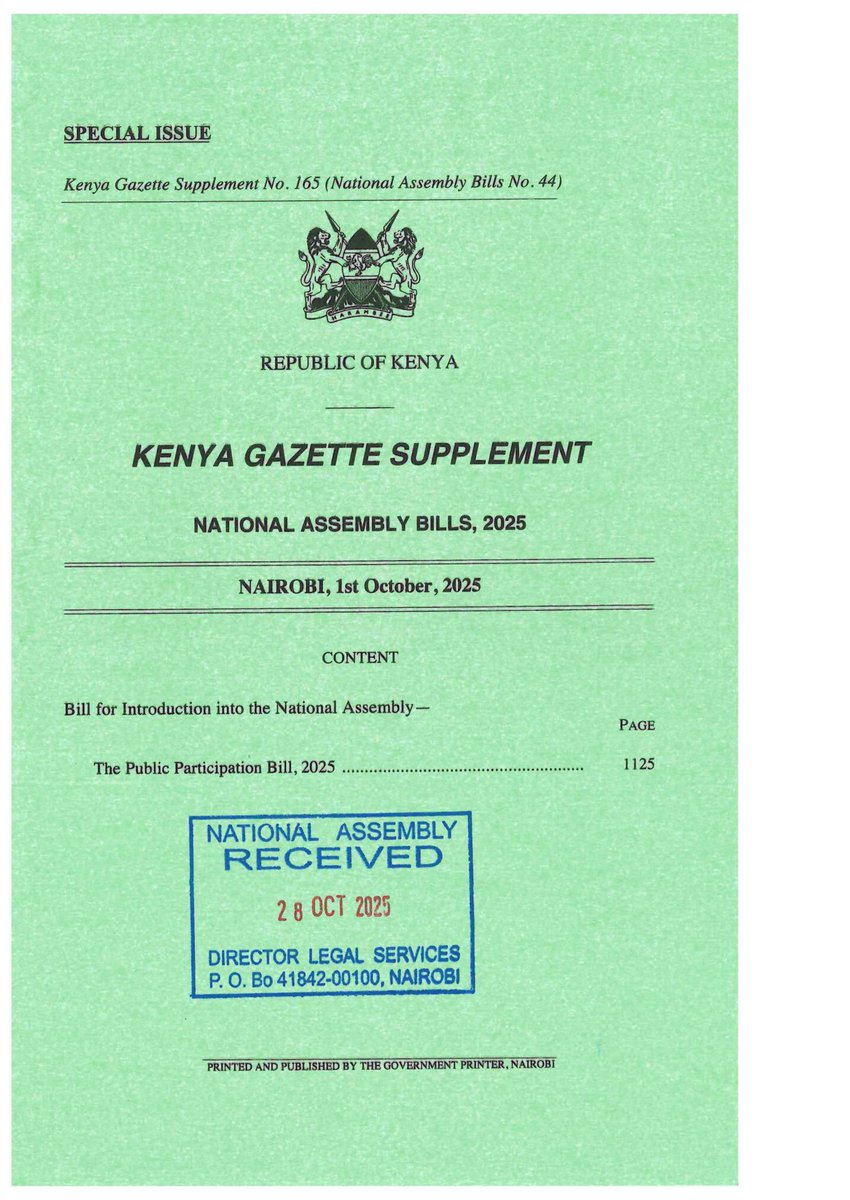
Gladys Shollei is pushing a dangerous amendment, and Kenyans should pay attention.
Yesterday, during a debate on the Public Participation Bill, she proposed removing a key safeguard: the requirement to publish public participation outcomes.
Right now, Section 12(2) requires that once public participation is done, the results be made public, for example, on a website, so citizens can see what Kenyans actually said.
Her proposal? Remove it completely or
Keep that information private.
If you want it, you must apply to the same authority that collected it.
Let me be honest, we already know how this ends.
We have been requesting NHIF, Housing levy, and capitation data for over 6 months. Letters sent to MOH and MOE. No response. Total silence. We are now heading to court soon.
Now imagine this:
A bad bill is rejected by Kenyans during public participation.
The authority then claims: “Kenyans supported it.”
How do you verify?
You write to them, and they ignore you.
That’s the trap.
This amendment would legalize secrecy and make it impossible to hold the government accountable.
Public participation without transparency is just a rubber stamp.
MPs must reject this amendment.
Kenyans deserve a public portal where participation outcomes are visible, verifiable, and permanent.
Enough hiding.
Article 35 on access to information is becoming ceremonial, and soon, we will prove that in court.
🔴🔴 COURT OF APPEAL WARNS LAND BUYERS AGAIN: EVEN A CLEAN TITLE CAN FALL; YEARS AFTER PURCHASE
For some time now, courts have repeated one uncomfortable truth: a title deed is not always the final word. From the landmark decision in Dina Management Limited v County Government of Mombasa & Others, the message has been clear: when the root of title is questioned, a registered owner must go beyond waving a certificate and demonstrate how ownership was lawfully acquired. That principle is not new. But in Patricia Mary Clark v Godfrey Ngatia Njoroge & Others, the Court of Appeal of Kenya has now delivered a sobering reminder; and pushed the conversation further into uncomfortable territory for innocent buyers.
In this case, the buyer conducted an official search, confirmed ownership at the Lands Registry, paid KSh 11 million through advocates, and obtained a certificate of lease. On paper, everything was perfect. Years later, however, the original owner emerged and denied ever selling the property. When the registry records were scrutinized, a glaring gap appeared: there was no transfer instrument showing how the seller acquired the land in the first place. The register showed movement, yes, but the paper trail, the legal spine of ownership, was missing. And that missing link changed everything.
In reaffirming that the title could not stand, the Court did more than restate existing law. It reinforced a growing judicial posture: due diligence is no longer just procedural, it is substantive. The decision signals that where circumstances raise suspicion, courts may expect purchasers to interrogate the history of ownership more deeply. This is not a departure from the law established in Dina Management, but it sharpens the warning. The comfort buyers once found in searches, titles, and registry entries is steadily narrowing.
The takeaway is quiet but powerful: land ownership in Kenya is no longer just about what the register says; it is increasingly about how the register came to say it. And for buyers, that means that the deeper you dig before purchase, the safer you stand years later.
Kindly repost widely🙏🙏.
For more info, check our profile.
I will never understand that level of tribalism where as an average citizen you actively defend corrupt politicians just because they’re from your tribe. It’s beyond my comprehension and honestly insane to me
Ruto has blamed previous governments and the opposition for the youth unemployment in the country.
This man is the leading politician who has been in government since 1997. No one else comes close. He is very incompetent, intellectually challenged, a narcissist & a pathological liar of the highest order.
A man who never takes responsibility is a very useless man. Anyone supporting Ruto & this government needs to check into Mathare Hospital.
What we saw in Tanzania and what is unfolding in Uganda is the reason we must insist on the centrality of our values in all political discourse. Democracy, Human Rights, Freedom, Rule of Law, Social Justice and Equality. Everything else must be done within the framework and in accordance with these values.
MP Ndindi Nyoro: There’s a worrying trend in the East Africa region during presidential elections to cut people off from communication. For democracy to work, all candidates must accept that you cannot be in the race alone #JKLive