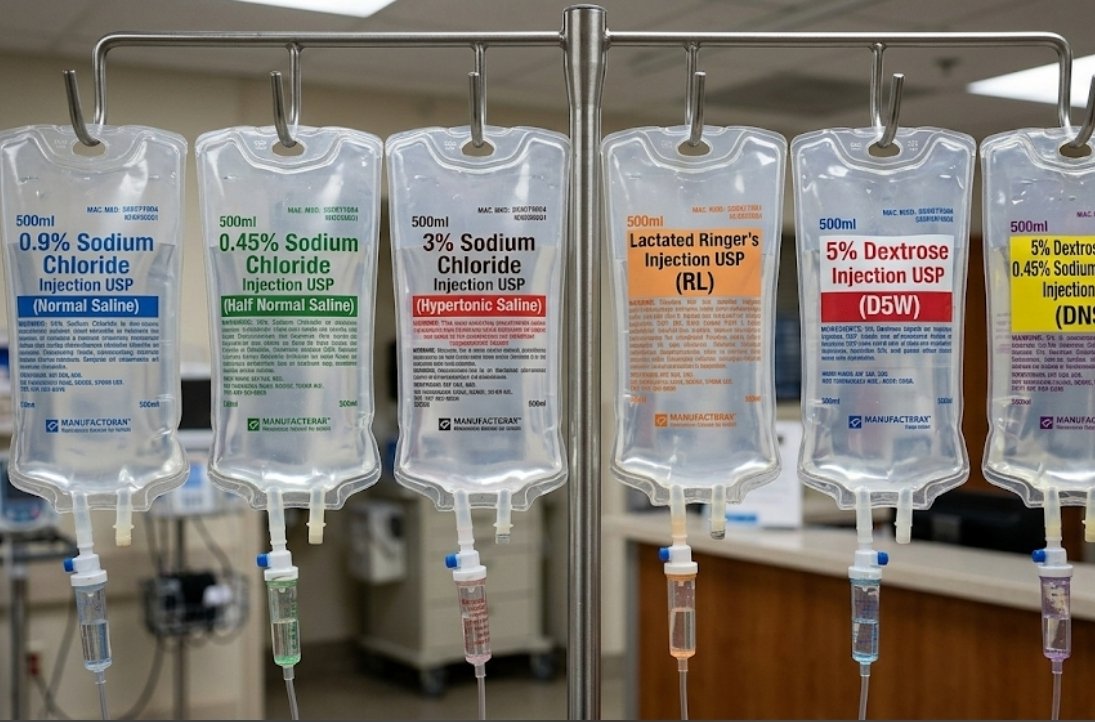
How confident are you in your IV fluid game?
Whether you are a med student building your foundation or a doctor running the casualty, mastering fluids is critical.
Let’s break down the 6 most common IV fluids, when to use them and when to avoid them. 👇
1/14
Why can't you use direct oral anticoagulants (DOACs) in patients with mechanical valves (MVs)?
DOACs have been one of the most important advances in my career. And yet, the presence of a MV is one of the few contraindications.
The reason highlights the unique nature of thrombus formation in those with a MV and provides insights into the evolution of human hemostasis.
Coronary artery territories
The main epicardial coronary arteries supply distinct regions of the myocardium, which can be mapped and assessed during an ultrasound examination. For standardization, the left ventricle (LV) is divided along its long axis into four quadrants: anterior, inferior, septal, and lateral.
At the basal and midventricular levels, the septal and lateral walls are further subdivided into anterior and inferior segments. Each wall is then divided in short-axis views into basal, mid, and apical thirds. Beyond the LV cavity, the distal apex forms a cap segment. Altogether, this results in a total of 17 myocardial segments.
Most of the heart’s blood supply comes from the left main coronary artery, which divides into the left anterior descending (LAD) and left circumflex (LCx) arteries. The LAD supplies most of the anterior ventricular wall, while its septal branches supply the anterior two-thirds of the interventricular septum. Its diagonal branches supply the anterolateral wall. In some cases, a large LAD may wrap around the apex and supply the distal portion of the inferior wall.
The LCx travels in the atrioventricular groove, and its obtuse marginal branches supply the inferolateral wall. The right coronary artery (RCA) supplies the inferior third of the septum and the inferior wall, and it also provides blood to the right ventricle.
Adapted from Bulwer BE, Rivero JM, eds. Echocardiography Pocket Guide: The Transthoracic Examination
The AQUATIC trial may be the most definitive trial of #ESCCOngress
The common combo of ASA and OAC for pts with CAD/stent and AF is clearly been harming people. Lots.
MACE worse, Death worse, Bleeding way worse.
STOP THE ASA when on OAC
https://t.co/OSx0UKWPXe
How do PPIs Induce Hypomagnesemia? - Whereas passive paracellular Mg2+ absorption remains intact, the active transport via TRPM6/7 channels is disrupted. https://t.co/JX3jb2cqWv
Bismack Biyombo is supposedly 0/3 on 3PT in his career. I launched an investigation. I believe this is false.
2/21/16: missed 38-foot heave at end of 3Q
1/1/21: missed corner 3 (Eric Collins' OH MY GOODNESS)
Apparently he missed one 11/24/17: ORL vs BOS. But it never happened.
NEW: Our meta-analysis of observational studies shows that statins significantly reduce HCC risk in MASLD patients. The lipophilicity and higher cDDD of statins correlate with greater HCC risk reduction.
Full paper: https://t.co/4sBYyy1xSw
#LiverTwitter#MASLD#HCC#Statins
Weird trick I’ve never shared:
After achieving hemostasis, I tattoo a Dieulafoy vessel directly… and I mix epinephrine into the ink.
Doesn’t ink cause submucosal fibrosis ?
Good, don’t come back Dieulafoy.
Throwback to the 3-6-9 rule for intestinal diameters, beyond which there is a risk of perforation:
🔸Small intestine: <3 cm
🔸Large intestine: <6 cm
🔸Caecum: <9 cm
(1/x) Intubating critically ill patients in the ICU has some important differences to the ED or OR.
It also carries with it a 3% chance of cardiac arrest. Yes, THREE percent (PMID: 33755076)
This may be the highest risk procedure we perform in the ICU. Here is how you can make intubation in the ICU as safe as possible.
A 🧵
#medtwitter #foamed #foamcc
Why isn't thiamine (vitamin B1) added to alcohol to prevent Wernicke–Korsakoff syndrome, like folate in bread?
In 1940, this was attempted. Thiamine was stable in alcohol, but laws prevented it 🚫
Here’s what happened 🧵1/9
🚨10 must-read papers for ICU staff: Jan to Jun 2024
Check out these 10 essential papers on intensive care medicine from Jan to Jun 2024.
Stay updated with the latest research🧵
A patient's family member said to me today, "Thank you for making us feel like you had all the time in the world for us. I work in healthcare & I know how chaotic the days can be."
Here are a few ways I’ve found to be more present with patients even when time is limited:
1/11
🤔Why does chronic hepatitis C infection "require" the intermediary of cirrhosis in order to cause hepatocellular carcinoma (HCC)?
Chronic hepatitis B can "skip" this step, going directly from chronic infection to HCC.
Why the difference?