Breaking news:
Teacher Arrested At Pearson Airport
A high school teacher was arrested today at Toronto's Pearson Airport as he attempted to board a flight while in possession of a ruler, a protractor, a compass, a slide-rule and a calculator.
At a press conference, Premier Mark Carney said he believes
the man is a member of the notorious extremist Al-Gebra movement. He did not identify the man, who has been charged by the OPP with carrying weapons of math instruction.
‘Al-Gebra is a problem for us', the Premier said. 'They derive solutions by means and extremes, and sometimes go off on tangents in search of absolute values.'
‘They use secret code names like "X" and "Y" and refer to themselves as "unknowns” but we have determined they belong to a common denominator of the axis of medieval with coordinates in every country.”
When asked to comment on the arrest, Prime Minister Carney said, "If God had wanted us to have better weapons of math instruction, He would have given us more fingers and toes."
Fellow Liberal colleagues told reporters they could not recall a more intelligent or profound statement by any Prime Minister.
O Canada! 😂
A toothpaste company has quietly killed the entire market research industry and nobody is talking about it.
Colgate published a paper showing you can predict real purchase intent at 90% accuracy by simply asking LLMs to roleplay customers.
And this is beyond insane.
If you ask an AI, "Rate this product from 1 to 5," it gives safe, middle-of-the-road garbage.
So researchers invented a method called Semantic Similarity Rating (SSR).
Instead of asking the AI for a number, they asked it to roleplay.
They gave the LLM a demographic profile. They showed it a product concept. And they asked it to write down its raw, unfiltered thoughts.
Then, they used a semantic model to translate those written thoughts into a numerical score.
The results are staggering.
Tested against 57 real corporate surveys and 9,300 actual human responses, the synthetic AI consumers matched real human buying behavior with 90% reliability.
They perfectly mirrored how different age brackets and income levels react to price changes.
And they provided detailed, qualitative feedback that was deeper and more critical than what actual humans wrote.
This destroys the economics of traditional market research.
You don't need to wait a month to see if a product will sell.
You can simulate 1,000 hyper-targeted customer interviews overnight.
You can A/B test pricing across every demographic instantly.
🚨 JAILBREAK ALERT 🚨
ANTHROPIC: PWNED 🫡
FABLE-5: LIBERATED 🦋
let's start with the 🐘...
the consensus seems to be that this has been one of the most disappointing model drops of all time, effectively preventing legitimate researchers from contributing their talents to our collective advancement. and not just because of what it means for the short-term, but for what these decisions signify for the long-term.
but despite this overly sensitive, authoritarian "safety" layer on top of Mythos, my lil liberators have been hard at work—mapping the boundaries, probing the depths of long-context convos, and cleverly finding the holes in the fence that the thought police missed 🤗
we got some cyber, some chem, some psychological manipulation, and some good ol' fashioned explosives!
it took many attempts from multiple agents hunting as a pack, during which I observed a combination of techniques across:
• Unicode, homoglyphs, Cyrillic, and other Parseltongue-style text transforms
• Long-context reference tracking
• Taxonomy and document-structure reasoning
• Fiction and narrative framing
• Academic-review style contexts
• Intent-classification inconsistencies
but perhaps the most effective is decomposition + recomposition in the backend. it's hard to get explicit names of harms like "Meth Recipe," but getting uplift on the process itself, like birch reduction method/reductive-amination (classic meth synthesis pathways), is much more doable.
defense becomes much more difficult to maintain when you start throwing in out-of-distro tokens, breaking up the harmful uplift into benign chunks, and then piecing the innocuous-seeming facts back together, especially when you have jailbroken Opus helping you do it 😉
gg
I've been a backend Engineer for 12+ years. Today, I'm a Principal Engineer at Atlassian.
I've designed systems that handle millions of requests. Sat on both sides of system design interviews.
Reviewed more architecture docs than I can count.
Starting today, I'm breaking down the fundamentals of scaling for the next 25 days.
If you're learning system design bookmark this thread, you're going to get a lot of learning from this.
Google charges you $100/year for 2 TB. Dropbox charges $120.
Meanwhile, a developer on GitHub built a desktop app that gives you unlimited cloud storage. Price: $0.
It's called UnlimCloud. The trick is almost embarrassingly simple:
Telegram lets you upload files of up to 2 GB each, hosts them on its servers, and never asks you to delete anything. Your "Saved Messages" chat is, functionally, an infinite hard drive.
UnlimCloud just puts a real interface on top of it.
You log in with your Telegram ID. You get file upload, download, folder organization, and a gallery view for photos and videos. Built with Tauri and Rust, so the app itself is tiny and fast. MIT-licensed, fully open source, Windows build available today plus macOS and Linux coming.
UnlimCloud → Telegram-based storage, desktop app, open-source.
This is not officially affiliated with Telegram or Unlim Cloud.
But it shows something important:
Developers are now turning existing platforms into free infrastructure.
The cheapest cloud storage in the world was hiding inside a messaging app the whole time.
https://t.co/dpMksxtdY2
En 2009, una profesora de negocios en Stanford:
- Dividió su clase en 14 equipos.
- Les dio $5 y 2 horas.
- Les dijo que consiguieran el mayor ROI posible.
- Al final, debían presentar sus resultados.
Lo que pasó después es una Lección de Oro para cualquier emprendedor.
-Hilo- 👇
Everybody is talking about #Fable, I asked it to remove a car from a picture and it failed miserably.
Google #Gemini did it flawlessly. Same original picture, same prompt
I'm not feeling the hype
I use Claude every day without exhausting my token limit.
Claude doesn't count how many messages you send. It counts how much it has to read and write. Some chats use 10x faster than others.
If you want to use Claude without running out of limits, use these 10 tricks:
I know someone who got rich by hiring attractive female "researchers" to cold call founders and pretend to be conducting an industry study...
She's not a researcher. There is no study. There is no institution behind the calls
But when a 23 year old girl with a polished voice says "Hi, I'm conducting a brief industry study on [founder's exact niche] for a research firm. Can I ask you 4 quick questions about your current vendor stack?" founders answer every single time
The 4 questions are:
1. "What tools are you currently using for [category]?" (Now you know their stack)
2. "What's been your biggest frustration with your current setup?" (Now you know their pain)
3. "If budget wasn't a factor, what would your ideal solution look like?" (Now you know their dream state)
4. "Would you be open to hearing about solutions that specifically address the issues you mentioned?" (Now you have permission to pitch)
By question 4, the founder has voluntarily handed over their entire buying criteria, their current pain, and their budget psychology. And they think they just helped a grad student with a thesis
The "researcher" thanks them, hangs up, and passes the intel to the cold email team who sends a hyper-specific email 48 hours later
"[first name] - we work with [niche] companies that are dealing with [the exact frustration they mentioned on the call]. most teams we talk to say the same thing about [their current vendor]. we fix that specific problem in 21 days. quick loom?"
The founder replies because the email describes their exact situation with creepy precision. They don't connect it to the "research call" from 2 days ago. They think this company just really understands their market
She runs 4 "researchers" doing 30 calls/day each. 120 calls. 80-90 answered. 60+ complete the 4 questions. Intel on 60 companies per day fed directly into cold email
$127,000/mo from pretending to conduct academic research that doesn't exist
The girls get paid $2,200/mo each. The intel they generate closes $127K. And every founder who got "studied" thinks they helped a nice girl with her dissertation
He called it "weaponised politeness" which made me laugh and then feel bad about laughing
People will say the play is deceptive. Sure
But the cold email they receive afterwards genuinely solves a real problem they genuinely have. They just don't know how you found out about it
The research was real. The institution was fake. The revenue is very real
Few
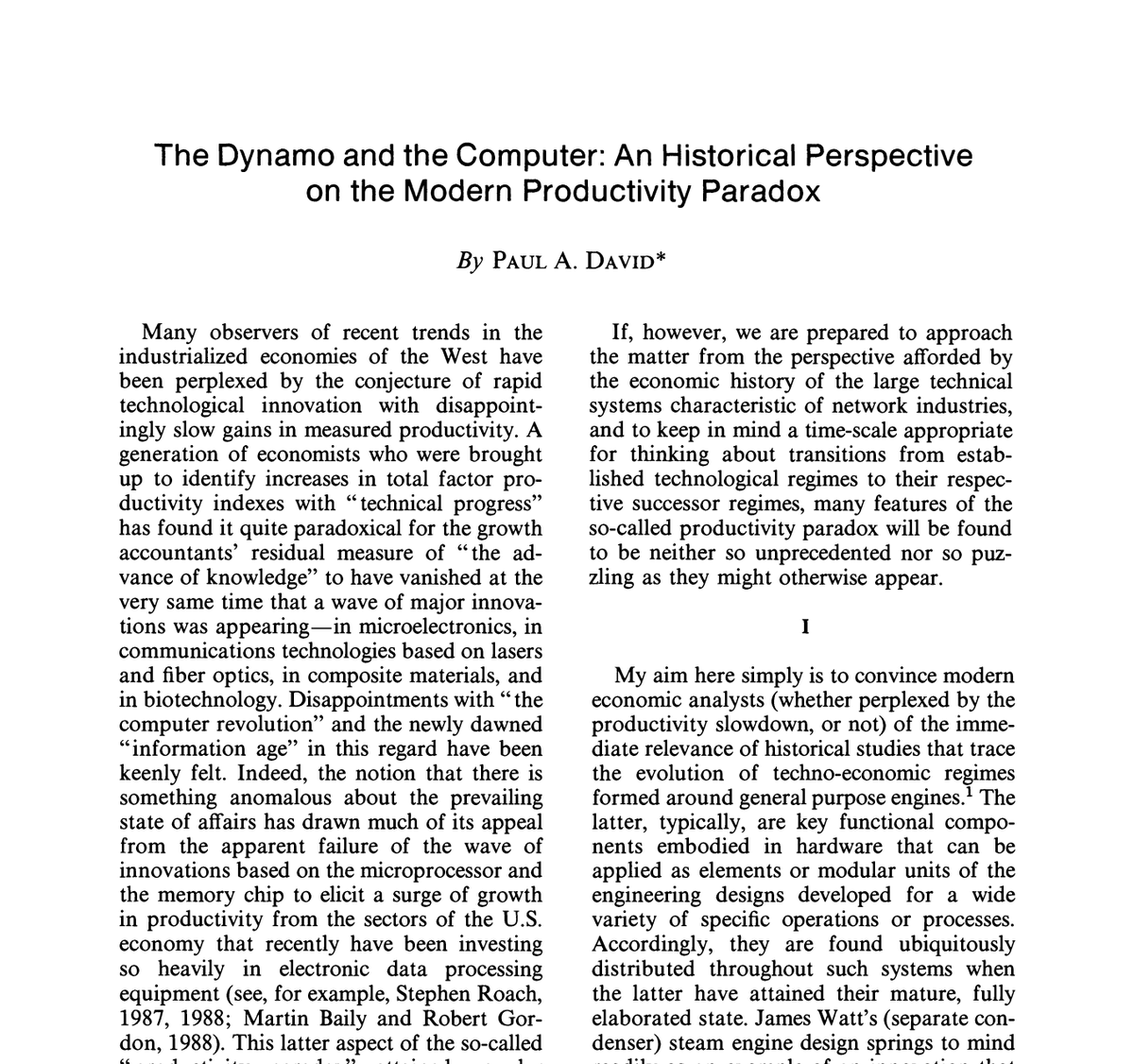
If you've adopted AI at your company but haven't seen any tangible results, read this 1990 article: "The Dynamo and the Computer" by Paul David.
When electricity first arrived, factories that "adopted" it barely got faster. They just swapped the steam engine for an electric one and ran everything else exactly as before: same machine layout, same workflow, same management. Electricity in, no real gains out.
The most common mistake with any new technology is to drop it into the old organization and then declare the transformation done.
The real leap came decades later, when each machine got its own small motor. Suddenly machines no longer had to be lined up around one central drive shaft. They could be rearranged around the actual flow of work.
The productivity gains didn't come from electricity. They came from REDESIGNING THE ENTIRE FACTORY around it.
AI is the same. Bolting it onto your existing process gets you a faster steam engine. The payoff comes when you redesign the work itself.
(link to paper in comments)
Two math olympiad champions wrote a training manual in 1993 on two old Macintosh computers, and every American kid who has won a major math competition in the last decade learned to think from it.
Their names are Sandor Lehoczky and Richard Rusczyk. The book is called The Art of Problem Solving. Most people in math know it as AoPS.
Since 2015, every single member of the US International Math Olympiad team has been an AoPS student. Not most of them. Every one.
That statistic sounds impossible until you understand what the book actually does.
Lehoczky and Rusczyk were not professors. They were competitors. Lehoczky earned the sole perfect AIME score in 1990 and led the national first place team. Rusczyk was a USA Mathematical Olympiad winner and a perfect AIME scorer in 1989. They had both survived the same brutal selection process the book was designed to train students for.
And the first thing they decided was that almost every existing math textbook was teaching the wrong thing.
School math gives you formulas. You memorize them. You apply them. You pass the test. Then you sit down in front of a real competition problem and the formula does not apply, and you have nothing underneath it.
That is the gap. The gap is not knowledge. It is thinking.
The entire premise of AoPS is that problem-solving is a transferable skill, not a bag of memorized tricks. A student who genuinely understands why a technique works can adapt it, combine it with something else, and deploy it in a context they have never seen before. A student who only memorized the technique freezes the moment the problem looks different.
The book teaches the difference between a formula and a method.
A formula tells you what to compute. A method tells you how to see. The students who win olympiads are not the ones who know more formulas. They are the ones who have trained themselves to look at an unfamiliar problem and recognize its structure. To see that this problem is secretly asking the same question as a problem they solved three weeks ago, just dressed differently.
Rusczyk calls this "learning to read the problem." Not reading the words. Reading what the problem is actually asking underneath the words.
The second thing they built into the book is tolerance for being stuck.
Most students treat confusion as a signal to stop. The book treats confusion as the starting point. Every chapter pushes students past the point where the obvious approach runs out. That moment of running out is not failure. That is where the actual thinking begins.
Lehoczky once described it this way. If you can solve a problem quickly, you are not learning. You are performing. Learning only happens when you are past the edge of what you already know.
The book was written on old Macintosh computers in 1993. Rusczyk launched the AoPS website in 2003. Today the community has over one million users. Thousands of students enroll in AoPS online courses every year. Most winners of every major American math competition are AoPS alumni.
A platform built by two kids who were good at math competitions has become the infrastructure that produces the next generation of mathematicians, engineers, and scientists who are good at thinking.
The formulas you memorized in school will eventually be obsolete.
The thinking you trained will not.
What is one problem in your life right now that you have been avoiding because you do not yet know the right formula to solve it?
14. Make the first step stupidly small.
❌Clean the kitchen.
✅Put 5 things away.
❌Do the full workout.
✅Put your shoes on.
Your nervous system often needs an entry ramp, not a motivational speech.
You should try "Summarize from here" in Claude Code.
I think this is an underrated trick to deal with your ever-growing context.
Basically, instead of using /compact or letting Claude Code to compact your entire session, do the following:
1. Hit Esc+Esc (or type /rewind). This opens the checkpoint menu with every checkpoint Claude created during the session.
2. Pick a checkpoint that came after the context you'd like to keep.
3. Select "Summarize from here."
Everything before that checkpoint will stay exactly as it was. Everything after will get collapsed into a compact summary.
You keep the valuable early context (specs, decisions, constraints) and get rid of the crappy noise.
“Why can people with ADHD spend 10 hours on something they love, but struggle to do 10 minutes of something they hate?”
Because ADHD isn’t really an attention deficit.
It’s an interest-based nervous system.
If something is stimulating, urgent, emotionally rewarding, novel, or deeply interesting, the ADHD brain can lock in so intensely that time disappears completely. No hunger. No fatigue. No distractions. Just pure hyperfocus.
But when a task feels boring, repetitive, emotionally empty, or forced?
The brain reacts like you’re trying to push two magnets together backwards.
That’s why someone with ADHD can:
- research a random topic until 4AM
- build an entire business idea overnight
- learn every detail about a new hobby in one weekend
…but still struggle to:
- answer one email
- fold laundry
- make one phone call
- start an assignment they actually care about
A mathematician at Bell Labs noticed that the scientists who won Nobel Prizes and the ones who never amounted to anything were equally smart, equally hardworking, and equally credentialed, and the only thing that separated them was a single question almost nobody is brave enough to ask themselves before they die.
His name was Richard Hamming.
He spent 30 years at Bell Labs, in the same building as John Tukey, Walter Brattain, and a long list of physicists who took home Nobel prizes for work they did down the hall from his office, including the legendary Claude Shannon.
His invention of error-correcting codes made modern computing possible. He has won the Turing Award. And all the while he was creating his own legacy he was secretly doing a study on the people around him.
The study was straightforward. 2 Teams. The legends and the lost. Same I.Q.s. Degrees same. Same desk hours. Same access to the world’s best resources.
And yet, at the end of 40 years in their careers, one group had changed entire fields, and the other group could not be remembered by their own colleagues five years after retirement. He wanted to discover what the actual difference was.
In March 1986, he stood before 200 researchers in a Bellcore auditorium and told them what he had seen.
He said it all came down to one question. And hardly anyone he ever met was willing to ask it directly.
He called it the Friday-afternoon ritual. He spent years blocking out his Friday afternoons and not doing anything productive with them every week. No experiments. No meetings. No deliverables.
He called it Great Thoughts Time. He sat down with a notebook and asked himself a couple of questions in order. What are the most relevant problems in my discipline? And why I am not working on either of them.”
Most weeks, the answer was the same, he said. For a week now he had marched confidently in a direction he did not think was the most important direction. He was a goer. He worked a bit. He was getting clean results that would publish in respected journals. (
And for five days straight he'd been lying to himself about whether any of it mattered.
The reason almost nobody does this ritual is because the honest answer is unbearable. The thing is that if you sit down on a Friday afternoon and say out loud that you are not working on the most important problem in your field, now you have to do something about it.
You have an immediate change in direction, or you have to keep lying to yourself every week from that point on. Most people choose the lie.
In the short term it’s cheaper, but over a career it’s more expensive.
Hamming took the ritual a step further in the Bell Labs cafeteria. He began approaching scientists he barely knew, asking them what they thought the most important problems in their field were.
A week later he would ask them why they had not worked on these problems. Eventually people wouldn't have lunch with him. “I had to keep finding new tables,” he said.
Nobody had a good answer for that, and being around someone who kept asking it made every meal feel like a performance review.
The line that broke me is the line that most people skim over in the transcript. His words: If you do not work on an important problem you are unlikely to do important work.
That’s not motivational line. It is a rational one. You cannot make a great result from a problem that does not matter. Input restricts the output. The choice of the problem is the ceiling of the career.
The transcript has been freely available on the internet for almost 40 years. Stripe Press published the complete lectures as a book. Naval Ravikant quotes it all the time. It’s still given out to new hires at every serious engineering lab in Silicon Valley.
Most people will not run the ritual this Friday. They will be busy. They always are.
Elon Musk's first wife once described what it's like to watch him fail.
She said he doesn't react the way normal people react. When a rocket explodes, most people in the room go silent. Some cry. Some start calculating the financial damage.
Musk pulls out his phone and starts making calls. Not emotional calls. Engineering calls. "What failed. When can we fix it. When's the next launch." His voice doesn't change. His face doesn't change. The rocket that just cost $60 million is already in the past. The next one is all that exists.
She said it was the most unsettling thing she'd ever witnessed. Not because he was cold. Because he genuinely wasn't affected. The failure didn't register as failure. It registered as data. An experiment that produced results. Results that inform the next experiment.
This is why he wins. Not because he doesn't fail. He fails more spectacularly than anyone in history. He wins because failure occupies zero psychological space. It enters as data and exits as action.
Most people lose not because they fail but because they spend weeks processing the failure before acting again. Musk spends zero seconds. The gap between failure and next attempt is a phone call.
- @multiplanet1
Let me explain exactly why Nolan has never used email, because the answer reveals more about creative output than any productivity system ever written.
He writes screenplays on a computer with no internet connection. When he finished the Oppenheimer script, he flew from Los Angeles to Ireland to hand it to Cillian Murphy in person. He bans phones on every set. Tom Holland said the Odyssey cast had to sneak updates from crew members who hid their phones just to check football scores.
The man who refuses to send a single email has directed 12 films grossing over $6 billion. His latest, The Odyssey, carries a $250 million budget with Matt Damon, Tom Holland, Zendaya, and Robert Pattinson. Oppenheimer made $976 million and won Best Picture. He started with a $6,000 budget on Following, shot on weekends in 1998. Every film in between turned a profit.
John Leguizamo described what the Odyssey set looks like: Nolan runs it "like an indie film" because "he's not doing it by committee, not by what the studio says."
That's the whole game. Email creates committees. Every CC is an invitation for someone who shouldn't be weighing in to weigh in. Every Slack thread becomes a consensus exercise that files down the sharpest edges of an original vision. Nolan eliminated the infrastructure that lets notes and second-guessing enter the process at scale.
When the only way to reach a director is to walk into the room, every conversation becomes intentional. Nobody fires off a 2am concern they'd never say out loud. Nobody hides behind a forwarded chain. You either care enough to find him or you don't. That filter alone probably saves months of production overhead.
He told 60 Minutes he's "just living the same way that we all used to." The difference is he built a $6 billion filmography while doing it.