Achieving The Standards 1.0 - 135 press, 225 bench, 315 squat, 405 deadlift - is more important and useful than getting down to 10% bodyfat and it's not even close.
It’s astounding how many coaches will attribute these kind of problems - the hips are shooting up at the start of the lift! - to various muscular or positional weaknesses and prescribe complex programming to solve them, when the problem is simply that they do not know basic pulling mechanics and the standard pulling position
There are certain aspects of the main barbell lifts that exist no matter what you do, when the weight is relatively heavy for the lifter.
Your hip position in the deadlift is one of those things. I don't care what you think you can do, or what you think would be better for x, y or z; when the weight is heavy (something you can do for 1-5 reps, let's say) you CAN'T keep the hips artificially low.
@sam_gzstrength More than 20 years since the first edition was published, and apparently over a million copies sold between all editions, there remains a shockingly low number of critiques of SS that aren’t total strawmen or just attacking a silly meme version of it
It's funny that people still seem to present anti barbell posts as edgy and "unpopular opinion, but..." when that view has become the mainstream or even dominant view among the physique oriented community.
@Theo_TJ_Jordan At the time “the adults are back in charge.”
Now “haha woke 1.0 sure was crazy!”
Meanwhile when they get back in power this will probably look tame.
@JackedBasedMgr It’s not the entire story, but I think a significant amount of the “bench doesn’t develop the pecs well“ discourse is because of the increasing prevalence of wide grip, high arch benches of significant weights without yielding a lot of muscular development
The combination of one-size-fits-all maximum grip width and absurd arching that powerlifting allowed for decades, led to where now lots of people associate bench press with a party trick instead of basic upper body development. Sad!
The combination of one-size-fits-all maximum grip width and absurd arching that powerlifting allowed for decades, led to where now lots of people associate bench press with a party trick instead of basic upper body development. Sad!
People think it’s a contradiction that the venn diagram of women who were upset at Sydney Sweeney for being scantily clad is now upset at Shane Gillis, for pointing out that women in the gym are scantily clad, is basically a circle.
It’s not a contradiction. When sexuality is in any way aimed at being for men, they hate it. When it’s aimed at being anti-men, they like it.
Simple as.
@homegymcoop This is a great explanation. End of the day you still have to calibrate each one for difficulty, but this should help people make a better first estimate.
https://t.co/nVJTX3FyvS
Something so obvious to a lot of us that we forget we had to learn it: the poundage labels on cable stacks are essentially worthless and you have to learn the actual difficulty of each one and assess it 100% independently of any other cable stack you’ve ever used.
Example: both these cable stacks, in the fore and rear grounds, are labeled with almost exactly the same weights. The foreground is 2.5-97.5 in 5 lb increments. The rear is 5 to 95. But take a close look. The foreground stack is much wider than the rearground stack. And if you use them you’ll soon realize, the one in the foreground is consequently a lot heavier too. But if you go solely by the label, this will confuse you greatly and you’ll think there’s something wrong with you.
“I used 65 for sets of 12 on tricep push downs just last week. Why is 67.5 lbs SO much harder, I can barely do 5 reps with compromised form?!”
The labels are meaningless. Maybe to the point they shouldn’t even be labeled at all, I don’t know. But you definitely have to learn each cable stack’s difficulty and not assume the labels are at all transferable from any one stack or tower to another.
Analysis: True.
As we often discuss, lacking. A framework of lifter development is still a major weak point. The same person will wax poetic about the need for progressive overload in one post and then make another a week later about how always trying to beat the logbook is hurting your progress, and instead, you need to make light weight feel heavy.
It's not that either of these two things is always wrong, but that they don't even seem to realize they're sending diametrically opposed messages that only make sense within the context of properly understanding lifter development and applying it to programming.
https://t.co/oPShyoUQ2M
Mind muscle connection is the cherry on top of biomechanics, not a magic elixir. It doesn’t matter how well you connect with your pecs when doing leg extensions, because that movement requires the quads, not the pecs, to do the work. You can squeeze a little more out of it with a good connection, but the primary thing is biomechanics.
This is why given a strict discipline to hold technique constant and not cheat to get heavier weights, objective performance increases over time remain the primary driver of progress.
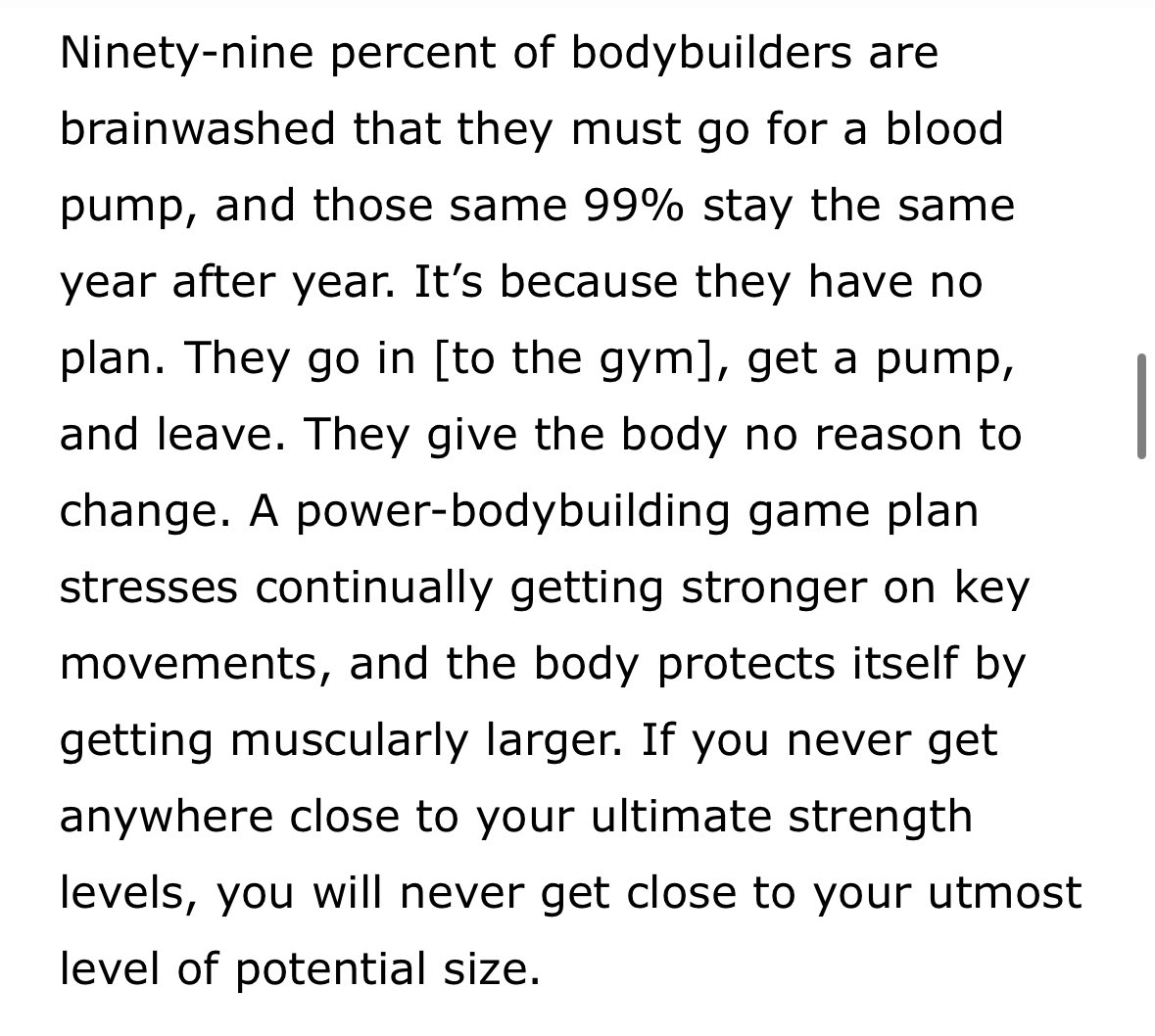
I sort of knew this intuitively even when I was new to lifting, but it was driven home to me by Dante Trudel of Doggcrapp fame. Here’s a good sample quote from a 2024 interview of Trudel:
@MohandesDavid@sam_gzstrength How can you maintain high neuroticism about mundane life stuff after surviving workout after workout of getting up from the bottom of a squat that you were sure would crush you?