What comes after levelling in HUNGER?
In our latest Developer Archive, Max explores wipes, character persistence and our plans for endgame in HUNGER, where reaching the end of your progression is just the beginning of your journey.
Wishlist HUNGER now - https://t.co/sMn8MKasm2
Just want to offer a correction and a bit of clarity on the terminology we’re using here, as we’ve been throwing around a few different names internally while developing these systems.
Expeditions are the main maps you’re already playing, like Jacques’ Bridge. Each has a variety of points of interest with different levels of danger and complexity. Fort Saint Rouge, for example, is a major, highly dangerous POI, but there are also medium, small and even micro POIs scattered throughout the map.
Dungeons are the large underground experiences within these maps, like Jacques’ Folly, the Pit and the Undercroft. We’d been using the term “dungeon” rather loosely internally, which is where some of the confusion in this video comes from.
Originally, our intention was that completing a dungeon would grant access to a separate, PvE-only boss encounter. However, as we developed the idea, we realised the fundamental concept of spending resources to overcome something extremely difficult in exchange for substantial rewards deserved to be much bigger than a simple boss fight.
And so we arrived at Ordeals. Believe me, they will be an ordeal.
An Ordeal is a separate, PvE-only experience that you enter using a boss key earned through its associated dungeon. Think of something structurally similar to Left 4 Dead or Darktide, where you bring your own equipment and resources, fight your way through an extremely challenging environment, and eventually confront the boss at the end.
The Black Sacrament, for example, is an Ordeal unlocked through the Undercroft.
These are designed to be some of the hardest PvE experiences in Hunger. They’re fundamentally about resource expenditure, survival, cooperation and the possibility of extraordinary rewards. There will be multiple ways to earn rewards throughout an Ordeal, not simply by defeating the final boss.
Trials are something different again. They share some of the structural ideas behind Ordeals, but are more accessible, less punishing and aren’t intended as endgame content. They’re designed to give players another form of PvE progression that they can move between alongside regular Expeditions.
So, for clarity:
Expeditions: Our main extraction maps.
Dungeons: Major POIs within Expeditions, such as Jacques Folly and the Undercroft.
Ordeals: Extremely difficult, PvE-only endgame experiences unlocked through Dungeons, culminating in boss encounters.
Trials: More accessible, repeatable PvE experiences that sit alongside Expeditions.
Battlegrounds: Our endgame PvP experiences.
When we recorded this video, I was still referring to Ordeals as Dungeons. The underlying experience was already designed, but its scope had expanded considerably and the terminology hadn’t quite caught up.
Hopefully that clears things up! Ordeals and Battlegrounds will form the two major pillars of our endgame PvE and PvP content respectively, while Expeditions, Dungeons and Trials will continue to offer different experiences throughout your character’s progression.
JUST IN: $3.5 trillion fund servicer Apex Group joins Hedera Council
The firm will help govern the network and explore its use for digital asset initiatives, adding its fund administration and institutional infrastructure expertise to Hedera's ecosystem.
Living, the wait is almost over.
The HUNGER Open Beta and Early Access are drawing near.
Watch our reveal trailer to discover when you’ll return to the Chateau.
Request access for the Open Beta and Wishlist HUNGER now on Steam: https://t.co/sMn8MK9Uwu
Living, the first episode of our developer podcast, After the End is here! 🎙️
Join Bence and Max as we look back at our Closed Beta, discuss your feedback, and explore what's next for HUNGER, including future features and endgame plans.
Watch Episode 1: https://t.co/xlWZXx00yG
I think it's time to address something head-on, particularly given some of the feedback we've received from players coming over from Hunt during our closed beta.
Fundamentally, Hunger is not a response to Hunt, nor is it designed in opposition to Hunt or even intended as an alternative to it. Hunt is an incredible game and one that is cherished and treasured by most - if not all of our dev team - myself included.
Hunger is our response to the loot-driven extraction genre more broadly, and our attempt to use the extraction mechanic as the foundation for a fully fledged multiplayer RPG.
Anyone familiar with Hunt will recognise that it's actually quite unique within the extraction genre. Beyond its extraction mechanic, Hunt is fundamentally an objective-based PvP game. Its progression loop revolves around pursuing objectives that nearly always require the fighting of other players and then extracting. Obviously, this is an observation - not a critique.
Beyond a shared historical Gothic sensibility (and the letters "Hun"), the principal similarity between Hunt and Hunger is that both games use extraction as a gameplay mechanic. What they do with that mechanic is fundamentally different.
Hunger is designed as an RPG. It has character levels, equipment progression, masteries, professions, an economy, PvE activities and a plans for an extensive endgame. PvP is an important part of the Expedition experience, but it is not the singular objective around which everything else is designed. You can progress through Hunger - including reaching the endgame - without being forced into PvP encounters.
This distinction has enormous implications for how the game is designed and balanced.
We've seen quite a lot of feedback suggesting that equipment should be flattened, that fights should be broadly equal regardless of progression, or that a player with substantially better equipment shouldn't enjoy a significant advantage.
However, that is precisely how Hunger is intended to work. In an RPG, someone who has spent considerably longer developing their character, acquiring equipment and building their economy should be more powerful than someone who has just started. That's not an oversight in our balancing - it's a fundamental feature of the genre.
You might be able to overcome someone significantly better equipped than yourself, but the odds are deliberately not in your favour.
At the same time, we believe that they shouldn't be. If the time you've invested in developing your character, acquiring better equipment and progressing through the game makes no meaningful difference to your effectiveness in combat, then we've fundamentally failed in our ambition to build an RPG. Progression has to mean something, and that necessarily means that players at different stages of their journey will not always meet on equal terms.
Equally, the entire progression structure of Hunger is designed around a substantial journey towards the endgame. That is intentional, and it isn't something we're looking to change. Of course, we're going to continue tightening matchmaking brackets to reduce the extremes between players who encounter one another. However narrowing those differences is not the same thing as removing the advantages of progression or gear altogether.
Where balance becomes considerably more important is at the endgame. When players are operating within comparable equipment tiers, wearing Epic and Legendary armour, using high-end weapons (or lower end weapons that have been tuned via our coming “weapon specialisation” system) and participating in activities such as PvP Battlegrounds, that's where we want much tighter competitive balancing. At that point, we're comparing mature characters and established builds, rather than trying to make a level 17 character equivalent to a level 70 character.
We know already that it's also where a great deal of the long-term balancing discussion will be focused.
I appreciate that this is a nuanced distinction, particularly when two games share an extraction mechanic, a historical setting and a degree of visual similarity. We've spent a considerable amount of time communicating these design decisions through our development vlogs, and they're reflected throughout the systems we've built.
Some of the feedback we've received seems to assume that we've misunderstood or overlooked the things that make Hunt work. In reality, many of those differences are deliberate decisions about what kind of game we want Hunger to be.
We're not trying to make Hunt with more loot or Hunt with character levels. We're trying to make a multiplayer RPG with a persistent economy, meaningful character progression, consequential equipment choices and a substantial PvE and PvP endgame (more coming on this soon), all built around an extraction loop.
There is plenty of room for improvement in Hunger and we're listening closely to feedback about how well our systems actually achieve their intended goals. However there's an important distinction between a system that isn't working as intended and a system that is working as intended but doesn't align with someone's expectations of a very different game (one might even say a different genre).
We're very interested in improving the former. We're not going to redesign Hunger around the latter.
I appreciate if that means that Hunger isn't for you. That's totally fine too, as many excellent titles exist to serve a different preference.
we're thinking that it'd be interesting to start an ongoing podcast to discuss the development of the game. We'd most likely use the first one as an opportunity to discuss the feedback around the CB and then open it up to the community to ask questions.
we also have more vlogs coming that start to look at additional topics (end game etc.), but we feel a podcast could be a bit more conversational and ad hoc.
Does that sound good?
Despite having done this many times before, both with Hunger and previously with Hell Let Loose, there’s always something uniquely nerve-racking about the first few hours of a large-scale test.
In many ways, launching a test is an exercise in waiting to discover what goes wrong. It’s a challenging but absolutely necessary part of development, and I thought it might be interesting to explain what actually happens behind the scenes once we open the doors.
Essentially, the entire development team assembles in Discord, with different people monitoring just about every channel imaginable. We’re looking for emerging patterns, reports of bugs, technical issues, crashes, and anything else that might suggest something isn’t working as intended.
As issues emerge, our production team begins compiling and organising them. These are then fed through to QA, who start the process of reproducing them, establishing how consistently they occur, under what circumstances, and ultimately trying to isolate the underlying cause.
Naturally, we have a fairly strict order of priorities. Server crashes sit right at the top, followed by client crashes, serious game-breaking issues, bugs that negatively affect other players, and then a descending list of less critical problems.
Once we’ve isolated something, we then need to assess how difficult it is to fix, how much risk the fix introduces, and whether it actually makes sense to deploy that fix during the test itself.
A seemingly straightforward fix can introduce an entirely new set of problems, so there’s a constant calculation taking place around whether something warrants a hotfix, when that hotfix should happen, and whether it requires taking the servers offline. All of this needs to be weighed against the disruption caused to people who are actively enjoying the game.
Meanwhile, another part of the team is watching Twitch streams, YouTube videos, reading Discord conversations and generally observing how people are actually interacting with the game.
As developers, we spend so much time playing our own game that we inevitably develop a very particular understanding of how everything works. Watching thousands of people encounter those same systems, often for the first time, is enormously revealing.
We’re looking for the moments where players become excited, confused, frustrated, surprised, or start behaving in ways we hadn’t anticipated. Importantly, we’re not necessarily trying to eliminate every source of frustration.
Hunger - like every game - is one that deliberately incorporates friction. There are moments where we want players to feel uncomfortable, under pressure, or frustrated by a difficult situation. That’s what makes overcoming those situations rewarding.
The challenge is distinguishing between frustration that’s a valuable part of the experience and frustration that exists simply because something is poorly communicated, unnecessarily cumbersome, or not working particularly well.
At the same time, we’re paying very close attention to the conversations taking place within the community, particularly between people who are actually participating in the test. Often, the most useful feedback isn’t a formal bug report or a direct suggestion to the developers, but simply two players discussing something they’ve just experienced.
So while a Closed Beta might look like a relatively straightforward event from the outside, internally it’s an extraordinarily busy period of observation, diagnosis, prioritisation, decision-making, development and inevitably, quite a lot of waiting to see what breaks next.
For those of you joining us this week, thank you for taking part. Whether you’re reporting bugs, discussing the game, streaming it, or simply playing, you’re providing us with an enormous amount of information that will help shape what Hunger becomes.
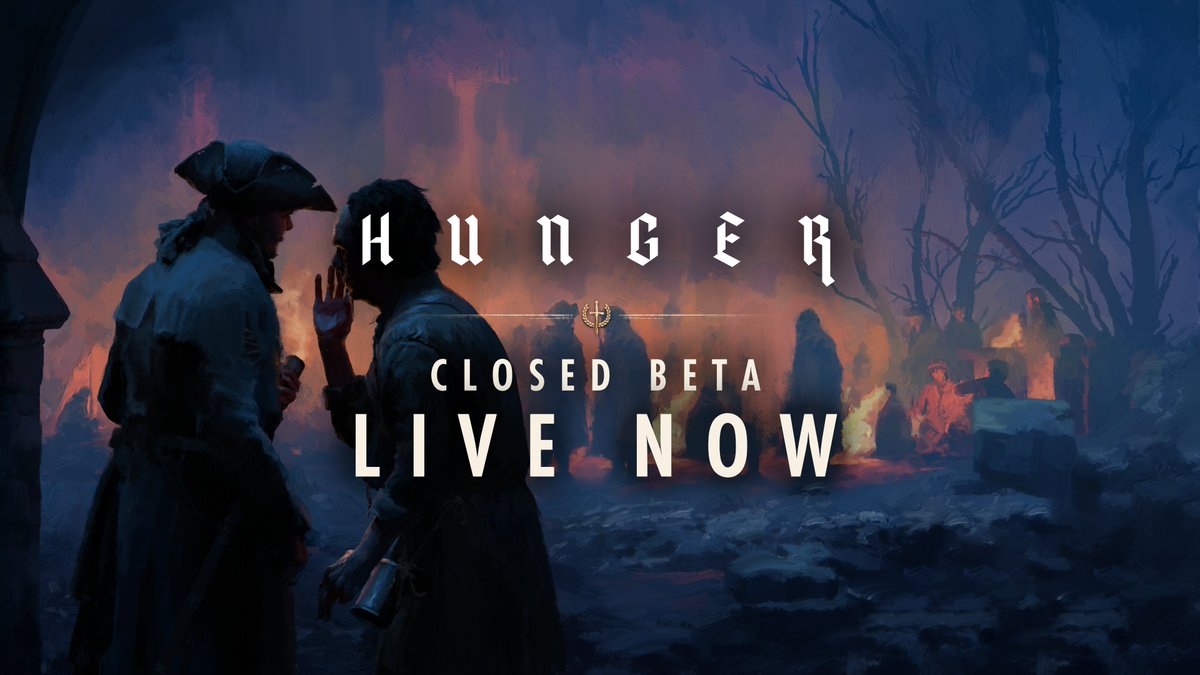
🕯️ Living, HUNGER’s Closed Beta is LIVE!
Gather your companions and venture into the world after the End. Will you make it back to the Château?
Prepare for your first Expedition with our Getting Started guide:
https://t.co/FTxPflMsJt
Did you know @hedera's max recorded throughput is over 11x higher than Ethereum's?
At 16,199 TPS, Hedera has reached performance levels few public networks ever reach
Scalable infrastructure is exactly what fast, secure, and compliant dApps need
📊 https://t.co/mUh6EhZEXx