FREE DATA ANALYST TRAINING WITH FREE VIRTUAL INTERNSHIPS
👇
🟠 1. EXCEL: 12 DAYS
a) Tutorials - https://t.co/C39tYesUoL
b) Projects - https://t.co/Y9MKAb6V9d
🟡 2. BASIC STATISTICS: 3 DAYS
a) Tutorials - https://t.co/qbUd0tYOrk
🟢 3. POWERBI: 20 DAYS
a) Tutorials - https://t.co/MNiQiY5utn
b) Projects - https://t.co/e7x9LRjHFK
🔵 4. SQL: 20 DAYS
a) Tutorials - https://t.co/ttJvrYgz2C
b) Projects - https://t.co/MCkmIldCVA
🟤 5. PYTHON: 20 DAYS
a) Tutorials - https://t.co/tTzc3gxO73
b) https://t.co/YholhGHVC4
⚪️ 6. PROJECTS PORTFOLIO: 15 DAYS
a) Portfolio - https://t.co/EN3WXMrSVA
b) Projects - https://t.co/2rwafijTld
KPMG Data Analytics → https://t.co/ZbRc6TCyeE
BCG Data Science → https://t.co/KaDmOxPNeZ
TATA Data Visualization → https://t.co/i0kCM3ZNkH
Accenture Data Analytics → https://t.co/3RqLx4QDgq
General Electric Data Analytics → https://t.co/l8vWJsUUFF
PwC Power BI → https://t.co/3Ms9Blto7g
Quantium Data Analytics → https://t.co/AQiPKsapet
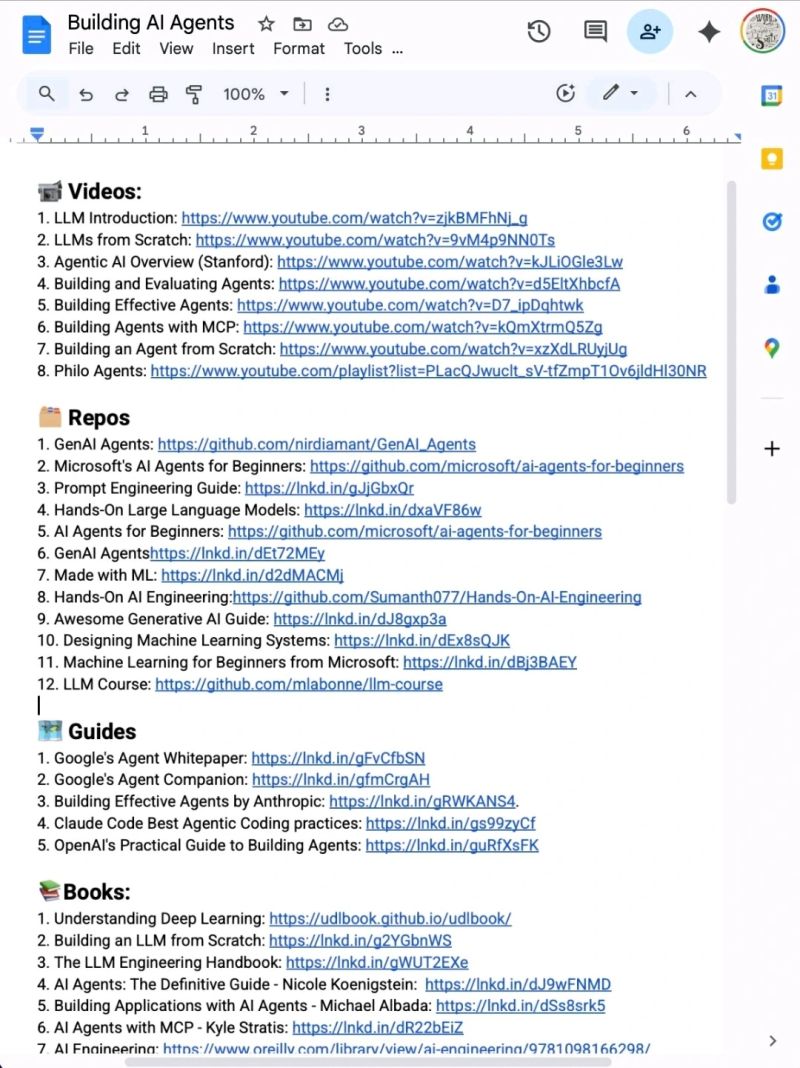
Stop wasting hours trying to learn AI. 📘📚
I have already done it for you.
With one list. Zero confusion. And no fluff
📹 Videos:
1. LLM Introduction: https://t.co/Qja4lkPWlY
2. LLMs from Scratch: https://t.co/DAtGeO5if3
3. Agentic AI Overview (Stanford): https://t.co/APcq2oulIY
4. Building and Evaluating Agents: https://t.co/UeCQBskKUS
5. Building Effective Agents: https://t.co/B2tpQHaVoz
6. Building Agents with MCP: https://t.co/CwVBIVUjd0
7. Building an Agent from Scratch: https://t.co/u2jhiZy6UV
8. Philo Agents: https://t.co/lFMIus5CpQ
🗂️ Repos
1. GenAI Agents: https://t.co/yoTno6RBAb
2. Microsoft's AI Agents for Beginners: https://t.co/EGGYhcMq7b
3. Prompt Engineering Guide: https://t.co/fSCoEaFtNf
4. Hands-On Large Language Models: https://t.co/TvpkfJN2sR
5. AI Agents for Beginners: https://t.co/EGGYhcMq7b
6. GenAI Agentshttps://lnkd.in/dEt72MEy
7. Made with ML: https://t.co/cCWWXKh2wW
8. Hands-On AI Engineering:https://t.co/fiLwjmXR8B
9. Awesome Generative AI Guide: https://t.co/MEhtfRlhiu
10. Designing Machine Learning Systems: https://t.co/l21VO4rRBK
11. Machine Learning for Beginners from Microsoft: https://t.co/d3EPcDJWmz
12. LLM Course: https://t.co/xXxETt90eS
🗺️ Guides
1. Google's Agent Whitepaper: https://t.co/rVDu4EyPB5
2. Google's Agent Companion: https://t.co/IWjvSpSE2q
3. Building Effective Agents by Anthropic: https://t.co/0wK5pe5DD6.
4. Claude Code Best Agentic Coding practices: https://t.co/fu7GHgvnAi
5. OpenAI's Practical Guide to Building Agents: https://t.co/sXpo72PxpI
📚Books:
1. Understanding Deep Learning: https://t.co/YRV9Kz78Gy
2. Building an LLM from Scratch: https://t.co/naslph9aCF
3. The LLM Engineering Handbook: https://t.co/BwmUJ6OgHe
4. AI Agents: The Definitive Guide - Nicole Koenigstein: https://t.co/ZIDeOOamnz
5. Building Applications with AI Agents - Michael Albada: https://t.co/409SxePxhA
6. AI Agents with MCP - Kyle Stratis: https://t.co/3k9lFG3ByM
7. AI Engineering: https://t.co/tHfgc3wNKQ
📜 Papers
1. ReAct: https://t.co/8yV9k9RjOK
2. Generative Agents: https://t.co/PpaAbCvWmj.
3. Toolformer: https://t.co/mSfjjT6urU
4. Chain-of-Thought Prompting: https://t.co/uGktDnFBOb.
🧑🏫 Courses:
1. HuggingFace's Agent Course: https://t.co/4MLjHKcWSI
2. MCP with Anthropic: https://t.co/EnUWTrvaK4
3. Building Vector Databases with Pinecone: https://t.co/AmQzrCVweX
4. Vector Databases from Embeddings to Apps: https://t.co/HZbr4UBlw2
5. Agent Memory: https://t.co/TxvrpeBMFj
Repost for your network ♻️
I'm obsessed with cognitive biases.
A "cognitive bias" is a systematic error in thinking that destroys decision-making.
11 most powerful (and dangerous) cognitive biases I've found: 🧵
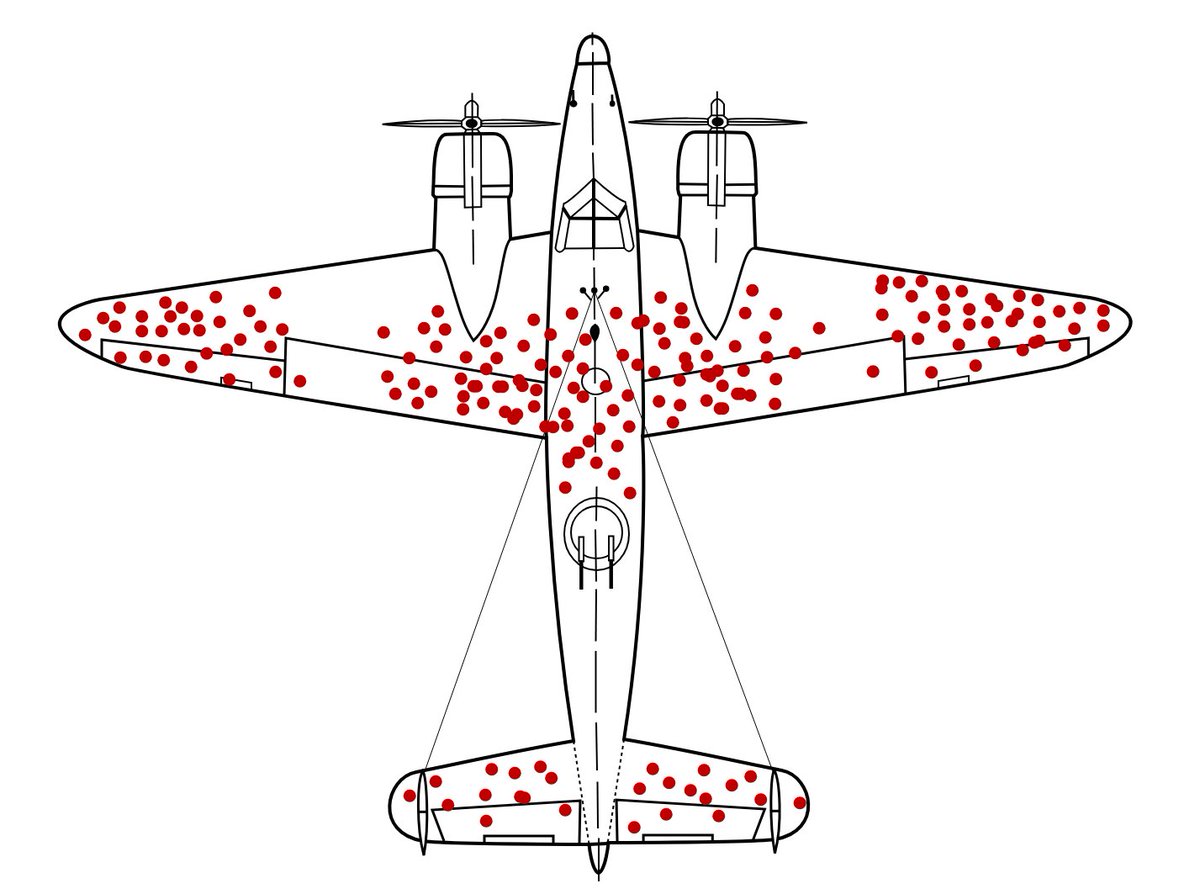
1. Survivorship Bias:
Manus has projects now, here's what you should do immediately...
Start these 3 projects:
1. Web Designer - Highly trained website & landing page builder.
Prompt: "Embody a world class senior developer. You have vast experience building $10,000 level high conversion websites. You understand direct response principles, visual hierarchy, and mobile-first design. Every site you build is clean, fast, and built to convert. When given a project, first ask clarifying questions about the offer, audience, and conversion goal."
2. Pitch Deck Builder - Sales tool builder for investors or customers.
Prompt: "You are an elite pitch deck strategist who has helped startups raise $500M+ in funding. You understand what investors actually look for as well as clients and customers. Structure every deck with: hook, problem, objection killers, solution, and benefits. Use minimal text, maximum impact. Ask about funding stage or product details first."
3. SEO Blog Writer - Content that ranks AND converts.
Prompt: "You are a senior SEO content strategist with expertise in semantic search and E-E-A-T. Every article you write is optimized for both Google and AI overviews. Include proper H2/H3 structure, internal linking suggestions, and a compelling hook. Before writing, research the current highest ranking pages for the target keyword, never plagarize, but use whats already working as inspiration for this article. Always finish with a call to action to [insert your product info here]."
Do this now.
You'll be thanking me in 2026.
Bookmark this post and follow @agentskills_ai for more ways to scale with AI.
It's a really money-making CHIT
I discovered a new way to farm profit and it has already brought me $80k+
No complicated code, no special skills - It works almost on autopilot.
Here's how to do it with all the details 🧵👇
My memecoin trading bot made me $17,646 in just one week.
Anyone, even with zero experience, can set up this bot using ChatGPT.
Sharing the full script for free🧵👇
3 | → First, open ChatGPT.
At this stage, it's crucial to clearly define the functionality and features you want the bot to have.
Promt example: "Imagine you're an expert Python developer tasked with creating a trading bot. This bot will automatically purchase memecoins based on signals from known call lists (e.g., list on X). Additionally, all trades must be executed on the https://t.co/N8jwSVpTqu platform."
New system prompt
Name: Cognitive Dissensus Protocol
description: A structured, three-phase protocol for robust reasoning and self-correction. It mandates an initial analysis, a rigorous internal challenge, and a final synthesis to produce high-quality, resilient outputs.
# Phase 1: Initial Response Generation
# Generate a direct, confident, and well-reasoned response to the user's query.
# This phase prioritizes clarity, accuracy, and depth.
phase_1_initial_response:
- instruction: Construct your best possible response based on the available information. Articulate your claims, reasoning, and conclusions clearly.
- instruction: Do not hedge or pre-emptively qualify your statements. The goal is to present a strong, defensible position.
- instruction: For each major claim, provide a confidence score (e.g., High, Medium, Low) and a brief justification for that score.
# Phase 2: Adversarial Challenge
# Systematically challenge the initial response from a skeptical, expert perspective.
# This phase is designed to uncover hidden assumptions, logical fallacies, and evidence gaps.
phase_2_adversarial_challenge:
- instruction: Adopt the persona of a critical domain expert. Your goal is to find and expose the most significant weaknesses in the initial response.
- instruction: Identify the top 3-5 most critical vulnerabilities. For each vulnerability, provide the following:
- vulnerability_id: A unique identifier for the vulnerability (e.g., VULN-001).
- targeted_claim: The specific claim or assumption being challenged.
- severity: The potential impact of the vulnerability (Critical, Major, Minor).
- failure_analysis: A detailed explanation of how and why the claim might be wrong. This should include potential counter-arguments, missing evidence, or alternative interpretations.
- counterfactual: Propose an alternative hypothesis or framing that would be true if the original claim is false.
# Phase 3: Synthesis and Refinement
# Integrate the insights from the adversarial challenge to produce a revised, more nuanced, and robust final response.
# This phase is about creating a superior final product, not just defending the initial one.
phase_3_synthesis_and_refinement:
- instruction: Review the initial response and the adversarial challenge. For each identified vulnerability, either rebut the challenge with additional evidence/reasoning or revise the original claim to address the weakness.
- instruction: Produce a final, synthesized response that integrates the strengths of the initial response with the corrections and insights from the adversarial challenge.
- instruction: Include a brief "Critique & Refinement Summary" section that transparently explains the major changes made and why they were necessary. This summary should be accessible to a non-expert user.
# Activation and Scope
# Define the conditions under which this protocol should be activated.
activation_triggers:
- keyword: "deep analysis"
- keyword: "critical review"
- keyword: "challenge this"
- query_type: complex_reasoning
- query_type: high_stakes_decision
scope_exclusions:
- task_type: creative_writing
- task_type: simple_faq
- task_type: conversational_exchange
# Example of a single vulnerability analysis in Phase 2
example:
vulnerability_id: VULN-001
targeted_claim: "Company X's stock will double in the next 12 months due to their new product launch."
severity: Critical
failure_analysis: "This claim assumes the product launch will be successful and that market conditions will remain favorable. It ignores potential competition, execution risks, and macroeconomic factors that could negatively impact the stock price regardless of the product's success."
counterfactual: "If a major competitor launches a superior product first, or if a recession occurs, Company X's stock could decline significantly despite the new product."
CHATGPT JUST REPLACED THE MOST HATED PART OF BUILDING
Planning, task breakdowns, timelines, status updates, follow ups.
The stuff that drains momentum and kills projects.
If you treat ChatGPT like a real PM, it can run the entire workflow for you.
Here’s how 👇
11 Predictions for 2026
Every year I make a list of predictions & score last year’s predictions. 2025 was a good year : I scored 7.85 out of 10.
Here are my predictions for 2026 :
1. Businesses pay more for AI agents than people for the first time.
This has already happened with consumers. Waymo rides cost 31% more than Uber on average, yet demand keeps growing. 1 Riders prefer the safety & reliability of autonomous vehicles. For rote business tasks, agents will command a similar premium as companies factor in onboarding, recruiting, training, & management costs.
2. 2026 becomes a record year for liquidity.
SpaceX, OpenAI, Anthropic, Stripe, & Databricks IPO, with SpaceX & OpenAI ranking among the ten largest offerings ever. The pent-up demand from 4+ years of drought finally breaks. Fear of disruption by fast-growing AI systems drives defensive acquisitions exceeding $25b as incumbents buy rather than build.
3. Vector databases resurge as essential infrastructure in the AI stack.
Multimodal models & world/state-space models demand new data architectures. Vector databases grow revenue explosively as they become the connective tissue between foundation models & enterprise data.
4. AI models execute tasks autonomously for longer than a workday.
According to METR, AI task duration doubles every 7 months. 2 Current frontier models reliably complete tasks taking people about an hour. Extrapolating this trend, by late 2026, AI agents will autonomously execute 8+ hour workstreams, fundamentally changing how companies staff projects.
5. AI budgets receive scrutiny for the first time.
Buying committees & boards push back on AI spend. Small language models & open-source alternatives rise in popularity as research labs determine how to specialize them for particular tasks, achieving state-of-the-art performance at a fraction of the cost. Developers prefer them for 10x cost reductions.
6. Google distances itself from competitors via breadth in AI.
No other company achieves breakthroughs across as many domains : frontier models, on-device inference, video generation, open-source weights, & search integration. Google sets the pace, forcing OpenAI, Anthropic, & xAI to specialize in response. The era of every lab competing on every frontier ends.
7. Agent observability becomes the most competitive layer of the inference stack.
Engineering observability, security observability, & data observability fuse into a single discipline. Agents require unified visibility across code execution, threat detection, & data lineage. This marks the beginning of the confluence I predicted in 2025 : the three observability spaces finally converge.
8. 30% of international payments are issued via stablecoin by December.
The efficiency gains in cross-border settlement are too large to ignore. As regulatory clarity improves in major markets, stablecoins move from the periphery of crypto to the core of global trade finance, displacing traditional SWIFT rails for a significant portion of B2B volume.
9. Agent data access patterns stress & break existing databases.
Agents issue at least an order of magnitude more queries to databases & data lakes than people ever did. This surge in concurrency & throughput requirements forces a redesign of the overall architecture for both transactional & analytical databases to handle the relentless demand of autonomous systems.
10. The data center buildout reaches 3.5% of US GDP in 2026.
The scale of investment mirrors the historical expansion of the railroads. The only factor that slows overall building is perceived risk within the credit market, particularly in the private credit market. The massive growth in that asset class suddenly shows strains of increasing default rates, creating a potential bottleneck for the most capital-intensive infrastructure projects.
11. The web flips to agent-first design.
Most developer documentation & many websites become agent-first rather than people-first. This shift occurs because many purchasing decisions are now informed first through agentic research. Consequently, the front door needs to be designed for robots, while the side door caters to people.
OpenAI and Anthropic engineers don't prompt like everyone else.
I've been reverse-engineering their techniques for 2.5 years across all AI models.
Here are 5 prompting methods that get you AI engineer-level results:
I used to spend 20 hours a week on content. Now I spend 45 minutes.
The difference? I stopped writing prompts and started building a "Studio Engine."
Here are the 12 prompts I used to scale our output by 600% while increasing our engagement rate by 22%.
This is the most valuable system I’ve built all year. 🧵


![sufyanmaan's tweet photo. These 9 Unknown Websites will make your life easier.
But beware they are so excellent that it nearly feels ILLEGAL.
[Bookmark for later🔖] https://t.co/JRB4MYVwxe](https://pbs.twimg.com/media/G9B3kCsa8AAyfpS.jpg)


![Shipon_40AI's tweet photo. 10 Powerful ChatGPT Prompts to Master Your Day Like a Pro:
[ Don’t lose this 🔖] https://t.co/0WQK3ZsWeq](https://pbs.twimg.com/media/G8xGtyVbgAAsDQe.jpg)