Carl Icahn told Larry Fink to his face that BlackRock is "an extremely dangerous company" - then told Wall Street "the mafia has a better code of ethics than you guys"
this is him explaining why BlackRock is pushing the economy off a cliff, why Wall Street keeps selling junk to the middle class, and what 50 years on Wall Street taught him about what's coming next
"BlackRock is an extremely dangerous company. people are buying these bonds not understanding what they're buying"
"the mafia has a better code of ethics than you guys. you're selling this crap and you keep selling it and you're shorting some of it"
"they're all on this party, having a drink, having fun, pushing this thing toward a cliff. you know what's going to destroy it? they're going to hit a Black Rock"
"I've been around a long time. I saw it in '69, '74, '79, '87, 2000. I think a time is coming that might make some of those times look pretty good"
bookmark & watch the full conversation ↓
Last week Warsh gave a masterclass in how not to lose the long end. And that is all a Fed Chair should care about: no one borrows at Fed Funds, they borrow at (say) 10s +spread and that spread is credit + term.
You can tell he has been schooled by Druckenmiller, not some irrelevant textbook.
If CPI is high next month, he should hike MORE than the market is demanding. A quick 50 immediately following the data release (why wait 2 weeks??) and long bonds will love it, just as they loved his commitment to get inflation back to 2% last week: he will have proven his credentials.
If he does that, 30s will end the day green and 10s will be green within 2 days.
If he does not, he loses the long end and we are in for a world of hurt, in all asset classes.
If CPI is low, fine, no need for anything.
During Volcker, when the market sniffed out that he might hike, front month SOFR (ED) traded as much as 200bp above Fed Funds. When looking for cuts, we traded sometimes 100 under. Those were the days when 12bp was the opening range of the first 10 minute bar of futures trading, not the effing yearly range.
During Greenspan we narrowed that range quite a lot, but we still went +125/-70.
Warsh wants to take us back towards those days, when men were men.
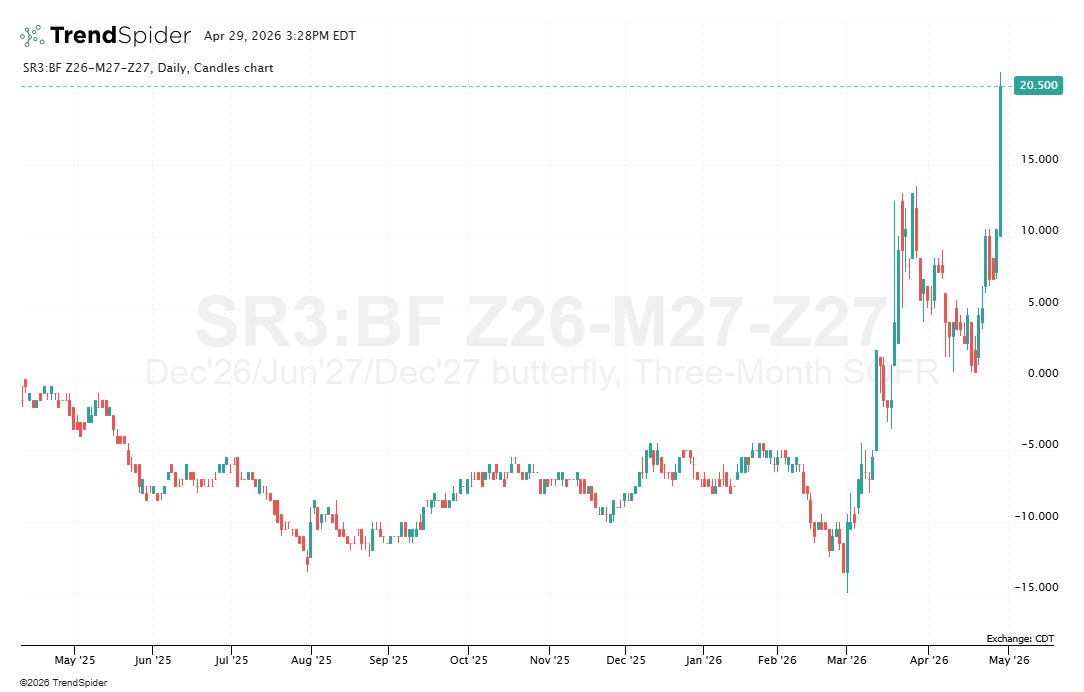
It's immaterial whether Warsh now hikes or cuts. It's where the market goes now that short end vol is becoming untethered again that matters. Because yield curve moves now will be merciless. Both ways.
Net negative supply has been a big tailwind for US stocks for years thanks to buybacks, cash-based M&A and low # of IPOs. That may now be changing. Between jumbo IPOs, expiring lockups, and stock-based M&A, 2026 could see a spike to net positive issuance >$500bn; lot to digest.
Jimmy Carr nailed something a lot of us feel but can’t explain.
We’re living better than 99.9% of humans who ever walked the earth, hot showers, modern medicine, endless entertainment, kids that actually survive infancy, yet so many of us feel miserable.
He calls it “life dysmorphia.” We get used to how good we have it (the hedonic treadmill), then compare ourselves to everyone else and tank our own happiness.
As he puts it: happiness = quality of life minus envy.
Marcus Aurelius put it perfectly: “Very little is needed to make a happy life; it is all within yourself in your way of thinking.”
When was the last time you caught yourself feeling unhappy despite objectively having it pretty damn good?
I give it a year until we see a new breed of AI native private equity firms that acquire companies just so they can move their workflows from Claude to open source Chinese models and flip them.
The CEO of Take-Two, the company behind GTA, just said something the entire AI industry doesn't want to hear.
And he said it without being anti-AI.
Strauss Zelnick's argument is precise. AI is built on datasets. Datasets are backward-looking. Creativity is forward-looking. A model trained on everything that already exists cannot, by definition, produce something genuinely unexpected. And all hits, by their very nature, are unexpected.
Asset creation and hit creation are not the same thing. AI is getting very good at the first one. The second one is what actually makes money, builds franchises, and changes culture. Nobody has shown AI can do that yet.
The derivative property problem is real. You can clone GTA with existing technology. You could do it before AI. It would take 3 years and look identical. It still wouldn't sell. Because it isn't GTA. It's a clone of GTA.
And consumers, despite what the industry occasionally pretends, can feel the difference between something genuinely new and something assembled from the residue of things that already worked.
Thousands of mobile games ship every year. 0 to 5 hits get made. The same studios make them every time. The technology to make more games has been commoditized for years. It didn't democratize hit creation. It just flooded the market with more forgettable product.
The Silicon Valley thesis that AI unlocks game creation for everyone is true in the same way that cheap cameras unlocked filmmaking for everyone. They did. And the same 5 studios still make the movies everyone watches.
What Zelnick is saying, without quite saying it, is that the thing AI cannot replicate is taste. The instinct for what hasn't been done yet. The cultural antenna that detects the gap in the market before the data can see it.
Data tells you what people wanted. Hits tell people what they want next.
Those are different jobs.
AI “trainers” for finance are getting up to $25k / day to teach AI applications
Useful application of AI for pod shops and other analysts = instant model updates based on live earnings call transcripts:
“Sinisterra, 30, then walked the class through how to scan transcripts from earnings calls with OpenAI's ChatGPT and Anthropic's Claude to find the most market-moving statements. The machine ran sentiment analysis and translated management’s spoken remarks into numerical spreadsheet inputs to forecast future financials. Participants could see how AI could help streamline some of the most labor-intensive parts of their jobs.”
Wild how fast AI is changing the landscape