Yes, exactly. The customer checks out once, even with products from multiple sellers.
At checkout, we combine the total into a single payment, then split it into separate seller orders in the backend.
~30 seconds later, each seller gets their own order notification and the normal seller flow continues.
On the customer side, they see one checkout and can switch between the individual orders from a dropdown to track each seller/order separately.
We’ve also designed the architecture to support platform-level charges at checkout in the future, rather than applying them separately at the order level.
What happens when you try to put Zomato + Blinkit + a marketplace into one app?
The hard part isn’t building the app.
It’s making 100 different businesses behave like one.
We learned this while building FoodBoss 2.0 for our client.
1/
Food delivery alone is already complex.
Now add:
• Grocery
• Multiple sellers
• Multiple stores
• Multiple riders
• Different pricing
• Promotions
• Settlements
• Franchises
…and make all of it feel like ONE product to the customer.
2/
That means the real problem isn’t “how do we build another food delivery app?”
It’s:
How do you build the operating system behind a marketplace with hundreds of moving parts?
3/
For FoodBoss 2.0, we built the ecosystem across:
Customer → Seller → Rider → Admin
With 45,000+ grocery products, smart + voice search, live rider tracking, multi-shop management, promotions, incentives, settlements, franchise management and real-time analytics.
4/
But here’s the interesting part:
The feature count isn’t what matters.
It’s what happens when all those systems finally talk to each other.
5/
A seller changes something.
Inventory changes.
A rider gets assigned.
An order moves.
A payment settles.
A promotion kicks in.
The customer shouldn’t have to know any of it happened.
6/
That’s the real test of good technology:
More complexity behind the scenes.
Less complexity for the customer.
7/
Because scaling a business shouldn’t mean creating a bigger operational mess.
It should mean building a system capable of absorbing more complexity without passing it on to the customer.
That’s what we were trying to build with FoodBoss 2.0
Your team is growing.
Your project management bill shouldn’t have to.
So we built TaskShelf, a fast, keyboard-first workspace for teams that want to spend less time managing work and more time shipping it.
Tasks. Projects. Sprints. Requests. Planning.
Slack. GitHub. Calendar. API.
Web. Mac. Windows. Linux.
And the part we really wanted to fix:
No per-seat tax. No feature roulette.
Start at $10/month or $100/year for up to 25 members, with simple tiers as your team grows.
Built for teams that move fast.
TaskShelf is live → https://t.co/xq1BeCsdsI
AI is about to make a lot of “service businesses” look like software companies.
The interesting question isn’t what can AI automate?
It’s:
What expensive work can we sell as a finished outcome?
I underestimated how expensive unclear expectations can be.
On one early project, the technical work was easy.
The problem? Everyone had a different definition of “done.”
For one person, the feature was complete.
For another, it needed more.
Someone else expected the entire workflow to work differently.
Nobody was wrong. We just weren’t aligned early enough.
A small misunderstanding at the start turned into weeks of changes later.
That taught me:
The cost of ambiguity grows with the size of the project.
Small project → a few wasted hours.
Large project → weeks or months of rework.
Today, I think a good project starts with one simple question:
Do we all mean the same thing when we say “done”?
Because building the wrong thing efficiently is still building the wrong thing.
At 25, I’m making a bold bet.
5 years ago, at 20, I started from 0 and built an agency that now does ~$250K/year in revenue.
It works. And that’s exactly why this decision is scary.
Instead of spending the next few years scaling the agency,
I’m choosing to build a product around what those 5 years taught me.
An Enterprise product.
The goal: $1M ARR by the end of 2027.
I don’t know if I’ll make it.
But I know I’d rather take the shot now than wonder later what I could have built.
25. One product. One very ambitious bet.
Let’s see where it goes.
Today is a special day for me.
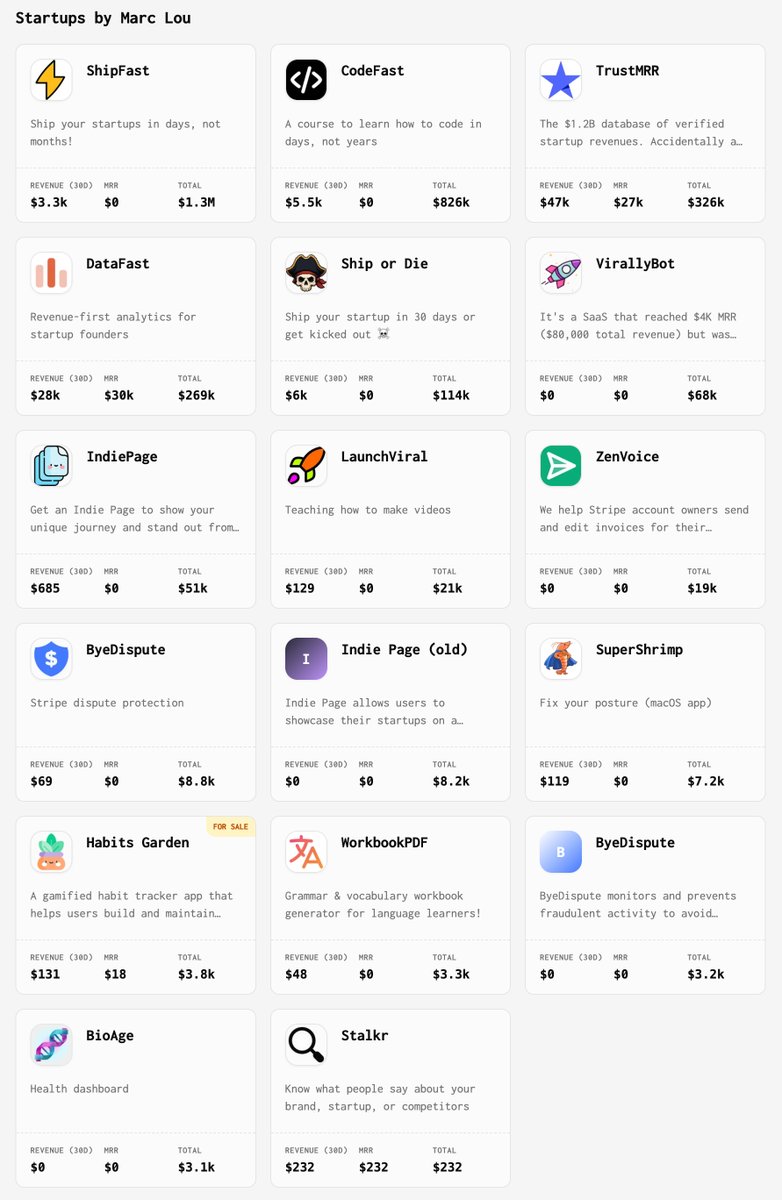
I've made $3M with my 36 startups.
Solo.
85% margin.
Bootstrapped.
It took 10 years, and I loved every second of it.
After failing as an entrepreneur for 5 years, I got a job in 2021.
That's when I discovered @levelsio's journey and decided to try again.
"If he can do it, maybe I can too?"
So I started building tiny startups and writing about it.
2021 and 2022 were quiet, but I was having fun.
Everything changed in 2023 when I launched ShipFast and made my first million.
Building something people finally paid for and enjoyed made me so happy.
My first 5 years of failures taught me not to get emotionally attached to a project, because everything goes to 0 eventually.
So I just kept shipping.
It's 2026, and I've launched 36 startups.
50% never made money.
Only 11% made decent money.
Back in 2016, when I started, I believed I would make it.
If I had known it would take 7 years of failure, I probably would never have started.
That's why I'm stupidly optimistic.
I don't think in years. I don't dream big.
I think in weeks. I build tiny projects fast. And I quit even faster.
That's how I wake up happy, enjoy the journey, and eventually build life-changing projects.
If you've been following the journey, thank you. You've given my posts a sense of purpose, which has kept me going, and I'm very grateful for this. ❤️
A developer recently said he deleted 3 months of AI-generated code.
That statement should make every company pay attention.
1/
Most teams measure AI success using:
→ More code shipped
→ Faster delivery
→ Higher output
Those metrics matter.
But they can also hide a dangerous problem.
2/
Software isn't just code.
Software is accumulated decisions.
Why this architecture?
Why this pattern?
Why this tradeoff?
Why this constraint?
The code is only the final artifact.
The thinking behind it is the real asset.
3/
When engineers make decisions themselves, they build context.
When AI makes those decisions repeatedly, teams can slowly lose context.
And context compounds.
Just like technical debt.
4/
The risk doesn't appear immediately.
It appears months later.
When:
→ A critical system needs to evolve
→ A major customer requests something unexpected
→ A key engineer leaves
That's when understanding gets tested.
5/
Suddenly, nobody feels confident touching the system.
Not because the code is bad.
Because nobody fully understands why it exists the way it does.
6/
The biggest challenge with AI-generated code isn't code quality.
It's knowledge transfer.
The code gets written.
The reasoning often doesn't.
7/
That's why AI should generate implementation.
Humans should generate intent.
The moment teams outsource intent, architecture starts drifting.
8/
Every AI-generated system needs documented reasoning.
Not just:
"What does this code do?"
But:
→ Why does it exist?
→ Why was this approach chosen?
→ What alternatives were rejected?
→ What tradeoffs were accepted?
9/
Future maintainability depends on decisions being visible.
Not just code being available.
10/
Codebases don't become fragile when code breaks.
They become fragile when understanding disappears.
11/
We've found the highest-leverage use of AI isn't replacing engineers.
It's helping engineers spend less time typing and more time thinking.
About systems.
About tradeoffs.
About outcomes.
12/
Because in the long run:
Code is easy to regenerate.
Context isn't.
@aayushman2703 Most builders optimize for faster page creation.
This optimizes for shared intent between humans + agent inside the editing surface.
That’s a fundamentally different product category if it holds up in practice.
@tim_yakubson Hot take: GTM Engineer isn’t a tool stack role, it’s a systems thinking role.
Clay, scraping tools, automations… they all change fast.
What doesn’t change is the ability to turn “signals → pipeline” reliably.
This is a solid roadmap either way.
@maestrotimk Every ghostwriter I know has a folder full of "stop writing like this" feedback that gets ignored by AI the next day.
A system that actually learns from edits instead of re-reading prompts is long overdue.
PARTNER.
@paolo_scales Most people focus on the posts.
The real conversion happens in the profile, DMs, and nurture sequence. Content creates attention, but the funnel turns attention into booked calls.
@AlfieJCarter The biggest mistake I see isn't bad prompts.
It's packing everything into one giant skill and wondering why performance degrades over time. Structure and retrieval matter as much as the instructions themselves.
@5harath Some of the best career opportunities start with an unexpected transition.
Community, storytelling, and growth are a rare combination. Hope the right people see this and reach out. Happy birthday and good luck with what's next.
@Safwon_CoderAI Most people are overengineering agents before they've proven a simple prompt chain can't solve the problem.
Complexity should be earned, not assumed.
@eCom_Amin The real unlock here is moving from "AI gives recommendations" to "AI operates the workflow."
Most marketers still haven't wrapped their heads around that shift yet.
Unpopular opinion:
Most funded startups are over-engineered and under-validated.
You hired 4 engineers before talking to 40 customers.
That's not a tech problem. That's a priorities problem.
#Startups#MVP#FounderAdvice