Scoop: US and EU are weighing new tariffs on Chinese steel and aluminum as part of a bid to fight carbon emissions and global overcapacity. @jendeben@AlbertoNardelli@europressos
https://t.co/Oe0NwAnvkU
USD dominance depicted
“Half of global trade is invoiced in USD.. despite the US accounting for just over 10% of global trade”
Link to the @BIS_org quarterly review: https://t.co/vFxxFrx4zj
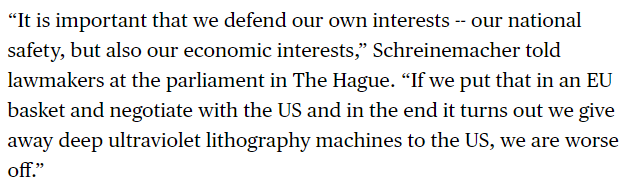
Dutch chip toolmaker ASMI warns of escalating tensions over export controls, as US officials about to hold talks with Dutch officials in Netherlands this week. US wants #Netherlands & #Japan to agree to a trilateral deal. #Chips (@AnnaSophieGross & @Dimi)
https://t.co/4QnD1TYj3E
Further indication of the strain that weaponized interdependence places on economic integration, as the Netherlands tries to distance itself from an all-EU strategy on semiconductor inputs. @WorldWeaponized.
“It’s so hard to cut China out of this supply chain,” said Chad Bown, a senior fellow at the Peterson Institute for International Economics. “In order to do it, you have to use policy instruments that we have never thought about using before.”
US government policy pronouncements related to China and technology have ramped up over the past six months…it is important to understand their evolution, and implications for allies...a thread🧵
As my quote in the prospect article makes clear, I don't think there has been much of a shift in global supply chains out of China.
At least not yet.
And there is a really big data puzzle here too. The Chinese data tells a different story than the US data.
1/
To me a big question about US-China tech competition is whether the world system can handle growth-stifling strategies among the largest economies. Since the 1940s US hegemony stabilized territorial order by enabling rapid growth for all. What happens when it no longer does?
OFAC targeted Armenia- and Taiwan-based front companies Milur Electronics and Sharp Edge for assisting a Russian microelectronics company Milandr to illicitly procure microelectronics. A Swiss company was used to facilitate financial transfers.
https://t.co/i8oUDy3gzk
Habeck: "Today there no longer is unpolitical trade". Responding to Siemens CEO Busch who talked about "cooperation & competition with 🇨🇳" Habeck said "I'd put stress bit more on competition. In the past we didn't look closely enough at critical sectors".
https://t.co/Tx3sKSFuil
Semi Thread for October 2022. 🧵
Focus: 1) Not on specific names, but rather industry dynamics now versus the past. 2) Front vs back-end. 3) Sector Spend. 4) Recent Events of interest.
@kittysquiddy
/1
FT: Indonesia is studying the establishment of an Opec-like cartel for nickel & other key battery metals, highlighting geopolitical confidence of nations that are rich in resources
discussed in Polycrisis "Geopolitics of Stuff" https://t.co/BjDbnGAP0q
https://t.co/XyzaI6sKzX
Maria's post below and the Bloomberg article on possible circumvention - through Armenia and Kazakhstan - of EU #sanctions on Russia raised some interesting discussion, so I felt it could be useful to unpack some legal issues involved.
(thread)
What better illustration of geopolitical actor-network theory than Western worries about imports of breast pumps, washing machines and fridges: by themselves harmless appliances but whose "sub-threshold" components can be reassembled by weapons engineers?
https://t.co/5Rn0aVivgE