#News: An increase to €7.4 billion of the @EIF_EU’s share #capital was approved today by our shareholders. This adds substantial capacity to our support of the European #SME financing market incl. guarantees & equity activity. 📑 Press release: https://t.co/e4UscU6h6L
Here is our new Covid-19 Credit Market Dashboard.
Data is updated daily and access is free.
For more information and to register, please see: https://t.co/TPn3pYbGuB
#COVID19#coronavirus#Dashboard#riskmanagement
But regulators have encouraged banks to be conservative in marking down their ratings and in any case most internal ratings are driven by slow moving accounting variables. This provides little insight in a fast-moving crisis.
Schnabel: Internal models are a well-accepted tool in banking supervision. To mitigate incentive problems, supervisors carefully check these models. The acceptance of internal ratings is a temporary measure to relieve the strains from the COVID-19 pandemic. #AskECB
Innovative risk transfer from IADB to Sweden. https://t.co/WgWu1winCl Such deals could drive big increase in development bank lending capacity if they catch on.
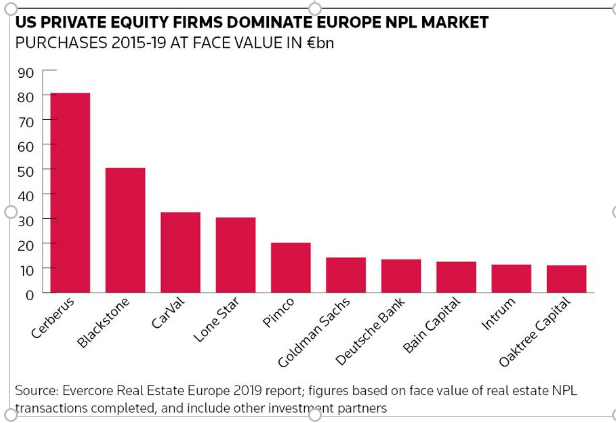
Europe NPLs set to jump in next couple of years - maybe by €340bn, adding to €529bn already. But banks better equipped to cope due to legal/process changes + with big US buyers like Cerberus, Blackstone, CarVal still on prowl. £ https://t.co/vuKCIDypyv
New EBA data gives optimistic view of health of EU banks https://t.co/YqWvq7UgU7 The problem is that most banks have very slow moving internal ratings that do not yet reflect #covid19 effects. Updates in ratings as in https://t.co/4to78Pe4G1 is only way to get accurate view
UK lock-down rigorous in many respects but construction industry allowed to continue full blast. Has that weakened the impact of closing the rest of the economy?
The frontline muni-bond regulator, the MSRB, is taking steps to bolster the independence of its board from the industry it regulates.
https://t.co/pWw59wLf8K
Tenor matters more than holder. If debt is long-dated, it does not much matter in a crisis who holds it. If one is willing to default (not to be recommended!), it is easier for a country to default on foreign debt than domestic.
When funding issues come to the fore, its not just your level of debt but who holds it that matters. Our measure of risk-weighted debt based on this chart is relatively favourable for Egypt, Brazil, India, less so for Hungary, Slovenia, Ukraine.
The current #pandemic triggered unusually fast outflows of dollars from emerging market economies. Read about the global effects: https://t.co/0yPiqZ5XLF