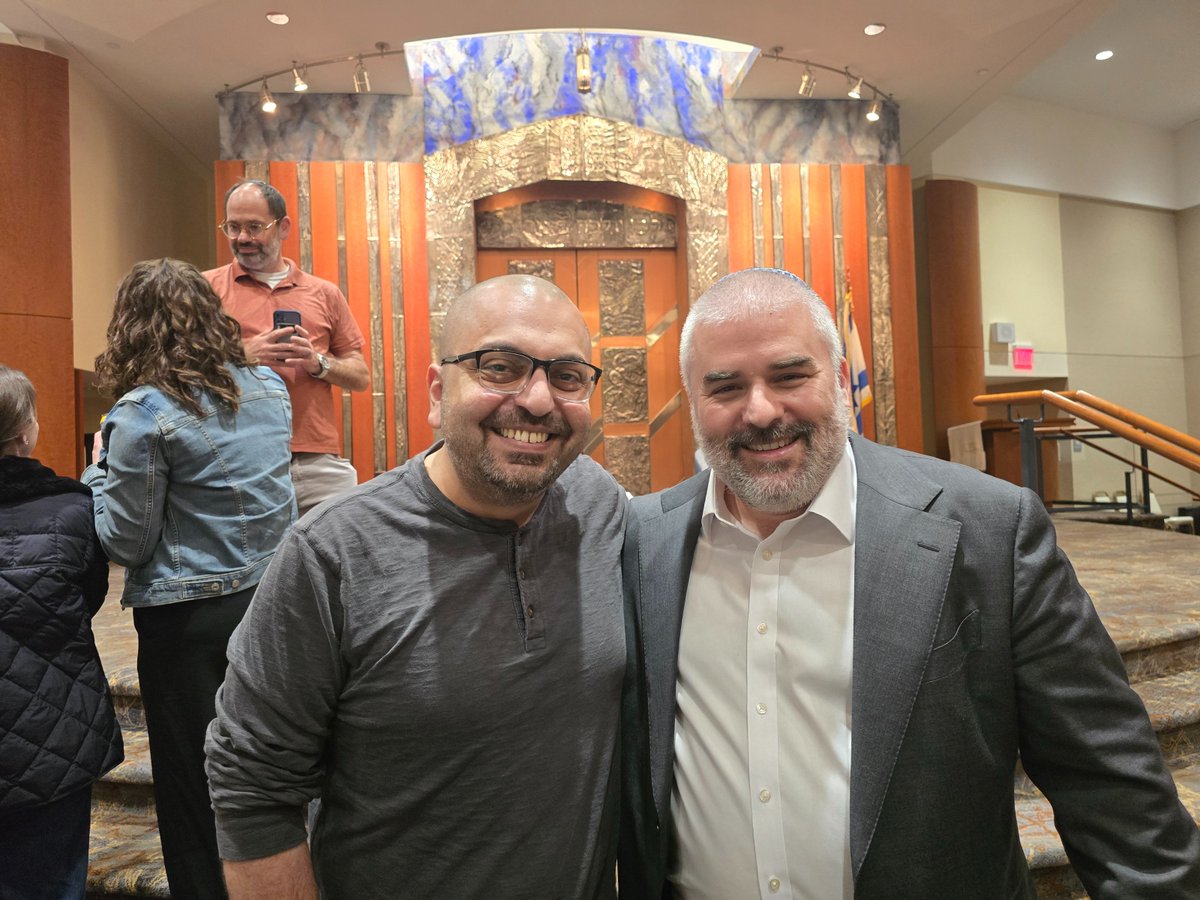
Hey @SkyNews 👋
Arab Israeli here. Allow me to set the record straight: there are no “Palestinian citizens of Israel” and your attempt to erase our identity and belonging in this country is racist, inaccurate and offensive. Can you imagine saying “the Mexican citizens of the United States” simply because one is Latino?
Less than 15% of Arab Israelis identify as Palestinian (and most polls have it closer to 7%). You don’t get to decide what our identity is.
@Bushra1Shaikh Verified source, please on the 70 percent of Jewish children attending Jewish schools full time. That’s a ridiculous claim.
As for integration, no need to demonize one religion to advocate for your own.
@Fincey47@MVGutierrezMD First, not very sick. Second, the vaccine doesn’t work immediately. Third, no one says you won’t get Covid. I’m old, so my risk of getting really sick is high & mitigating risk is smart.
The internet told them Europe was a social paradise. Turns out the trains are awful, the health care isn’t free, and people can be really mean. https://t.co/Hs4uzWMxxO
@MVGutierrezMD Novovax 9/28
Covid symptoms began 10/10
No clue where I was exposed — possibly during a medical procedure where I couldn’t mask & med team wore crap masks.
Pls mask when traveling. This is not fun.
At conferences and in journal articles, let’s demand for complete transparent reporting of adverse events. Without this, there can be no informed discussion of risks and benefits. https://t.co/FwIPB5a9q8
Can the echo chambers surrounding Israel and Palestine be broken? A few days ago, I spent an unusually intense day in five engagements with policymakers, officials, diplomats, journalists, former executive branch figures, and commentators.
I began with a briefing to a parliamentary committee in a major European Union country on UNRWA funding and Gaza’s humanitarian needs. I urged support for UNDP efforts to clear waste that is driving infestations and health risks and encouraged the committee to see UNICEF as a platform for broader educational services. I argued that UNRWA is no longer a viable vehicle for humanitarian delivery in postwar Gaza and that its role there should be assessed separately from its work in the West Bank and neighboring Arab states. I then spoke with government officials about Palestinian politics and the barriers to near‑term change. After that, I met regional diplomats to discuss concrete policy steps that could reshape Gaza’s trajectory and, over time, the broader Israeli and Palestinian conflict.
Later, I attended a discussion of Brink, Brett McGurk’s account of his years as President Biden’s Middle East coordinator and a senior diplomat across several administrations. Moderated by David Ignatius of The Washington Post, the conversation examined the conflicting goals that have defined the aftermath of October 7: freeing Israeli hostages, securing a ceasefire, and removing Hamas from Gaza. I ended the day with journalist and analyst Haviv Rettig Gur, whose remarks spanned Gaza, settler violence, Israeli politics, and the elusive prospect of Israeli and Palestinian peace.
Across those five engagements, I heard sharply different views on Palestinian politics, Israeli society, October 7, the war in Gaza, and the broader conflict. One theme connected them all: echo chambers. They shape how information spreads, how people react to it, and how personal and public attitudes form, especially when people refuse to consider unfamiliar ideas. Some participants were genuinely open to perspectives that challenged their assumptions. Others responded instantly with counterarguments, more interested in asserting their case than in an honest exchange. Some spoke only to their own circles and repeated familiar lines. Others, even within those same circles, were willing to question conventional thinking and explore new possibilities.
Consider these two examples: in parts of the pro‑Palestine movement, Israel is cast as an inherently illegitimate, colonial, genocide-committing enterprise, reinforced across academic, activist, political, and journalistic spaces. In parts of the pro‑Israel movement, settler violence in the West Bank is minimized or reflexively blamed on Palestinians despite video evidence, official acknowledgments, and a long record of extremism enabled and protected by the Israeli government. The difference is that “pro‑Palestine” narratives increasingly reach mainstream global audiences, while pro‑Israel advocates often speak mainly to one another, doing little to arrest Israel’s declining diplomatic and reputational standing.
The question is whether either community can break out of its echo chamber and engage honestly with the other, and critically, whether outside observers can resist forming their own echo chambers from information that is limited, curated, manipulated, or incomplete.
For centuries, Europeans called Jews foreigners from the Middle East and murdered six million of them for it.
Now Mehdi says they’re Europeans.
“Asiatic” in Warsaw, “Polish” in Jerusalem.
The only constant is the claim that Jews belong nowhere.