One thing that really worked for HubSpot in the early days was that we published our "culture code" which, at the time, was quite unique.
I'm waiting for someone to create a version of that for a truly ai native company. If you see a great one, send it along.
Interesting to see model maturity impact personal hardware decisions. @GeminiApp has released updates that have transformed chat into personal intelligence across my email, scheduling, and family planning. But my Apple phone can’t (or won’t) coordinate with proper protocols. Software has always been a moat for matching hardware, but I think agentic capabilities make philosohical decisions on protocols (open, closed, etc) more relevant to everyday (non technical) buyers. No, I’m not ready to be a Pixel convert yet, but the pull is there.
What happens when we can bend the internet toward us vs us stooping or shapeshifting to meet it? Millions of digital design decisions have been made to unleash a brand's will on a user. Sure, we've tried to make them good and accessible and honest. But the reality remains the internet has become something that is constantly trying to amaze, disrupt, capture, and make us behave a certain way.
The most egregious examples would be local car dealership websites and the 100 pop ups you see before clicking on a vehicle. These annoying and pestering interactions exist to bend you toward the will of the website owner or brand. Perhaps a more tolerable but obvious one would be social media: enough features to feel simple but enough behavior patterns (visible and invisible) that make us generate revenue for a company.
What's odd, is that this is not how good machines work.
Machines and machine engineering don't operate to impose their will on the user. They are designed with the intent of the person in mind. The best machines are the most accessible and intuitive. The most expensive machines are the ones most bent toward a persons will.
I believe we're heading in a similar direction for the best digital experiences of our age and this need not be just a dream unrealized. Because AI capabilities have created an opportunity to be sovereign with our time and ruthlessly clear with our intent. This means that over the next year, companies of all sizes in all markets will have to reckon with user intent anthropologically—not just consumeristic tendencies they can manipulate into revenue. I predict that, instead of creating things that stop, interrupt, amaze, or even capture attention, the best brands will create things that help others create meaning based on their values and for their respective custom interface. Instead of a web experience demanding how someone sees, hears, or digests information, an agent can and will do that for the user based on their needs.
Watch your own behavior over the next week and month. Look at how much you expect of a personalized interface from your preferred AI model. I think we are close to tipping away from overly precious pixels that we think "delight" someone and into an internet that works like our plumbing or HVAC. While that may sound "dull" to you, imagine the meaningless clutter we have accumulated and the amount of meaning we regain if the worlds information bends toward us instead of us bowing to it.
hey @grok distill an argument that how people feel from an interaction will matter the most now that anything can be built with low friction/cost. use a philosophical and anthropological lens.
No structured data. No MCP endpoints. No machine-readable signal of any kind. They are invisible to the new customer. The agent-native consultancy's entire value proposition is closing that gap. Not building apps. Not automating workflows. Making businesses legible to the intelligence layer that is rapidly becoming the primary interface between supply and demand. The firms that figure this out in the next 18 months will own the next decade the way the best web agencies owned the 2000s.
I just tried to book multiple roofing and gutter estimates using agents and it's simply way harder than it should be for small businesses to take my money.
The gap today is identical. Most small businesses have no idea that AI agents are already making purchasing decisions, routing service requests, and selecting vendors — and that none of their current infrastructure is visible to those agents.
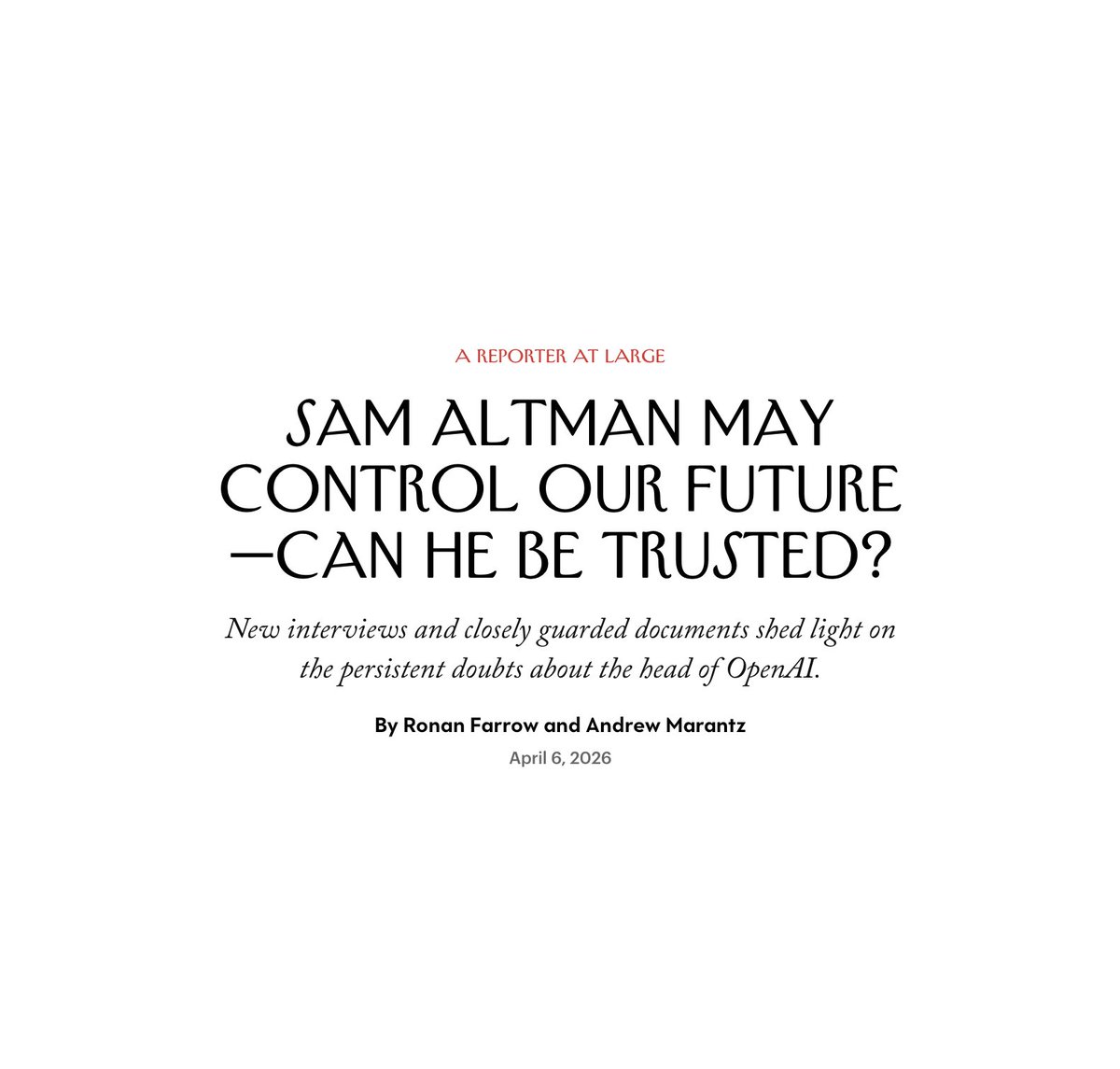
(🧵1/11) For the past year and a half, I've been investigating OpenAI and Sam Altman for @NewYorker. With my coauthor @andrewmarantz, I reviewed never-before-disclosed internal memos, obtained 200+ pages of documents related to a close colleague, including extensive private notes, and interviewed more than 100 people.
OpenAI was founded on the premise that A.I. could be the most dangerous invention in human history—and that its C.E.O. would need to be a person of uncommon integrity. We lay out the most detailed account yet of why Altman was ousted out by board members and executives who came to believe he lacked that integrity, and ask: were they right to allege that he couldn't be trusted?
A thread on some of of our findings:
@ryry__mimi Depends on terminal set up, /permissions, and tasking, A lot of the slow, I’ve found, is me not utilizing it properly or efficiently. But curious if there’s a point that feels slow or a certain phase?
I wish someone would have taught me code at the same time I learned mathematics. It’s a ridiculous proposition to teach algebra or calculus without showing the magic it can create. We might as well teach writing without books.
When everything can be made, the ability to choose, select, identify, and predict unveils the measure of intellect: whether there exists true imagination or a predisposition to follow all road signs.
Attachment as risk.
Today, tooling aptitude is not the thing I am most concerned about when evaluating ai fluency or even infrastructure deployment. I'm most interested in the rare (and becoming rarer) ability to hold tightly, test, then let go completely.
In other words, humans that are idea fascinated but conclusion flexible. There's a circuit pattern that will be hard to replicate and what I suspect is behind a lot of the first wave of AI researchers. Yes, mathematic basics, statistical understanding, and others are currency today, but behind them is more interesting to me: fascination with how things work.
Math and stats have been the gateway to answer to that question at scale for machine learning. Philosophy and psychology have been the answer for humans.
Neither camp is wrong or right, but the makeup behind the insatiable desire to experiment, explain, and pivot (without attachment) is what I suspect will be studied, valued, and rare.