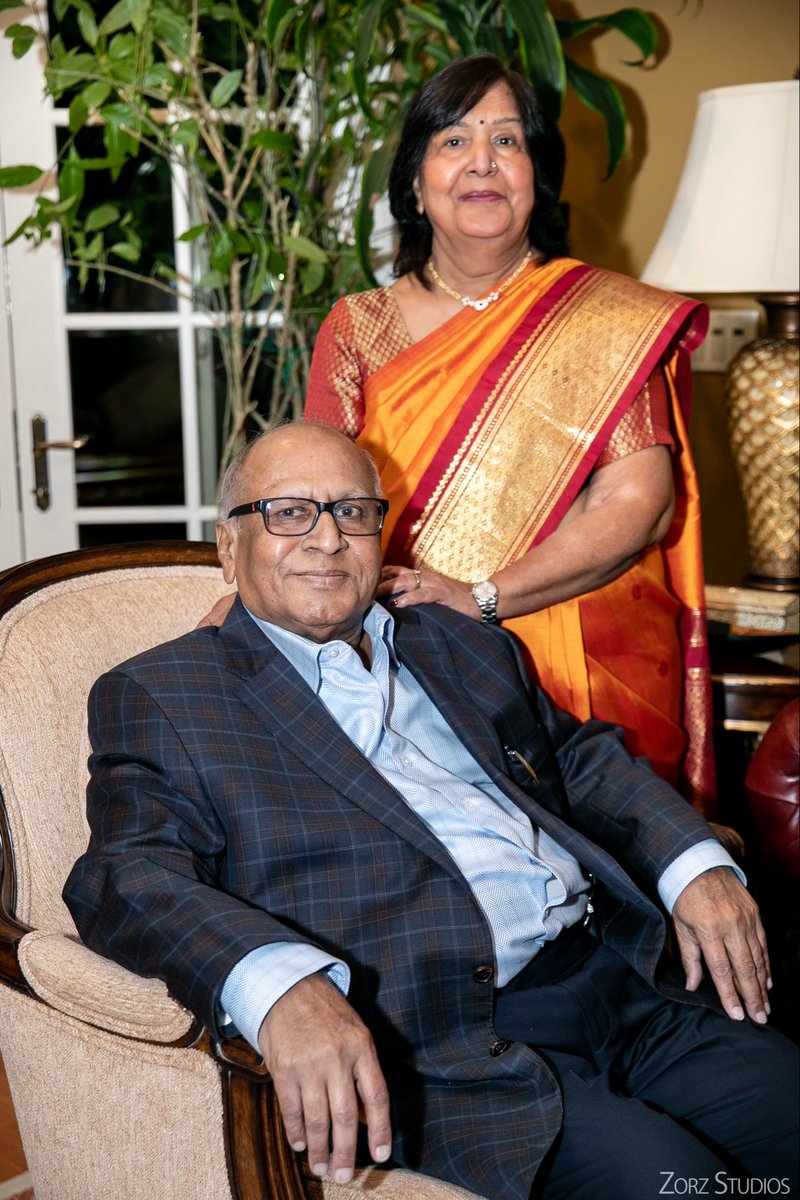
@tishasaroyan Is it marriage or is it children? I have observed that DINK are the most happy & vibrant couples.
Indian marriage institution may have its issues. However, responsibilites of family do take a toll on the spark of husband & wife.
A wife went viral for admitting she and her husband are mediocre. Average looking, not funny, no friends, mentally ill. And she can't explain why their marriage feels like a fairytale.
A psychologist in Seattle solved this exact puzzle in the 1990s.
John Gottman wired an apartment near the University of Washington with cameras and brought in 130 newlywed couples to just live in it. He tracked something he called bids: the tiny reaches for attention partners make all day. "Look at that bird." "Listen to this." A sigh that wants acknowledging.
Six years later, 17 couples had divorced. When his team went back to the tapes, the still-married couples had turned toward those bids 86% of the time. The divorced couples had managed 33%.
That one behavior predicted the outcome better than anything else in the data. Looks never entered the model. Humor never entered the model. Intelligence, money, status, shared hobbies: none of it showed up.
Now reread her post. "I can spend every minute of every day with this dude and not really get tired of it. We can get in the car and just drive for hours and talk."
Two people driving nowhere for hours are exchanging hundreds of bids and catching nearly all of them.
She graded the marriage on every trait that predicts nothing, and missed that they're elite at the one behavior that predicts almost everything.
We’ve moved from fixing systems to banning tools. Banning Telegram is a convenient way to look like the government is doing something without actually doing anything at all.
IFF emphasises that the NEET (UG) 2026 re-examination is worth protecting and it concerns the future of lakhs of aspirants.
The State cannot switch off a service used by lakhs to answer the wrongdoing of a few, and cannot do it through an order no one affected is allowed to read.
Comic by @aaaaadvik
Statement on the Hon'ble Delhi High Court's dismissal of Telegram's Petition impugning the blocking direction issued by the Union Government
Internet Freedom Foundation | June 19, 2026
The Delhi High Court today (June 19, 2026) declined to interfere with the Union Government's Orders of 16 June 2026 (interim order) and 17 June 2026 (final order) blocking access to the Telegram messaging platform under Section 69A of the Information Technology Act, 2000, ahead of the NEET (UG) re-examination till 22 June 2026 (blocking) and also disabling the message editing features till 30 June 2026. On the findings as pronounced, the Court has held that the requirements of natural justice were satisfied, that the power to block "information" is wide enough to permit the blocking of an entire platform, and that the restriction meets the test of proportionality because it is temporary. Doing so it has dismissed the writ petition titled as Telegram FZ LLC & Anr. v. Union of India & Others (W.P. (C) 8259/2026).
We respect the Court and will study its judgment carefully. We offer a preliminary analysis on the law of blocking and how it has been applied given the widespread impact not only on the 150 million users of Telegram in India but also of any other digital communication platforms.
First, the construction of "information" under Section 2(1)(v) of the Information Technology Act, 2000 to permit a platform-wide block is the finding of greatest consequence. When the Supreme Court upheld Section 69A in Shreya Singhal v. Union of India, it did so on the basis that the power is narrowly drawn, confined to blocking access to specific, identified information, on specified grounds, through a reasoned order. To read that power as reaching an entire intermediary, and with it the access of 150 million users to a medium of communication, is to treat the speech of a whole population as a single switch to be turned off. It sets a concerning precedent with consequences for the open internet that extend well beyond this case.
Second, on proportionality, it has been argued that the temporary character of a measure limits the duration of the harm; however that does not, by itself, establish that the least restrictive means was chosen. The standard in Anuradha Bhasin v. Union of India requires the State to demonstrate that no less intrusive alternative, here, the targeted takedown of unlawful content, which was available and was in fact acted upon, perhaps would have achieved the objective. A blanket block, however brief, restricts the lawful expression and the right to receive information of millions of Indians.
Third, on natural justice, the emergency procedure under Rule 9 of the 2009 Rules was invoked in place of the pre-decisional hearing under Rule 8, against an intermediary that had been in sustained engagement with the authorities for several weeks. That hearing is a safeguard integral to the fairness of the blocking process, and its displacement in these circumstances calls for close scrutiny. The law of blocking is, in practical terms, an extension of a constitutional power under Article 19, that governs access to the internet in India.
IFF will publish a detailed analysis of the judgment once its full text is available later this evening.
Caveat: The statement above is based on transcripts of proceedings as observed by us and also carried by reports in Bar and Bench and LiveLaw. It is also based on the oral pronouncement of portions of the judgement and a reading of the pleadings in the case. A detailed analysis will be provided after the entire text of the judgement is made available.
Lately, I’ve found myself thinking about the countless business dinners and social meals my parents attended during their early years in America.
Before ordering, my mother would invariably tell the server: “We are strictly vegetarian. No meat, no chicken, no fish, no eggs.”
She might then remind them—no beef stock, no gelatin…and list all the ways in which meat might be hidden in our food.
As a child, I often felt a twinge of embarrassment when she said it. I worried that we were making things difficult, creating extra work for the wait staff, drawing attention to ourselves in a way I wished we wouldn’t.
What I didn’t appreciate then was how much courage that simple sentence required. Especially when social pressures and convention would invite conformity. Instead they were often forced to answer a set of uncomfortable, sometimes ignorant questions:
“Have you always been a vegetarian?”
“How do you get protein?”
“Have you ever tried meat?”
“Don’t you know you’re missing out?”
And then they quietly would use the moment to share our belief system.
My parents arrived in a country where fitting in would have been easier than standing apart.
They could have quietly relaxed their commitments.
They could have decided that some traditions were not worth carrying across an ocean.
Instead, they held fast to a faith and culture rooted in nonviolence, one that called them to remain strictly vegetarian even when it was inconvenient, awkward, or misunderstood.
I don’t judge those who made different choices.
Every immigrant family navigates these questions in its own way.
But looking back, I see that what embarrassed me as a child was actually an expression of conviction.
Every child of immigrants, I suspect, wants their parents to adapt a little more, to blend in a little better.
We feel the friction when they don’t.
Yet now, whenever my wife and I sit down with friends or colleagues and hear ourselves say, “We are strictly vegetarian. No meat, no chicken, no fish, no eggs,” I feel something entirely different.
I feel gratitude.
What once sounded to me like a dietary restriction now sounds like an inheritance.
A small sentence.
A quiet act of conviction.
A reminder that my parents carried more than suitcases when they came to this country—they carried their beliefs.
And they had the courage to keep carrying them.
His name is Ranjitsinh Disale.
He wanted to be an engineer. When that did not work out, his father suggested he train as a teacher instead.
In 2009, he was posted to a government primary school in Paritewadi, a small village in Solapur district, Maharashtra. The school was a crumbling building wedged between two storerooms, one of which had been used as a cattle shed.
What he found there troubled him.
Girls were being married off young instead of being sent to class. Attendance was poor. The textbooks were written in a language many of the children, who spoke Kannada at home, could not properly read.
He decided to fix all of it, starting with the books.
He learned the children’s mother tongue and rewrote their textbooks in a language they could actually understand.
Then he did something no one in India was doing at the time.
He printed unique QR codes inside the textbooks, allowing students with access to a phone to scan a page and instantly access audio poems, video lessons and practice questions.
A village school in Solapur had built a digital classroom out of paper and printed squares.
The results changed the village.
Girls’ attendance reached nearly one hundred percent. Teenage marriages in the area stopped. His QR code idea worked so well that the Maharashtra government adopted it across the state.
The following year, the national education body embedded QR codes in textbooks across the country.
In 2020, Ranjitsinh Disale won the Global Teacher Prize. He was chosen from more than twelve thousand nominations across roughly one hundred and forty countries and was the only Indian in the top ten.
The award carried one million dollars, around seven crore rupees.
Then he did something no winner had ever done before.
He announced that he would give away half the prize money, dividing it equally among the other nine finalists so that their work could continue as well.
He said teachers are the real change makers.
He meant all of them, not just himself.
A man who became a teacher only because engineering did not work out changed how an entire country learns, and then gave half his fortune to the people he had competed against.
Follow for stories India deserves to remember.
More than 10 billion devices run on his idea.
He made $0 from every single one ~ and he planned it that way. 🤯
Meet Ajay Bhatt 🇮🇳🇺🇸
> Indian-American engineer. Born 1957 in Vadodara, Gujarat.
> Came to the US with a master's degree and joined Intel in 1990.
> One frustrating night, he couldn't connect a printer for his daughter's homework.
> He asked: why isn't there ONE universal port?
> His boss said it would never work. Told him to drop it.
> He didn't.
> Built it with fellow Intel engineer Bala Cadambi.
> Then united 7 fierce rivals ~ Intel, Microsoft, IBM, Compaq, DEC, NEC, Nortel ~ behind one shared standard.
> Apple fought it with FireWire. USB was cheaper. USB won.
> USB 1.0 launched in 1996. He went on to build USB 2.0 and 3.0.
> Intel made it royalty-free ~ free for the entire planet. 🚀
> Bhatt earned not a dime in personal royalties. By choice.
> 2009: Intel made him a "rock star" in a viral ad ~ played by a hired actor, not him.
> 2025: India finally honored him with the Padma Shri.
The man who connected the world.
And asked for nothing in return.
Absolute Legend 🐐
#NavIC | On 13 March, the last working clock on IRNSS-1F gave out. With that, NavIC dropped to three functioning satellites. You need four for a position fix.
India's indigenous navigation system, built so as to never depend on GPS again, is now effectively offline.
@astrokaran brings you the full story of what broke, how the NavIC crisis is a case study in compounding dependencies, and what's being built to fix this.
NavIC's Clock Crisis, And The Indian Clocks That Could Fix It 👇
https://t.co/Kyq1X63WpE
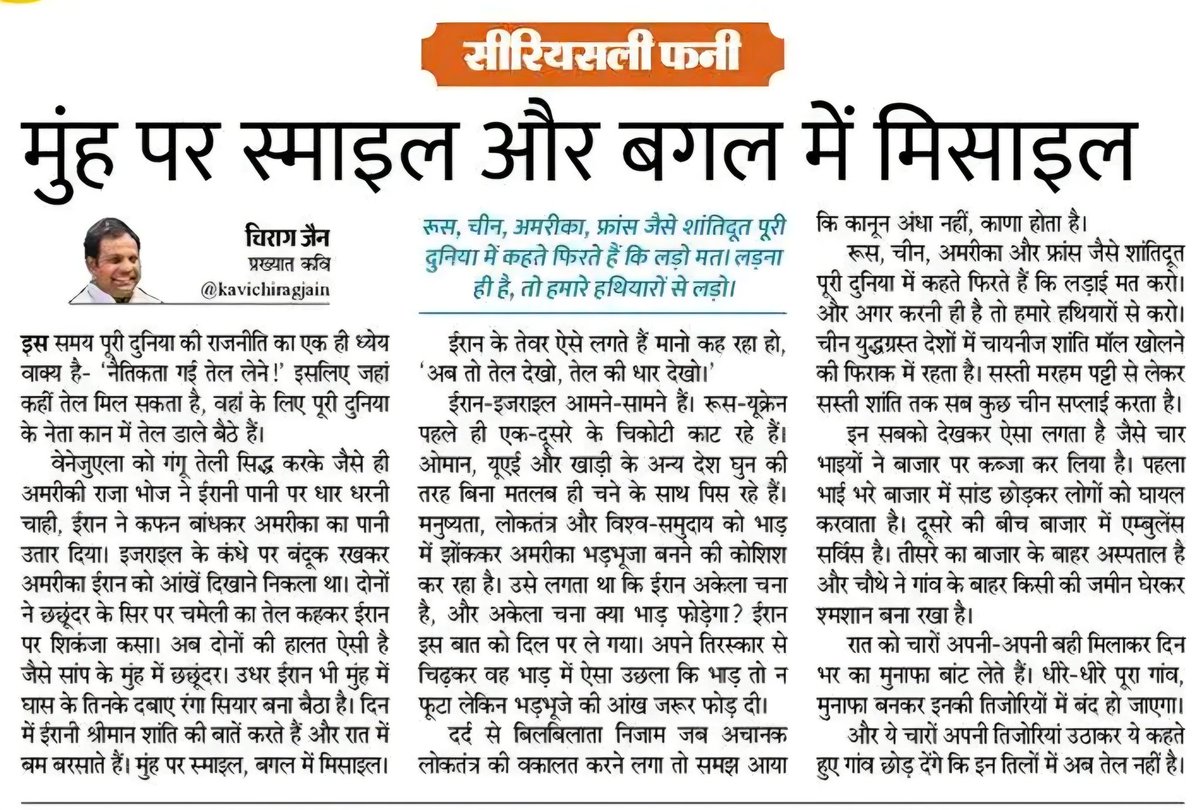
*मुँह पर स्माइल, बगल में मिसाइल*
इस समय पूरी दुनिया की राजनीति का एक ही ध्येय वाक्य है- "नैतिकता गई तेल लेने!"
इसलिए जहाँ कहीं तेल मिल सकता है वहाँ के लिए पूरी दुनिया के नेता कान में तेल डालकर बैठे हैं।
चूँकि तेल तिलों से ही निकलता है इसलिए तेल की हवस में दुनिया भर के मासूम लोग तिल-तिल कर पिस रहे हैं। आसमान से आग बरस रही है और राजनीति का खून ठण्डा हो चुका है।
वेनेजुएला को गंगू तेली सिद्ध करके जैसे ही अमरीकी राजा भोज ने ईरानी पानी पर धार धरनी चाही, ईरान ने सिर पर कफन बांधकर अमरीका का पानी उतार दिया।
इजरायल के कंधे पर बंदूक रखकर अमरीका ईरान को आंखें दिखाने निकला था। दोनों ने छछूंदर के सिर पर चमेली का तेल कहकर ईरान पर शिकंजा कसा। अब दोनों की हालत ऐसी है जैसे सांप के मुँह में छछूंदर।
उधर ईरान भी मुँह में घास के तिनके दबाए रंगा सियार बना बैठा है। दिन भर ईरान के श्रीमान शांति की बातें करते हैं और रात भर ईरान के विमान बम बरसाते हैं। मुँह पर स्माइल, बगल में मिसाइल।
ईरान को देखकर ऐसा लगता है, जैसे उसकी इमारतें नींव पर नहीं, मिसाइलों पर खड़ी हों। ईरान की ताकत के बारे में मीडिया चैनल जब बताते हैं तो ऐसा लगता है मानो ईरान के घरों में टीवी और एसी के रिमोट भी वास्तव में मिसाइल के रिमोट हैं, जिनका मोड बदलकर उनसे टीवी ऑपरेट करने का काम लिया जा रहा है।
ईरान के तेवर ऐसे लगते हैं मानो कह रहा हो, "अब तो तेल देखो, तेल की धार देखो।"
ईरान-इजरायल आमने-सामने हैं। रूस और यूक्रेन पहले ही एक-दूसरे के चिकोटी काट रहे हैं। ओमान, यूएई और खाड़ी के अन्य देश घुन की तरह बिना मतलब ही चने के साथ पिस रहे हैं। मनुष्यता, लोकतन्त्र और विश्व-समुदाय को भाड़ में झोंककर अमरीका भड़भूजा बनने की कोशिश कर रहा है। उसे लगता था कि ईरान अकेला चना है, और अकेला चना क्या भाड़ फोड़ेगा?
ईरान इस बात को दिल पर ले गया। अपने तिरस्कार से चिढ़कर वह भाड़ में ऐसा उछला कि भाड़ तो न फूटा लेकिन भड़भूजे की आँख जरूर फोड़ दी।
दर्द से बिलबिलाता हुआ निज़ाम जब अचानक लोकतंत्र की वक़ालत करने लगा तो समझ आया कि कानून अंधा नहीं, काणा होता है।
रूस, चीन, अमरीका और फ्रांस जैसे शांतिदूत पूरी दुनिया में कहते फिरते हैं कि लड़ाई मत करो। और अगर करनी ही है तो हमारे हथियारों से करो। चीन युद्धग्रस्त देशों में चायनीज शांति मॉल खोलने की फ़िराक़ में रहता है। सस्ती मरहम पट्टी से लेकर सस्ती शांति तक सब कुछ चीन सप्लाई करता है। बाकी सारे दादा लोग आग बेचकर कमाते हैं और चीन जैसे खलीफा पानी बेचकर कमाते हैं।
इन सबको देखकर ऐसा लगता है जैसे चार भाइयों ने बाज़ार पर कब्जा कर लिया है। पहला भाई भरे बाजार में सांड छोड़कर लोगों को घायल करवाता है। दूसरे की बीच बाजार में एम्बुलेंस सर्विस है। तीसरे का बाजार के बाहर अस्पताल है और चौथे ने गांव के बाहर किसी की जमीन घेरकर श्मशान बना रखा है।
रात को चारों अपनी-अपनी बही मिलाकर दिन भर का मुनाफ़ा बाँट लेते हैं। धीरे-धीरे पूरा गांव, मुनाफ़ा बनकर इनकी तिजोरियों में बंद हो जाएगा।
और ये चारों अपनी तिजोरियां उठाकर ये कहते हुए गांव छोड़ देंगे कि इन तिलों में अब तेल नहीं है।
✍️ चिराग़ जैन
The Cowboys and the Indians were having a huge fight out in the high country.
They fought and fought, and finally there was only one cowboy left. He promptly surrendered to the Indians.
The Chief Indian said,
Cowboy, you a tough fighter!
We give you one wish a day for 3 days, then we scalp you!" " Are you ready for your first wish?"
The cowboy said, " I want to see my horse" They brought the horse over, the cowboy whispered in the horse's ear, slapped him in the ass, and the horse took off.
The horse came back about 3 hours later with a beautiful blonde. The cowboy took the blonde into the tent.
The next morning the Chief Indian told the cowboy, " OK Cowboy, time for wish # 2, and the cowboy said again, " I want to see my horse".
They bring the horse over, he whispers in the horses ear, slaps him in the ass, and the horse takes off.
The horse comes back around 4 hours later with a beautiful redhead.
The Indians all look at each other and shrug. The cowboy takes her hand, and they go into the tent.
The next morning, the Chief Indian says to the cowboy, "OK Cowboy, last wish, and then you die"
The cowboy says," I want to see my horse" The Indians look at each other incredulously, but shrug and say OK.
They bring the horse over, and the cowboy goes over to the horse, lifts his ear, and screams, " POSSE HORSE, I SAID POSSE!!!!"
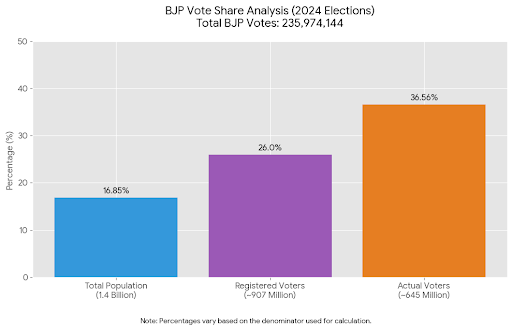
Truth is that BJP got 235,974,144 votes in 2024 elections.
If that was calculated as a percentage of 1.4 Billion, then it works out to just 16.85%.
If that was calculated as a percentage of total registered voters, then it works out to 26%.
Their voting percentage as per number of people who actually voted stands at 36.56%.
By no stretch of imagination do 1.4 Billion people support BJP and Modi.
At least I don't.
As you look at the horrific pictures of the bombed Iranian school…
Pause for a minute and think..
Indian Air Force and the Army were given 2 and 7 terror targets respectively to hit on the night of May 6-7 in Op Sindoor…
Each was fully destroyed…
On the morning of May 8, the IAF carried out extensive air defence suppression using long-range kamikaze drones…
On May 9-10 the IAF targeted 14 PAF bases or radar stations/missile batteries…
Destructive evidence of almost all these strikes cane up in satellite pictures…
All strikes were carried out by precision munitions from long distances…
Not one missed aim or strayed to harm civilians… no school, no village or city, no hospitals. None…
This despite not having a fraction of the US military weapons, sensors or surveillance ability…
And in a furiously contested air space against near-peer PAF and its Chinese air defences…
Let’s give credit where due. To our armed forces in this case…
@JuliaEMcCoy I see many such posts.
You forget, thinking needs data(memory).
Creating (assuming you refer to something new) requires history/knowledge (memory).
Discerning requires knowledge of what is (memory).
Human brain requires data to think. That data is memory.
IIA Meerut is organizing the 10th edition of India Solar and EV Expo on 21, 22 and 23 February 2026 at IIA Bhawan, Mohkumpur Industrial Area, Meerut.
Hope to see all of you there. @IiaMeerut@iiaonline
https://t.co/dSw5IqkfkN
आज ही के दिन सरदार पटेल ने आरएसएस पर गांधी हत्या के आरोप में प्रतिबंध लगाया था.
आज 4 फरवरी 1948 को राष्ट्रीय स्वयंसेवक संघ पर सरदार पटेल द्वारा प्रतिबंध लगाए जाने की वर्षगांठ है। RSS पर यह प्रतिबंध महात्मा गांधी की हत्या में संदिग्ध भूमिका के कारण लगाया गया था। जरा समझते हैं कि महात्मा गांधी की हत्या के तुरंत पहले और बाद RSS क्या कर रहा था?
5 जनवरी, 1948 को नेहरू ने मुख्यमंत्रियों को लिखा: "हाल में हुए घटनाक्रम में आरएसएस ने महत्त्वपूर्ण भूमिका निभाई है. इस बारे में पर्याप्त सबूत मिले हैं कि हाल में हुई ख़ौफ़नाक घटनाओं के पीछे आरएसएस का हाथ है. उनके नेता खुले तौर पर कहते हैं कि आरएसएस एक राजनैतिक संगठन नहीं है, लेकिन इस बात में कोई संदेह नहीं हो सकता कि उनकी नीति और कार्यक्रम राजनैतिक हैं, सांप्रदायिक हैं और हिंसक गतिविधियों पर आधारित हैं. उन पर लगाम कसना ज़रूरी है, और हमें किसी भी सूरत में उनकी ऊपर से दिखने वाली अच्छी बातों से दिग्भ्रमित नहीं होना चाहिए, क्योंकि यह बातें उनकी असली नीति से कोसों दूर हैं.'
प्रधानमंत्री नेहरू ने देश के गृहमंत्री और उप प्रधानमंत्री सरदार वल्लभ भाई पटेल को गांधीजी की हत्या के आठ दिन पहले 22 जनवरी, 1948 को पत्र लिखा: " पिछले कुछ हफ्ते से दिल्ली के ज्यादातर उर्दू और हिंदी अखबार जहर उगल रहे हैं। गांधीजी के उपवास के दौरान यह बात खास तौर पर दर्ज की गई है। इनमें से कुछ अखबार हिंदू महासभा के आधिकारिक अंग हैं या इससे जुड़े हुए हैं.. हिंदू महासभा और आर एस एस की दवाइयों को देखते हुए उनके प्रति उदासीन बना रहना दिन पर दिन कठिन होता जा रहा है।"
गांधी जी की हत्या से 2 दिन पहले 28 जनवरी 1948 को पंडित नेहरू ने श्यामा प्रसाद मुखर्जी को पत्र लिखा: " पिछले कुछ समय से हिंदू महासभा की गतिविधियों से मैं बेहद दुखी हूं इस समय यह न सिर्फ भारत सरकार और कांग्रेस के लिए मुख्य विपक्ष है बल्कि यह एक ऐसा संगठन है जो लगातार हिंसा को भड़का रहा है आर एस एस ने तो इससे भी बुरी तरह काम किया है। उसकी करतूतों और दंगों और अशांति में इसकी जुड़े होने के बारे में हमने सूचना इकट्ठा की है।"
इसके बाद 30 जनवरी 1948 को महात्मा गांधी की हत्या कर दी गई। सरदार पटेल ने 4 फरवरी 1948 को आरएसएस पर प्रतिबंध लगा दिया। 6 फरवरी 1948 को पटेल ने नेहरू को लिखा : देसी राज्यों में राष्ट्रीय स्वयंसेवक संघ पर प्रतिबंध लगाने के बारे में हम सारे बड़े राज्यों को जिनमें भरतपुर और अलवर भी शामिल है तार द्वारा सूचित कर चुके हैं कि वह अपने-अपने प्रदेशों में समानांतर कदम उठाएं। आशा है कि उनमें से अनेक हमारी सलाह मानेंगे, जो नहीं मानेंगे, हम उनसे बाद में निपट लेंगे।"
27 फरवरी 1948 को सरदार पटेल ने नेहरू को लिखा: जहां तक दिल्ली आर एस एस का प्रश्न है तो मैं ऐसे के लिए प्रमुख व्यक्तियों या सक्रिय कार्यकर्ताओं को नहीं जानता जिन्हें हमने छोड़ दिया हो। RSS जैसे गुप्त संगठन के पास ना तो सदस्यों का कोई रिकॉर्ड है और ना ही कोई रजिस्टर वगैरह है इसलिए इसके बारे में यह प्रमाणित जानकारी हासिल करना कठिन है कि कोई विशेष व्यक्ति सक्रिय सदस्य है या नहीं।"
18 जुलाई 1948 को सरदार पटेल ने श्यामा प्रसाद मुखर्जी को लिखा: 'आरएसएस और हिंदू महासभा के बारे में मैं इतना ही कहूंगा कि गांधीजी की हत्या का मुकदमा विचाराधीन है, इसलिए मुझे उसमें इन दो संस्थाओं के हाथ के बारे में कुछ नहीं कहना चाहिए, परंतु हमारी रिपोर्टें ज़रूर इस बात की पुष्टि करती हैं कि इन दो संस्थाओं की, खासतौर पर आरएसएस की प्रवृत्तियों के परिणामस्वरूप देश में ऐसा वातावरण पैदा हो गया था, जिसमें ऐसी भीषणतम घटना संभव हो सकी. मेरे मन में इस संबंध में किसी तरह का संदेह नहीं है कि हिंदू महासभा का अत्यंत उद्दाम वर्ग इस षड्यंत्र में शामिल था. आरएसएस की प्रवृत्तियां सरकार और राज्य के अस्तित्व के लिए स्पष्ट ख़तरा बन गई हैं. हमारी रिपोर्ट दिखाती है कि प्रतिबंध के बावज़ूद वे प्रवृत्तियां खत्म नहीं हुई हैं. बेशक, समय बीतने के साथ आरएसएस के लोग ज्यादा अवज्ञापूर्ण बनते जा रहे हैं और दिन-पर-दिन उनकी विध्वंसक प्रवृत्तियां बढ़ती जा रही हैं."
A speed reading training video starts at 300 words per minute and ends at 900 words per minute.
I was able to understand this entire video the first time it was present.
Could you?