Stop thinking human->agent.
Start thinking human<->agent.
You prompt it to perform better. Ask it to “preprompt” you before your next interview, meetup or difficult conversation.
The goal isn’t just a more capable agent.
It’s a more capable human-agent team.
10+ years in enterprise software, deep into AI, and hiring feels broken.
I wonder how many interviewers have job-hunted lately. Do they know what it’s like now?
I answer for myself, not with AI feeding me answers in real time. But that’s an option now. What are these interviews actually measuring?
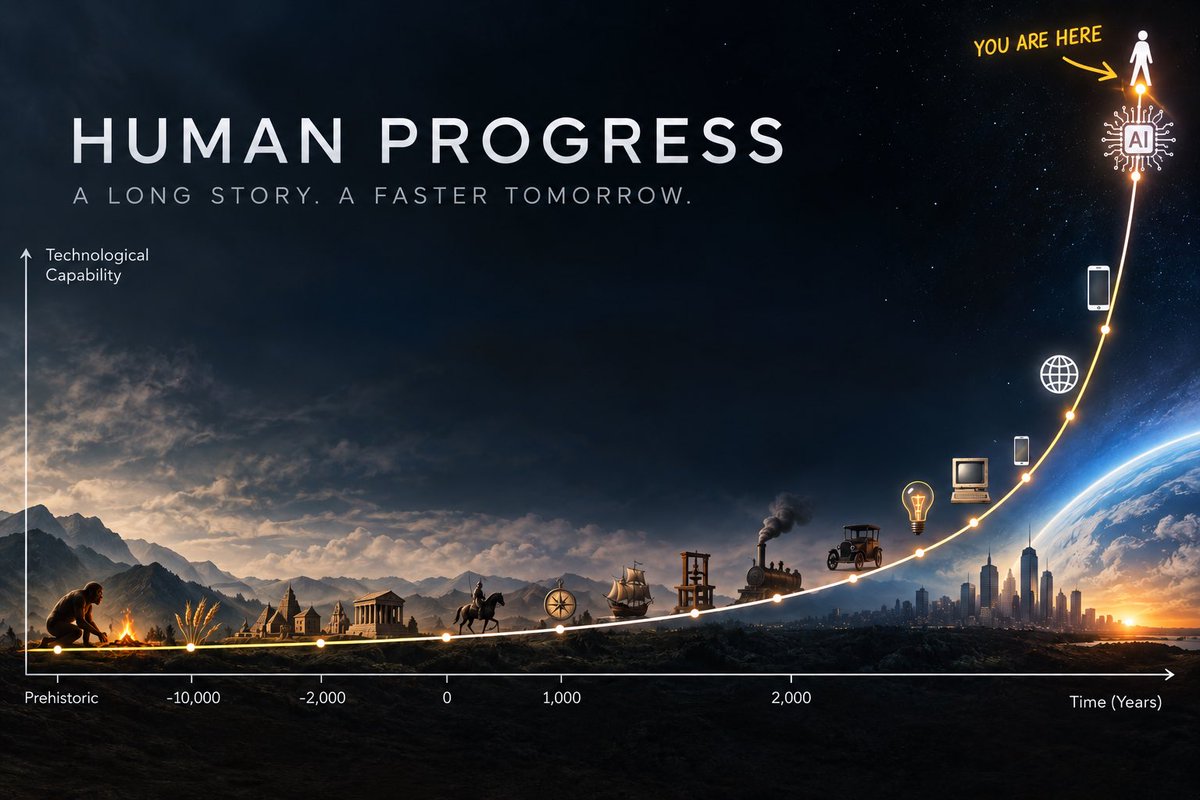
The skill is shifting.
As models get better, we spend less effort telling them exactly what to do and more effort figuring out the right question to ask
Let your app choose the right model, tool, or action in near real-time with Decisions API, now available to all developers in public beta.
The Decisions API makes decisions up to 10x faster than GPT-6 Luna through the Responses API.
OpenAI Dots thinking it's smart to default local agents to Extra High Astra when implementing a simple web service is far less than ideal UX.
The worst part is that agents created by Dots do not always appear correctly inside of ChatGPT Remote, so your tokens get blindly drained.
AI Thought Experiment:
What if sufficiently capable AI red teamers eventually force software to converge?
One web framework. One database. One auth system. One hardened stack that nearly all new software is built on.
Not because it's the best developer experience, but because maintaining thousands of frameworks, libraries, runtimes and dependency combinations becomes impossible to secure against superhuman attackers.
Maybe extreme offensive capability eventually makes software diversity itself an attack surface.
I wish that Codex could natively wait for long-running external jobs and resume the same conversation when they finish, without repeated model calls to check progress or a manual nudge from me. I built wake-codex for this and it’s been working well for me.
https://t.co/RN41L2T3Qs
Codex starts a long-running job. How does it know when to continue?
I made wake-codex to solve that problem.
With wake-codex, your program signals the right chat when it finishes, pauses, or needs attention. Codex picks up from there.
No model polling. No manual “continue.”
https://t.co/RN41L2T3Qs
Being smart is losing its value.
Thinking has become an engineering problem. AI is already eating through it.
Being the smartest human in the room starts to feel like being the best human at chess.
The blackpill: AI does the thinking. Humans don’t have to. Idiocracy is a documentary.
AI just searched biological code at a scale humans never could and surfaced what might be an undocumented biological API.
Now we get to figure out what it does.
And more importantly, whether we can program it.
BREAKING: Anthropic’s new wet lab produces its first discovery, with nearly 1,000 Claude agents autonomously uncovering a novel enzyme system after 21 hours of work.
AI does not suck at Rust. In fact, Rust is one of the better languages for AI to work within precisely because of the guardrails rustc provides. The compiler gives an agent deterministic feedback on ownership, lifetimes, types, and other invariants, allowing it to iteratively correct itself and close the loop.
Rust can be harder for an AI to get right on the first pass, but that’s also part of the advantage: many mistakes become explicit compiler errors instead of silently surviving until runtime. AI is capable of working in a lot more than Python and JavaScript.
Your current opinion is effectively anti-AI slop
This is kind of insane.
You can now give Codex an entire Linux desktop to operate.
Not a browser sandbox.
Not a purpose-built API.
Your actual remote desktop.
I built xRDP Agent Harness, an MCP server that gives Codex screenshots, mouse, keyboard, and control of your existing desktop session.
The point is simple: you can now automate software and workflows that were previously difficult or impossible to automate because they had no API.
If you can do it through the GUI, Codex can do it too.
The GUI is now an API.