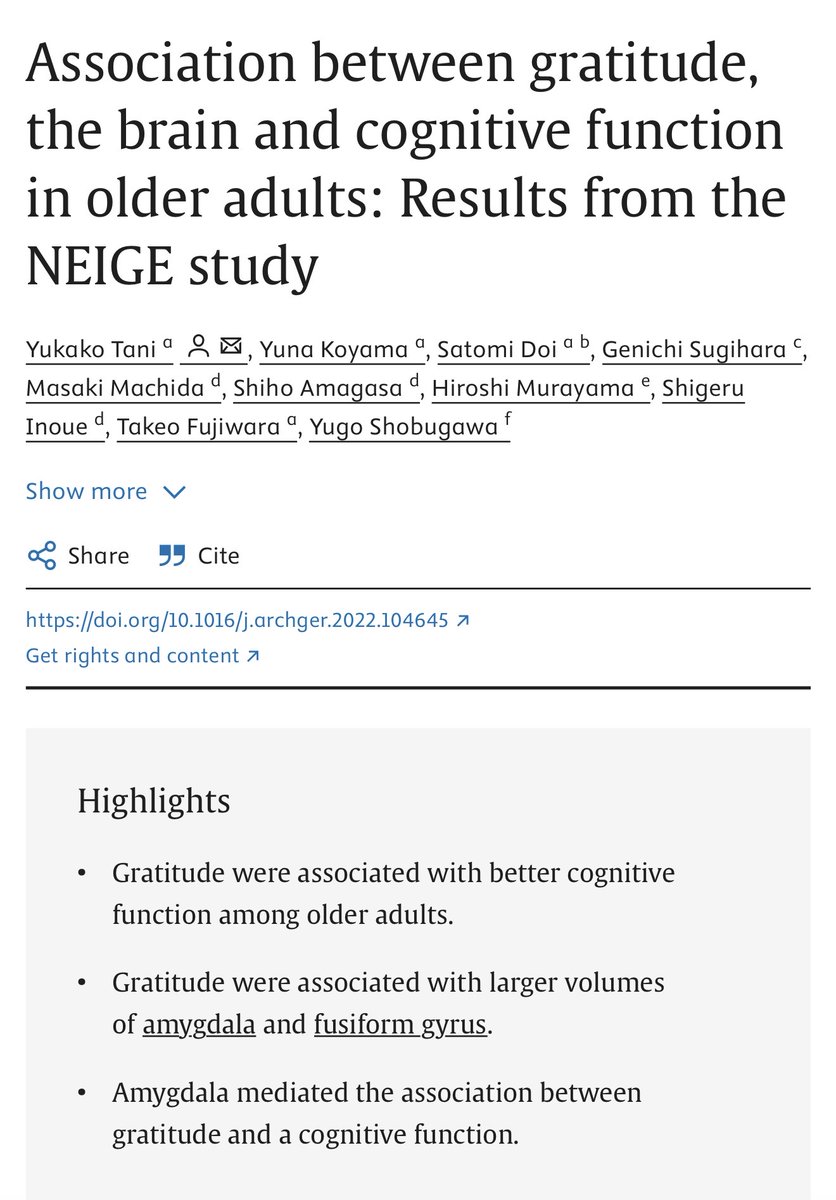
🚨Research confirms that your brain physically reshapes itself when you feel grateful, and the process happens in reverse of what most people think.
The common story about gratitude goes like this: count your blessings, feel better, repeat. Mental health gurus treat it like a mindfulness exercise where you inventory good things until your mood lifts.
The neuroscience reveals something far stranger.
Gratitude doesn’t work by making you notice positive things that were already there. It works by literally building new neural pathways that change how your brain processes all incoming information, positive and negative.
When you experience genuine gratitude, your anterior cingulate cortex lights up in ways that are measurably different from other positive emotions like joy or contentment. The anterior cingulate sits at the crossroads between emotion and attention. It decides which signals get amplified and which get filtered out before they reach conscious awareness.
Most people live with an anterior cingulate trained by evolution to scan for threats, problems, and gaps. This made sense when predators could kill you, but in modern life it means your brain’s default setting is to spotlight everything wrong, missing, or potentially dangerous in any situation.
You walk into a room and immediately notice the stain on the wall, not the ten things that look perfectly fine.
Gratitude practice doesn’t override that system. It builds a competing neural network.
Each time you feel grateful for something specific, you’re strengthening synaptic connections between your memory centers and reward circuits. Your brain begins associating the act of paying attention with positive neurochemical hits. Over time, this creates a new default: your attention system starts scanning for things worth appreciating instead of things worth worrying about.
The really wild part is how fast this happens. Neuroimaging studies show detectable changes in brain activity patterns after just eight weeks of consistent gratitude practice. The prefrontal cortex, which handles executive function and emotional regulation, develops stronger connections to the limbic system, where emotions get processed. People literally become better at managing stress and making decisions under pressure because their neural architecture has physically reorganized.
But here’s where it gets interesting in ways that most gratitude research misses completely.
The brain changes from gratitude practice don’t just make you feel better. They make you perceive reality differently. Your visual cortex, auditory processing, even your sense of time passing, all get influenced by which neural networks have become dominant in your anterior cingulate.
People with gratitude trained brains report that colors look more vivid, music sounds richer, and positive experiences seem to last longer while negative ones seem to pass more quickly. This isn’t metaphorical. Their brains are literally processing the same sensory input through different neural filters than they used before.
This explains why gratitude feels fake and forced when you first try it. You’re asking a threat detection system to appreciate what it’s designed to ignore. The neural pathways for appreciation barely exist yet. It’s like trying to play piano with no finger muscle memory. But once those pathways strengthen, gratitude stops feeling like work and starts feeling like upgraded perception.
The most profound part might be how this rewiring affects social relationships. The neural networks that handle gratitude overlap heavily with the networks that handle empathy and social cognition. When you strengthen one, you automatically strengthen the others.
People who develop strong gratitude circuits become measurably better at reading facial expressions, predicting how others will respond to their words, and maintaining long term relationships. Their brains get better at spotting what others are doing well instead of cataloging what others are doing wrong.
What started as a simple practice of noticing good things ends up rebuilding the fundamental neural infrastructure through which you experience other people and they experience you.
The brain you have today was shaped by every thought pattern you’ve repeated for years. The brain you’ll have next year is being shaped by the thought patterns you’re repeating right now.
Gratitude just happens to be the most efficient way to aim that reshaping process somewhere useful.
Any contacts in acute care PT?!?! I have patient profile to run by you and need some help with care transition to long term acute care hospital. They are saying he doesn’t meet Medicare criteria and would like to consult.
@HawkeyeFootball@TheIowaHawkeyes@IowaHoops My dad is fighting in the ICU after a severe illness. He’s a long time and loyal Hawk Fan. Can you send some good vibes his way to get better???
Hey @ChicagoBears, my father is long time Bears fan and is fighting in the ICU after recent severe illness. He didn’t get to see the always great win against GB yesterday. Can you send him some positive vibes his way???
So many young people use achievement to hide their insecurities. When you place value in things outside of your control, your self-confidence is unstable.
Great leaders retrain the thinking: It's not what you get, it's who you become.
NEW RELEASE: https://t.co/PPGqokD6Fz
The core skills of learning are a critical eye and an open mind.
Critical thinking is refusing to accept ideas at face value. Don't believe information until it's verified.
Openness is refusing to reject ideas at face value. Don't disbelieve information until it's falsified.
@FaiyazHumanMech @dibbygibby @SanDiegoSummit @VPrakashPT @OrthopaedicAPTA @louis_gifford@KHariohm@AshisArmyPhysio@PhysioMeScience@AdamMeakins@Retlouping So here's an interesting anecdote. Participated in the course attached, was revolutionary. 1st patient on last day an elderly man with chronic+ neck pain. After hearing about hands off, Louis manipulated his neck, when asked why LG said because the man believed it would help him.
@DrSethPT Unfortunately I end up seeing similar cases in various body areas because the previous clinician focused on just calming sx down but NO building capacity back with progressive loading.
Rob Scheidegger, @Mariners VP of Health & Performance, joins the Inside Athletic Training podcast this week!
Rob shares some awesome stories from his time as the head AT for @UW_Football and from his new role with the #Mariners.
Listen here: https://t.co/jEr0HmJXl5
Congressman Murphy is not wrong.
Medicare practices are not sustainable as the costs easily overwhelm revenue.
For a fairly busy practice with one physician, the math is simple: at 7,000 wRVU (roughly 15,000 total RVU), Medicare reimbursement is $480,000 at $32 per RVU.
Just the top 6 expenses at least: $465K cost
CMS reimbursement: $480K "revenue"
Doctor's take-home salary at CMS rates: $15K/year ($7.5/hr if 40 hours).
Conservatively,
rent/office expenses (heat/electricity/cleaning): $50,000-$70,000
Billing/office manager is $70K ($25-35/hr plus benefits = $90K
5 staff (Front Desk, 2 Medical Assistants, Receptionist) = $60K + 15K benefits = $75K * 5 = $300K
Malpractice depending on specialty/location: $10-$50K.
Office supplies (gloves, etc): $15,000
EMR/associated services (clearinghouse): $15K