@GergelyOrosz@biwills When googling for "The deal valued Cursor at $29.3 billion, a nearly 15-fold" in quotes, I got a series of mashups of TechCrunch headlines with their date followed directly by the same Cursor article snippet.
@lpachter The Stanford Comp Sci department is huge so the 13 profs shown constitute less than 20% of faculty. Not surprised Berkeley is represented well since it's a top CS grad program but the same could be said for MIT, CMU, and Stanford itself (13 self-hires).
https://t.co/NrCcf5xv1R
🪰 A team of researchers has unveiled the complete connectome of a male fruit fly central nervous system—a seamless map of all the neurons in the brain and nerve cord of a single male fruit fly and the millions of connections between them.
🔗 https://t.co/F3ElzePkCo
Wouldn't it be great if we could not only image large connectomic volumes, but also completely reconstruct them? And if a whole mouse brain project didn't cost billions?
With the PATHFINDER preprint (https://t.co/Ae3UCLOljP), we preview a future where it doesn't have to.
We built an AI model to simulate how a fruit fly walks, flies and behaves – in partnership with @HHMIJanelia. 🪰
Our computerized insect replicates realistic motion, and can even use its eyes to control its actions.
Here’s how we developed it – and what it means for science. 🧵
Some people today are discouraging others from learning programming on the grounds AI will automate it. This advice will be seen as some of the worst career advice ever given. I disagree with the Turing Award and Nobel prize winner who wrote, “It is far more likely that the programming occupation will become extinct [...] than that it will become all-powerful. More and more, computers will program themselves.” Statements discouraging people from learning to code are harmful!
In the 1960s, when programming moved from punchcards (where a programmer had to laboriously make holes in physical cards to write code character by character) to keyboards with terminals, programming became easier. And that made it a better time than before to begin programming. Yet it was in this era that Nobel laureate Herb Simon wrote the words quoted in the first paragraph. Today’s arguments not to learn to code continue to echo his comment.
As coding becomes easier, more people should code, not fewer!
Over the past few decades, as programming has moved from assembly language to higher-level languages like C, from desktop to cloud, from raw text editors to IDEs to AI assisted coding where sometimes one barely even looks at the generated code (which some coders recently started to call vibe coding), it is getting easier with each step.
I wrote previously that I see tech-savvy people coordinating AI tools to move toward being 10x professionals — individuals who have 10 times the impact of the average person in their field. I am increasingly convinced that the best way for many people to accomplish this is not to be just consumers of AI applications, but to learn enough coding to use AI-assisted coding tools effectively.
One question I’m asked most often is what someone should do who is worried about job displacement by AI. My answer is: Learn about AI and take control of it, because one of the most important skills in the future will be the ability to tell a computer exactly what you want, so it can do that for you. Coding (or getting AI to code for you) is a great way to do that.
When I was working on the course Generative AI for Everyone and needed to generate AI artwork for the background images, I worked with a collaborator who had studied art history and knew the language of art. He prompted Midjourney with terminology based on the historical style, palette, artist inspiration and so on — using the language of art — to get the result he wanted. I didn’t know this language, and my paltry attempts at prompting could not deliver as effective a result.
Similarly, scientists, analysts, marketers, recruiters, and people of a wide range of professions who understand the language of software through their knowledge of coding can tell an LLM or an AI-enabled IDE what they want much more precisely, and get much better results. As these tools are continuing to make coding easier, this is the best time yet to learn to code, to learn the language of software, and learn to make computers do exactly what you want them to do.
[Original text: https://t.co/HdI3Jb9HmF ]
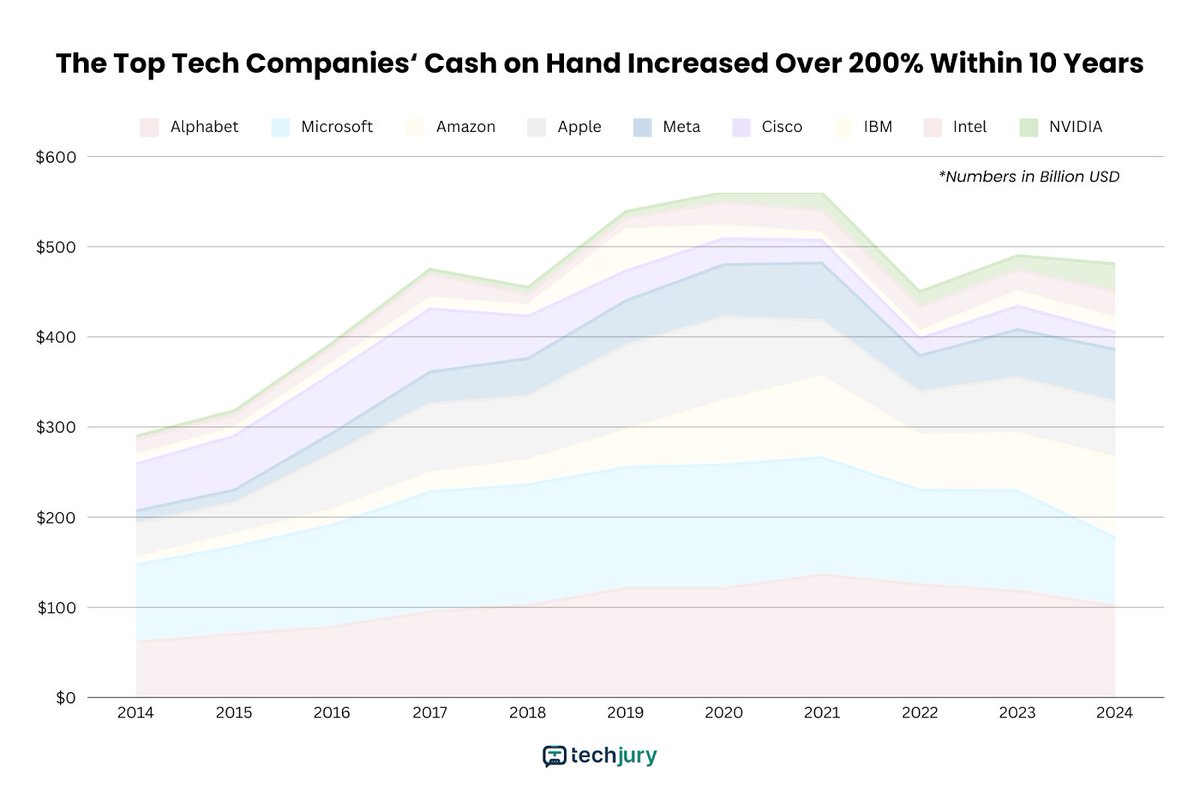
@DrCraigEverett@paulg@abarrallen Yes, but the point I was making was how long you keep cash around before using it to buyback stock. In addition to periodic buying, it would make sense to have a fair amount of longer-term cash to have dry powder in the case of a big downturn like Meta's 2022 price crash.
@DrCraigEverett@paulg@abarrallen There do seem to be other legitimate reasons for holding cash:
https://t.co/EpuwpL0b1j
Wouldn't keeping cash make sense to preferentially buyback stock during market drops (e.g., Meta during 2022) as opposed to fixed purchases over time?
@pbwinston Just came back from a 3 week trip to Tokyo. I think all of the various high-end hotels (including a Hyatt in Tokyo) had nice flat screens, some allowing easy use of your own YouTube, Netflix, etc. They also had USB ports near bed for charging.
📢Our latest preprint shows that learning global neuron shapes can help to automatically proofread connectomes and predict neuron types. https://t.co/v39Zm5Igo1 Work done in collaboration with @HHMIJanelia, @srinituraga & @HarvardVCG#connectomics#AI 🧵(1/n)
Our work simulating the fly visual system connectome with @jakhmack@lappalainenjk is now out in @Nature Paper (open access): https://t.co/QDwCLdCqFE
Research Briefing: https://t.co/QDwCLdCqFE
@pablothee @AmyClukey @tuuliel The article cites an 18% reduction. We're nowhere near perfectly sanitized environments and even implementing the suggested systems wouldn't prevent waves of airborne infections that can then pass on to others.